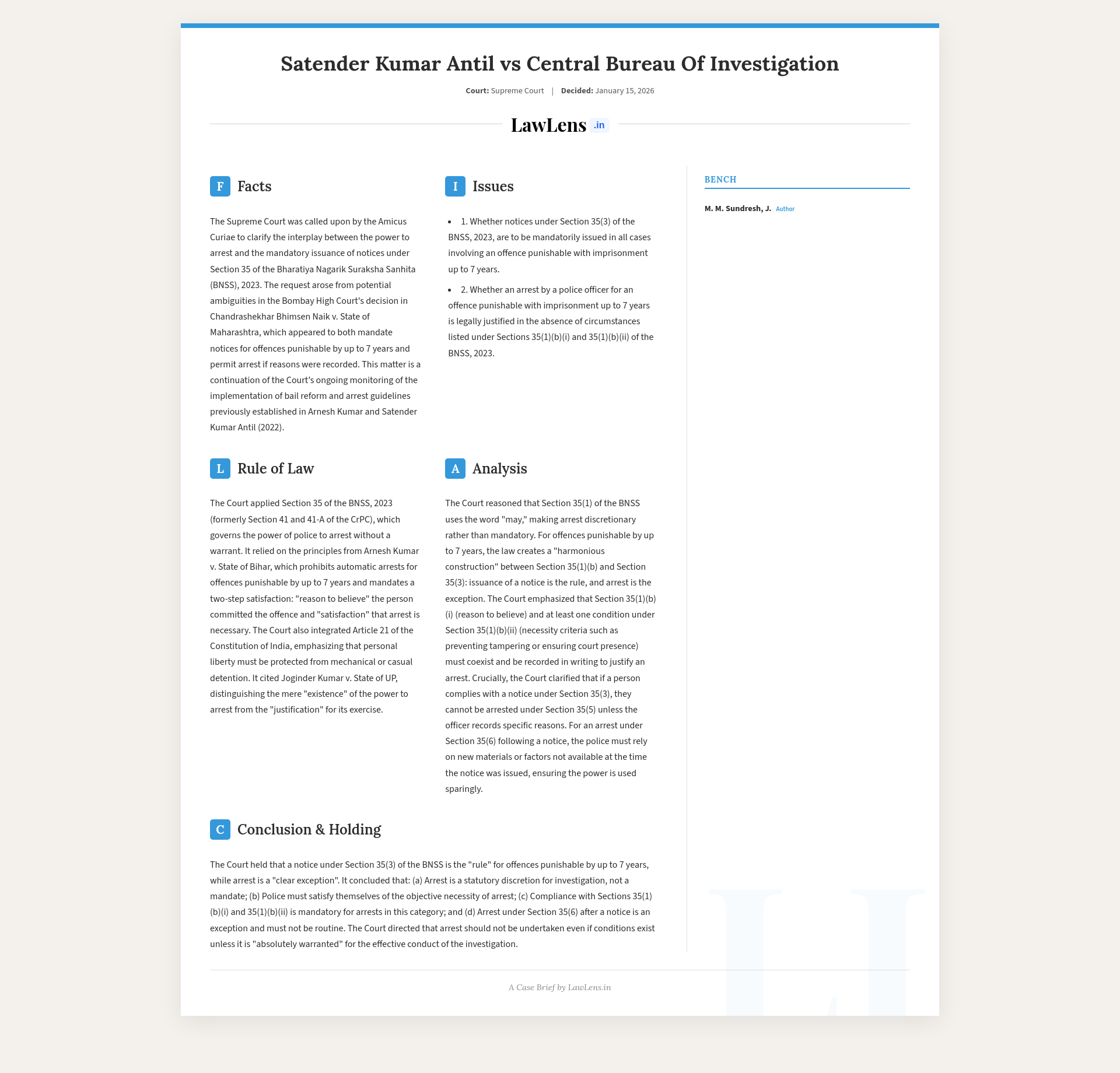
Satender Kumar Antil v. Central Bureau of Investigation 2026 INSC 115 - S.35 BNSS - Notice - Power To Arrest

Bharatiya Nagarik Suraksha Sanhita 2023 - Section 35 -As a matter of course, a notice under Section 35(3) BNSS is to be issued to an accused or any individual concerned, qua an offence punishable with imprisonment up to 7 years -As long as a person to whom a notice under Section 35(3) BNSS is issued has complied and continues to comply with the terms of the notice then, it is not open for the police officer to arrest him unless, for reasons to be recorded, the police officer is of the opinion that he ought to be arrested. (Para 26)
Bharatiya Nagarik Suraksha Sanhita 2023 - Section 35 - a. An arrest by a police officer is a mere statutory discretion which facilitates him to conduct proper investigation, in the form of collection of evidence and, therefore, shall not be termed as mandatory. b. Consequently, the police officer shall ask himself the question as to whether an arrest is a necessity or not, before undertaking the said exercise. c. For effecting an arrest, qua an offence punishable with imprisonment up to 7 years, the mandate of Section 35(1)(b)(i) of the BNSS, 2023 along with any one of the conditions mentioned in Section 35(1)(b)(ii) of the BNSS, 2023 must be in existence. d. A notice under Section 35(3) of the BNSS, 2023 to an accused or any individual concerned, qua offences punishable with imprisonment up to 7 years, is the rule. e. Even if the circumstances warranting an arrest of a person are available in terms of the conditions mentioned under Section 35(1)(b) of the BNSS, 2023, the arrest shall not be undertaken, unless it absolutely warranted. Page 22 of 22 f. Power of arrest under Section 35(6) read with Section 35(1)(b) of the BNSS, 2023, pursuant to a notice issued under Section 35(3) of the BNSS, 2023 is not a matter of routine, but an exception, and the police officer is expected to be circumspect and slow in exercising the said power. (Para 33)
Case Info
Case name and neutral citation
Satender Kumar Antil v. Central Bureau of Investigation and Anr, 2026 INSC 115
Coram
Justice M. M. SundreshJustice Nongmeikapam Kotiswar Singh
Judgment date
15 January 2026 (New Delhi)
Caselaws and citations referred
- Arnesh Kumar v. State of Bihar & Anr, (2014) 8 SCC 273
- Satender Kumar Antil v. Central Bureau of Investigation, (2022) 10 SCC 51
- Satender Kumar Antil v. Central Bureau of Investigation, 2025 SCC OnLine SC 1578
- Chandrashekhar Bhimsen Naik v. State of Maharashtra & Ors., 2025 SCC OnLine Bom 5357
- Vicky Bharat Kalyani v. State of Maharashtra, Criminal WP (St.) No. 24338 of 2024 (pending before Bombay High Court, referred)
- State of Uttar Pradesh v. Bhagwant Kishore Joshi, (1964) 3 SCR 71
- H.N. Rishbud and Inder Singh v. State of Delhi, (1955) 1 SCR 1150
- Joginder Kumar v. State of UP and Ors., (1994) 4 SCC 260
Statutes / laws referred
- Bharatiya Nagarik Suraksha Sanhita, 2023 (BNSS, 2023) – especially Section 35 (sub-sections (1)(a)–(j), proviso to 35(1), and 35(3)–(7))
- Code of Criminal Procedure, 1973 – Sections 41, 41-A, 60-A
- Bharatiya Nyaya Sanhita (offence provisions referred in facts via Bombay High Court judgment)
- Article 21, Constitution of India, 1950
Three‑sentence brief summary
The Supreme Court considered whether notice under Section 35(3) BNSS, 2023 (earlier Section 41‑A CrPC) is mandatory in all cases involving offences punishable with imprisonment up to seven years, and how this interacts with the police power of arrest under Section 35(1)(b) and 35(6). The Court held that issuing notice under Section 35(3) for such offences is the rule, and arrest under Section 35(6) read with Section 35(1)(b) is a strictly limited exception, to be exercised only when objectively necessary and with reasons recorded in writing, even after non‑compliance with notice. It endorsed the Bombay High Court’s view in Chandrashekhar Bhimsen Naik, reiterated and harmonised the earlier rulings in Arnesh Kumar and prior Satender Kumar Antil decisions, and emphasised that arrest is a discretionary investigative tool, not a mandatory step, to safeguard personal liberty under Article 21.