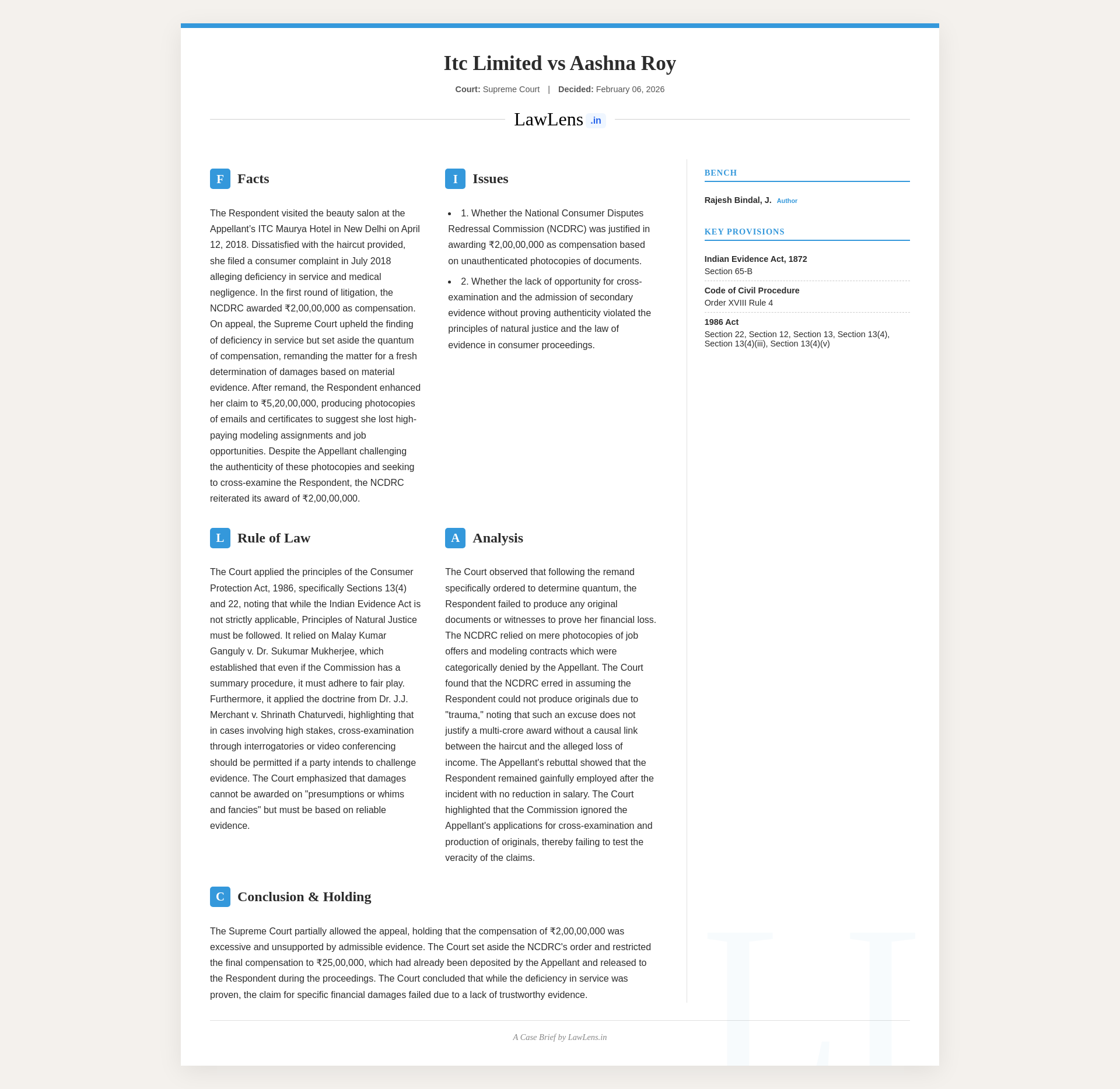
ITC Limited v. Aashna Roy, 2026 INSC 135 - Consumer Protection Act - Evidence

Consumer Protection Act 1986 - The damages cannot be awarded merely on presumptions or whims and fancies of the complainant. To make out a case for award of damages, especially when the claim is to the tune of crores of rupees, some trustworthy and reliable evidence has to be led. (Para 22)
Consumer Protection Act 1986 - Section 13 - The provisions of the Indian Evidence Act, 1872 (Bharatiya Sakshya Adhiniyam, 2023) are not strictly applicable for proceedings under the 1986 Act. The Commission is, however, bound to comply with the Principles of Natural Justice, save and except as laid down in sub-section (4) of Section 13. (Para 17) While trying a complaint the evidence of the parties could be taken on affidavits as provided in Section 13(4)(iii). The Commission is also empowered to issue commission for examination of any witnesses in terms of Section 13(4)(v) of the 1986 Act. It is akin to Order XVIII Rule 4 CPC, which also provides that in every case examination-in-chief of the witness shall be on affidavit. Further, witness could be examined by the court or the Commissioner appointed by it. The Commission also needs to follow the same system. In case the facts are taken in evidence and cross-examination is sought by the other side, the Commission can easily evolve a procedure permitting the other side to crossexamine the witnesses. The same can be done by putting certain questions in writing or through video conferencing or by appointment of a Commission. (Para 17.1)
Case Info
Case name and neutral citation:ITC Limited v. Aashna Roy, 2026 INSC 135
Coram:Hon’ble Mr. Justice Rajesh Bindal and Hon’ble Mr. Justice Manmohan (Bench of two Judges).
Judgment date:6 February 2026 (New Delhi)
Case laws and citations referred:
- Chief Administrator, HUDA v. Shakuntala Devi, (2017) 2 SCC 301
- Charan Singh v. Healing Touch Hospital, (2000) 7 SCC 668
- Nizam’s Institute of Medical Sciences v. Prasanth S. Dhananka, (2009) 6 SCC 1
- Malay Kumar Ganguly v. Dr. Sukumar Mukherjee, (2009) 9 SCC 221
- Dr. J.J. Merchant v. Shrinath Chaturvedi, (2002) 6 SCC 635
- R.V.E. Venkatachala Gounder v. Arulmigu Viswesaraswami & V.P. Temple, (2003) 8 SCC 752
- Bharat Bank Ltd. v. Employees, AIR 1950 SC 188 (referred)
- Nahar Industrial Enterprises Ltd. v. Hong Kong & Shanghai Banking Corporation, (2009) 8 SCC 646 (referred)
Statutes / laws referred:Consumer Protection Act, 1986 – especially Sections 12, 13, 14, 22 and 13(4);Indian Evidence Act, 1872 / Bharatiya Sakshya Adhiniyam, 2023 (on applicability and proof of documents);Code of Civil Procedure, 1908 – Order XVIII Rule 4 (by analogy for evidence by affidavit and cross‑examination).
Brief summary (three sentences):The Supreme Court had earlier affirmed deficiency of service by ITC’s salon in relation to the respondent’s haircut but remanded the matter to the National Commission (NCDRC) to reassess compensation on the basis of proper evidence. After remand, the NCDRC again awarded ₹2 crores relying largely on photocopies of documents to support a vastly enhanced claim, without originals, without examining authors, and despite ITC’s specific denial and request to cross‑examine. Holding that such huge damages cannot rest on unauthenticated photocopies and conjecture, the Court modified the NCDRC order and restricted the respondent’s compensation to the ₹25 lakhs already deposited and released.