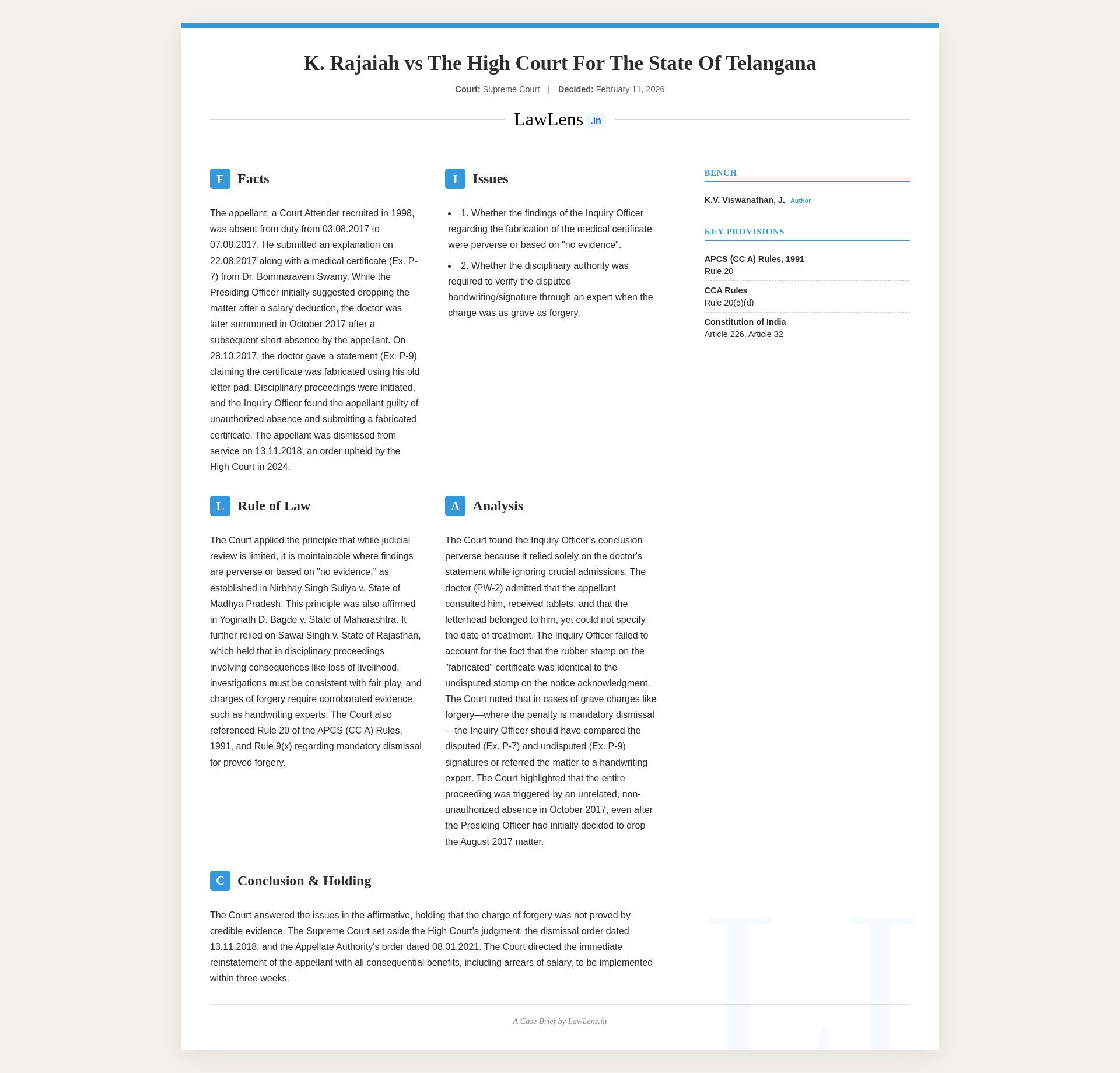
K. Rajaiah v. High Court for the State of Telangana 2026 INSC 142 - Disciplinary Proceedings
Graver The Charge, Greater The Need For Caution & Circumspection: Supreme Court On Disciplinary Proceedings

Constitution of India - Article 226 - The parameters for judicial review against orders passed in disciplinary proceedings are limited. However, where the findings are based on no evidence a court of law is perfectly justified in interfering with the orders in disciplinary proceedings -if the findings in the enquiry report are perverse and not supported by the evidence on record, the Court in judicial review can interfere. (Para 43)
Disciplinary Proceedings - Andhra Pradesh Civil Services (Classification, Control and Appeal) Rules, 1991 - Reference to handwriting experts and examination of handwriting experts is not a procedure alien to disciplinary inquiries. (Para 34) When charges are grave, the caution and circumspection that should be exercised by the authorities should be greater. (Para 44)
Case Info
Case name: K. Rajaiah v. The High Court for the State of Telangana
Neutral citation: 2026 INSC 142
Coram: Hon’ble Mr. Justice K.V. Viswanathan and Hon’ble Mr. Justice Vipul M. Pancholi
Judgment date: 11 February 2026
Caselaws and citations referred:
- V.M. Saudagar (Dead) through Legal Heirs v. Divisional Commercial Manager, Central Railway and Another, 2025 SCC OnLine SC 2277
- Sawai Singh v. State of Rajasthan, (1986) 3 SCC 454
- Surath Chandra Chakrabarty v. State of W.B., (1970) 3 SCC 548
- State of A.P. v. S. Sree Rama Rao, AIR 1963 SC 1723
- Central Bank of India Ltd. v. Prakash Chand Jain, AIR 1969 SC 983
- Bharat Iron Works v. Bhagubhai Balubhai Patel, (1976) 1 SCC 518
- Rajinder Kumar Kindra v. Delhi Administration, (1984) 4 SCC 635
- Yoginath D. Bagde v. State of Maharashtra and Another, (1999) 7 SCC 739 (identified from the citation in para 42)
- Nirbhay Singh Suliya v. State of Madhya Pradesh and Another, 2026 SCC OnLine SC 8
Statutes / rules referred:
- Andhra Pradesh Civil Services (Classification, Control and Appeal) Rules, 1991, particularly Rule 20 (procedure for imposing major penalties) and Rule 9(x) proviso (providing dismissal in proved cases of forgery, misappropriation, etc.).
Brief summary (three sentences):The appellant, a court attender, was dismissed from service on charges of unauthorised absence and allegedly fabricating a medical certificate, which the disciplinary authority and High Court upheld. The Supreme Court held that the grave charge of forgery was not proved, noting that the doctor admitted treatment, the letterhead and stamp were his, the signatures were inconclusive, and no handwriting expert was engaged, making the finding of fabrication perverse and unsupported by credible evidence. Consequently, the Court set aside the dismissal, ordered reinstatement with all consequential benefits and arrears, emphasizing that in serious misconduct cases disciplinary authorities must exercise greater caution and fair play, and courts can interfere where findings are based on no evidence.