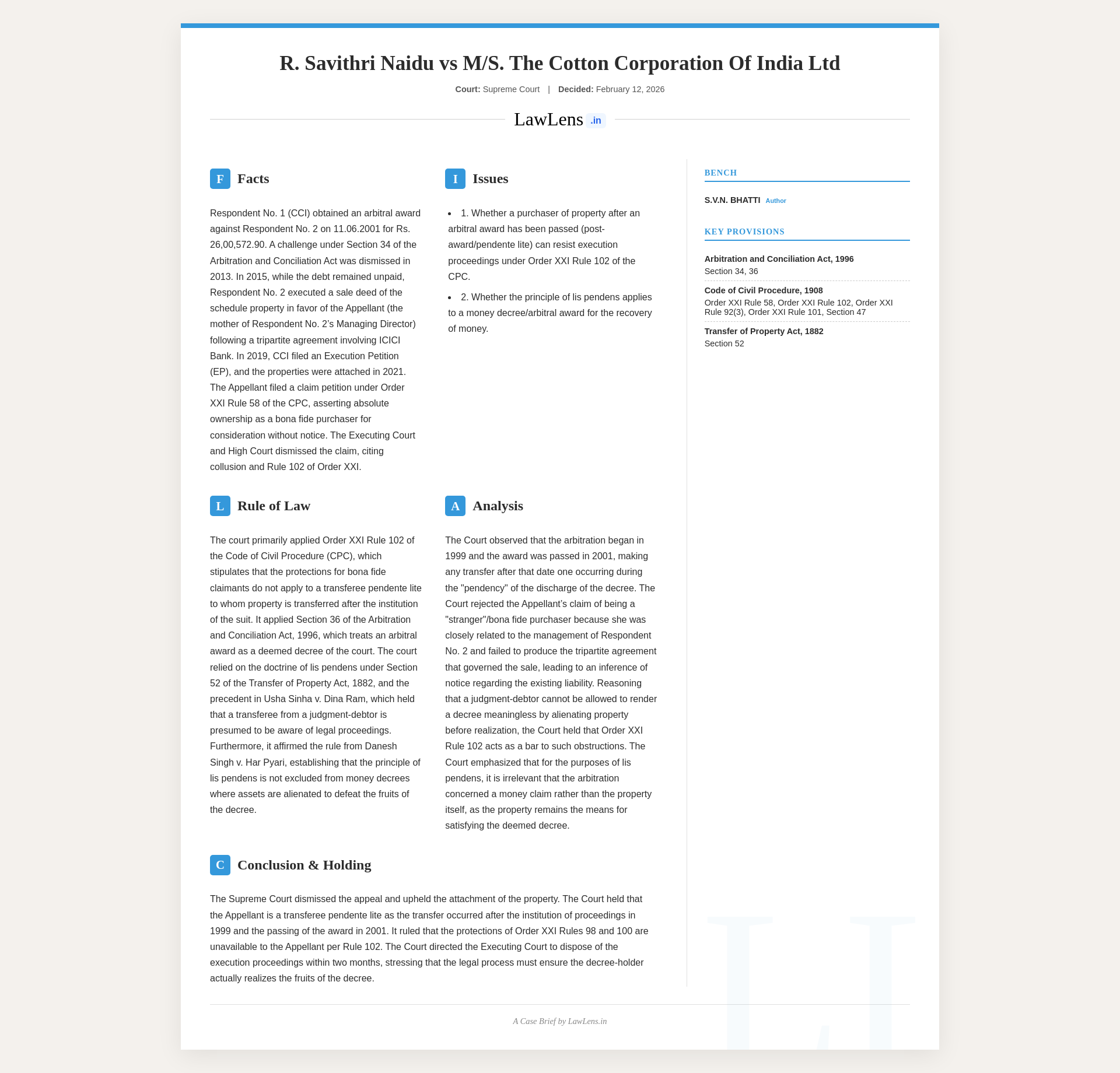
R. Savithri Naidu v. Cotton Corporation of India Limited 2026 INSC 150 - TP Act - Lis Pendens - Money Decrees
Transfer of Property Act 1882- Section 52 - Lis Pendens - Money Decrees

Transfer of Property Act 1882- Section 52 - The principle of lis pendens not excluded for money decrees. Transferee pendente lite is defined as someone to whom the property is transferred after the institution of the suit in which the decree was passed. (Para 10)
Quote - . We need a shift in mindset: the goal of the legal system should not just be to dispose of cases, but to ensure that the litigant enjoys the reliefs. The provisions in the CPC must be employed to secure actual relief, not just a formal decree. We must ensure that the legal process results in justice not just appearing to be done, but justice actually being done - The true difficulties of a litigant begin only after they have obtained a decree. Winning a case is meaningless unless the winner actually gets the relief they sought. (Para 13-13.1) A judgment debtor cannot defeat a decree by alienating the property after the decree is passed but before the decree is realised. (Para 10)
Case Info
Basic Case Details
Case name and neutral citation:R. Savithri Naidu v. M/s The Cotton Corporation of India Limited and Another, 2026 INSC 150
Coram:Justice Pankaj Mithal and Justice S.V.N. Bhatti
Judgment date:12 February 2026 (New Delhi)
Caselaws and citations referred
- Usha Sinha v. Dina Ram, AIR 2008 SC 1997; (2008) 7 SCC 144
- Danesh Singh and others v. Har Pyari (Dead) Thr. LRs., 2025 INSC 1434
- Annakkili v. Murugan & Anr., 2021 SCC OnLine Mad 1673 (Madras High Court)
- Jini Dhanrajgir v. Shibu Mathew, (2023) 20 SCC 76
- General Manager of the Raj Durbhunga v. Coomar Ramaput Singh, (1871-72) 14 MIA 605; 1872 SCC OnLine PC 16
Statutes / laws referred
- Arbitration and Conciliation Act, 1996
- Section 34 (challenge to arbitral award)
- Section 36 (enforceability of arbitral award as decree)
- Securitisation and Reconstruction of Financial Assets and Enforcement of Security Interest Act, 2002 (SARFAESI Act)
- Code of Civil Procedure, 1908
- Order XXI Rule 58 (claim/objection to attachment)
- Order XXI Rule 98 and Rule 100 (resistance/obstruction; restoration of possession)
- Order XXI Rule 102 (transferee pendente lite not protected)
- Section 47 (questions relating to execution)
- Transfer of Property Act, 1882
- Section 52 (doctrine of lis pendens)
Brief summary (three sentences)
The Supreme Court held that the appellant, who purchased the judgment‑debtor company’s property in 2015 under a SARFAESI-related sale, was a post‑award transferee pendente lite and thus could not resist execution of an arbitral award passed in 2001 and challenged unsuccessfully in 2013. Treating the arbitral award as a deemed decree under Section 36, the Court applied Order XXI Rule 102 CPC and the doctrine of lis pendens, emphasizing that a judgment debtor cannot defeat a money decree by subsequent alienations and that the purchaser failed to prove absence of notice of existing liabilities. Upholding the orders of the executing court and High Court dismissing her claim petition, the Court dismissed the civil appeal and directed the executing court to complete the execution within two months.