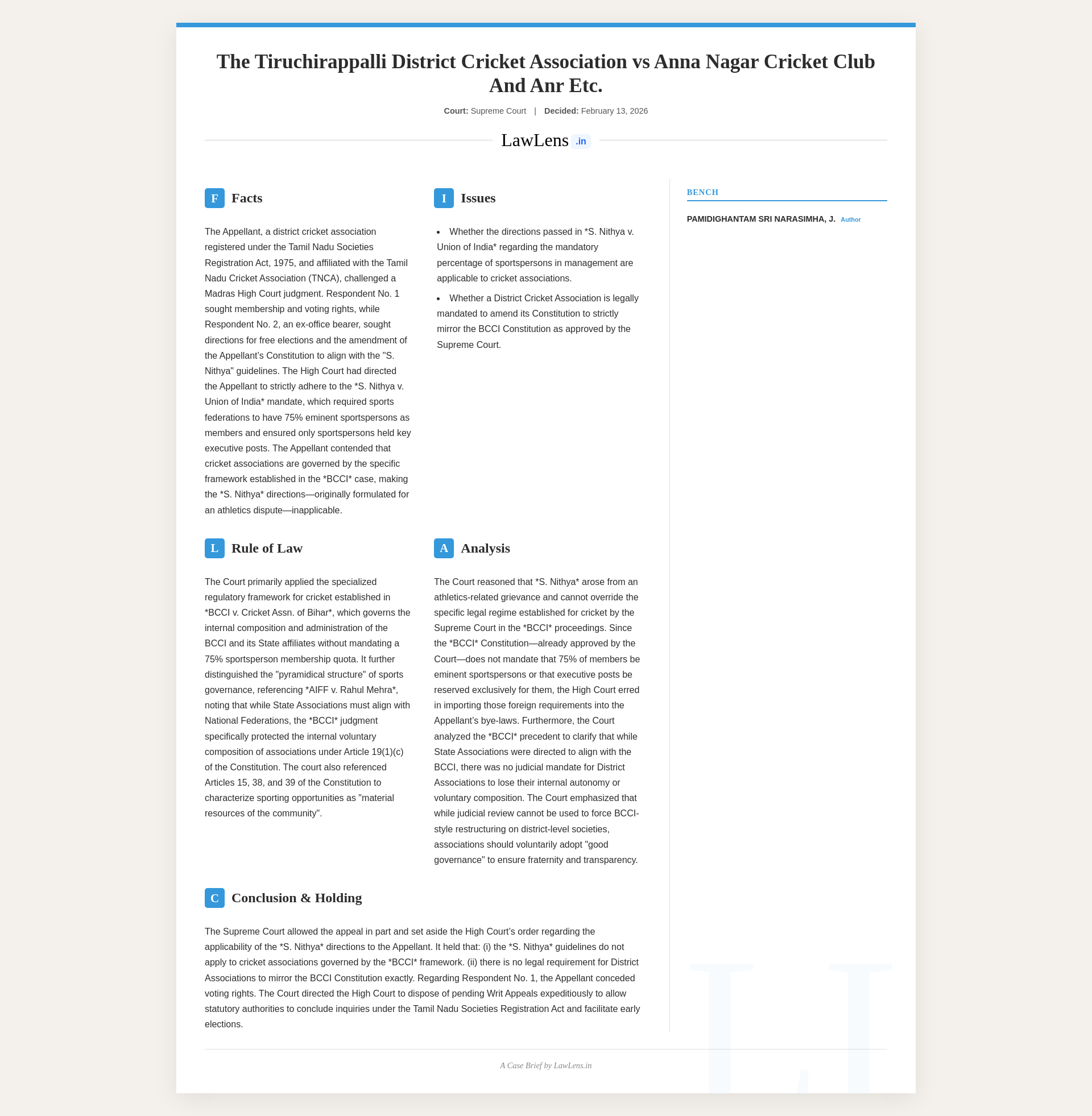
Tiruchirappalli District Cricket Association v. Anna Nagar Cricket Club 2026 INSC 154 -Sports & Fraternity
Constitution of India - Fraternity - Sports

Constitution of India - Fraternity - Sports -National, international, regional or even mohalla sports in India serve as the Karmabhumi where cohesion and collective purpose take tangible form. They bring together individuals from diverse social, linguistic, and cultural backgrounds under a common pursuit, embodying the Constitutional value of fraternity - Accessibility of sports is important, for when opportunities to participate are open to all— irrespective of race, caste, religion, sex, or economic status—the unifying power of sport is amplified. This inclusiveness ensures that sports become not a privilege of the few but a medium through which fraternity is strengthened across society. In this way, sports operationalise what the framers envisioned: an intangible yet indispensable force that holds us together through shared effort and common purpose. It is high time we recognize that sporting “facilities and opportunities” are “material resources of the community”, and their organizers are “the institutions of the national life”. As “places of public resort”, sporting institutions and bodies must remain accessible, not just for pursuing sport, but also for its administration. It should be the deeper Sadhana (endeavour) of the State, and it is also our Constitutional duty to ensure that sporting facilities and opportunities flourish with institutional efficiency, integrity, professionalism, and expertise. It is also necessary to ensure that sporting facilities and opportunities are not concentrated in the hands of the urban economic elite and that the revenues from sporting events, intellectual property and media rights are so distributed to subserve and encourage accessible and affordable sport in our country. (Para 22- 23)
Case Info
Case name and neutral citationThe Tiruchirappalli District Cricket Association v. Anna Nagar Cricket Club & Anr. Etc., 2026 INSC 154
CoramHon’ble Mr. Justice Pamidighantam Sri NarasimhaHon’ble Mr. Justice Alok Aradhe
Judgment date13 February 2026 (New Delhi)
Case laws and citations referred
- Board of Control for Cricket in India v. Cricket Association of Bihar, (2016) 8 SCC 535 (referred to as BCCI)
- S. Nithya v. Union of India, W.P. (MD) No. 3447 of 2019 (Madras High Court)
- Secretary, Tamil Nadu Olympics Association v. S. Nithya, W.A. No. 1202 of 2022 (Madras High Court)
- All India Football Federation v. Rahul Mehra, 2025 INSC 1131
Statutes / laws referred
- Constitution of India, Articles 15(2), 19(1)(c), 19(1)(g) read with Article 19(6), 38, 38(2), 39(b)
- National Sports Development Code of India, 2011
- Tamil Nadu Societies Registration Act, 1975 (including Section 36)
Brief three‑sentence summaryThe Supreme Court held that the Madras High Court’s directions in S. Nithya, including the requirement that 75% of sports‑body members be eminent sportspersons, are not applicable to cricket associations governed by the BCCI framework, and therefore cannot be imposed on the Tiruchirappalli District Cricket Association. The Court also rejected the contention that the district association is bound to model its constitution on the BCCI Constitution, while nonetheless emphasizing the need for transparency, good governance, and reform in district cricket administration. It set aside the High Court’s order to that limited extent, left membership and composition disputes to be decided expeditiously by the Madras High Court and statutory authorities, and recorded that the club’s voting rights and oversight of future elections could stand.