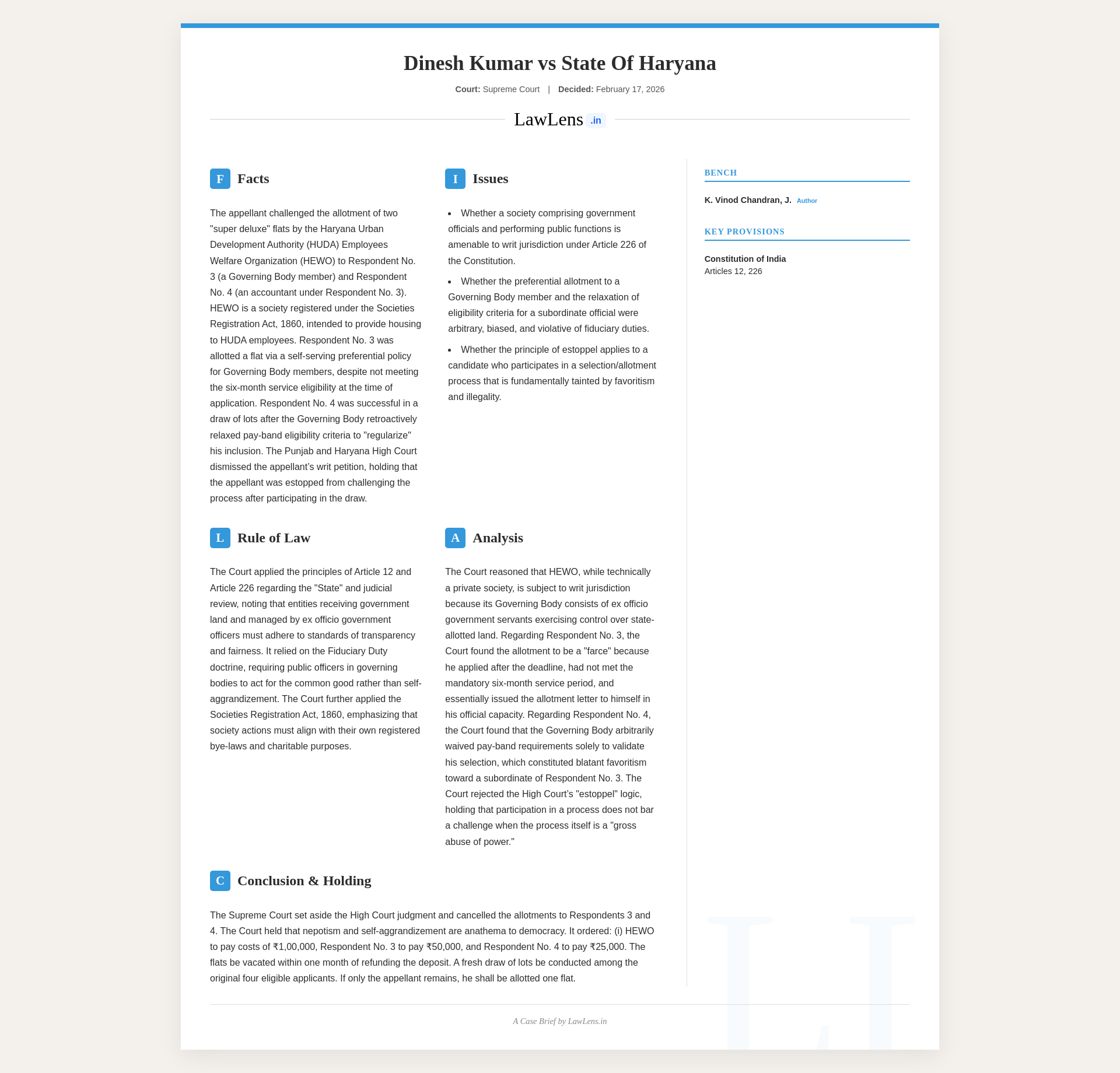
Dinesh Kumar v. State of Haryana 2026 INSC 163- Article 12 - Society - Govt. Land
Constitution of India - Article 12,226 ; Democracy - Nepotism and Self-aggrandizement

Constitution of India - Article 12,226 - In this case, the respondent (HUDA, Urban Estate and Town and Country Planning Employees Welfare Organization) contended that Article 226 not being capable of invocation, the society being a private entity, not subject to governmental control, thus taking it out of the definition of State under Article 12 of the Constitution - High Court rejected this contention - In appeal, SC observed - Especially when lack of transparency and violation of fairness and reasonableness was raised, considering the fact that the land stands allotted by the Government and the privilege conferred upon the members of the society to seek allotment of housing facilities. (Para 5)
Democracy - Nepotism and self-aggrandizement are anathema to a democratic system. (Para 2)
Case Info
Basic Case Details
Case name: Dinesh Kumar v. The State of Haryana and Ors.Neutral citation: 2026 INSC 163Court & jurisdiction: Supreme Court of India, Civil Appellate JurisdictionCase number: Civil Appeal No. … of 2026 (@ SLP (C) No.16057 of 2025)
Coram
Coram: Justice Sanjay Kumar and Justice K. Vinod Chandran(Lead judgment authored by K. Vinod Chandran, J.)
Date of Judgment
Date of decision: 17 February 2026(Place: New Delhi)
Statutes / Laws Referred
- Constitution of India
- Article 226 (writ jurisdiction over bodies discharging public functions)
- Article 12 (definition of “State” – discussed in context, though HEWO held amenable to writ despite being a society)
- Societies Registration Act, 1860
- HEWO is a society registered under this Act; preamble purposes referred (promotion of literature, science, fine arts, diffusion of knowledge/political education, and charitable purposes).
- Internal instruments / bye‑laws (non‑statutory but legally relevant):
- Rules and Regulations of HUDA/HEWO Employees Welfare Organization (HEWO) – membership and eligibility conditions (serving/retired HUDA employees, deputationists with minimum six months’ service, pay-band levels 10–20, basic pay ≥ ₹56,000 for super deluxe flats).
- Governing Body decisions/resolutions dated 16.10.2020, 22.10.2020, 21.01.2021, 12.05.2021, 25.05.2021, 25.07.2023 (especially preferential allotment to governing body members and later “regularisation” of an otherwise ineligible allotment).
These are the main legal norms; the judgment is largely fact‑centric and principle‑driven (fairness, transparency, fiduciary duties in public‑facing bodies) and does not heavily cite external case law.
Case Law & Citations
From the text you provided, there are no explicit citations of other Supreme Court/High Court cases (no “v.” citations, SCC citations, AIR citations, etc. are visible). The decision proceeds on first principles of administrative law, fairness, absence of arbitrariness, and fiduciary conduct of public officials, without naming prior precedents in the extracted portion.
If the full official report later includes a headnote or separate discussion with precedents, those are not in the portion reproduced here.
Brief 3‑Sentence Summary
The Supreme Court held that HEWO, though a registered society, is amenable to writ jurisdiction under Article 226 because it manages government-allotted land and provides housing to government employees, which attracts public law obligations of fairness, transparency and non‑arbitrariness. It found the allotment of one super deluxe flat to the third respondent (a governing body member/Chief Controller of Finance, HUDA) and the other to his subordinate (fourth respondent) to be a blatant exercise of favouritism and self‑aggrandizement, since both violated HEWO’s own eligibility conditions (no timely application/deposit, no six months’ deputation, and non‑compliance with pay‑band criteria, with post‑hoc “regularisation”). The Court set aside the High Court’s judgment, cancelled both allotments, imposed costs on HEWO and respondents 3 and 4, directed refund of deposits and vacation of the premises, and ordered a fresh draw of lots for the two super deluxe flats from the originally eligible applicants, giving priority to the appellant if others are unwilling.