Parameshwari v. State of Tamil Nadu 2026 INSC 164 - Sentencing - Victim Compensation
Can victim compensation provision be treated as a substitute of sentence ?

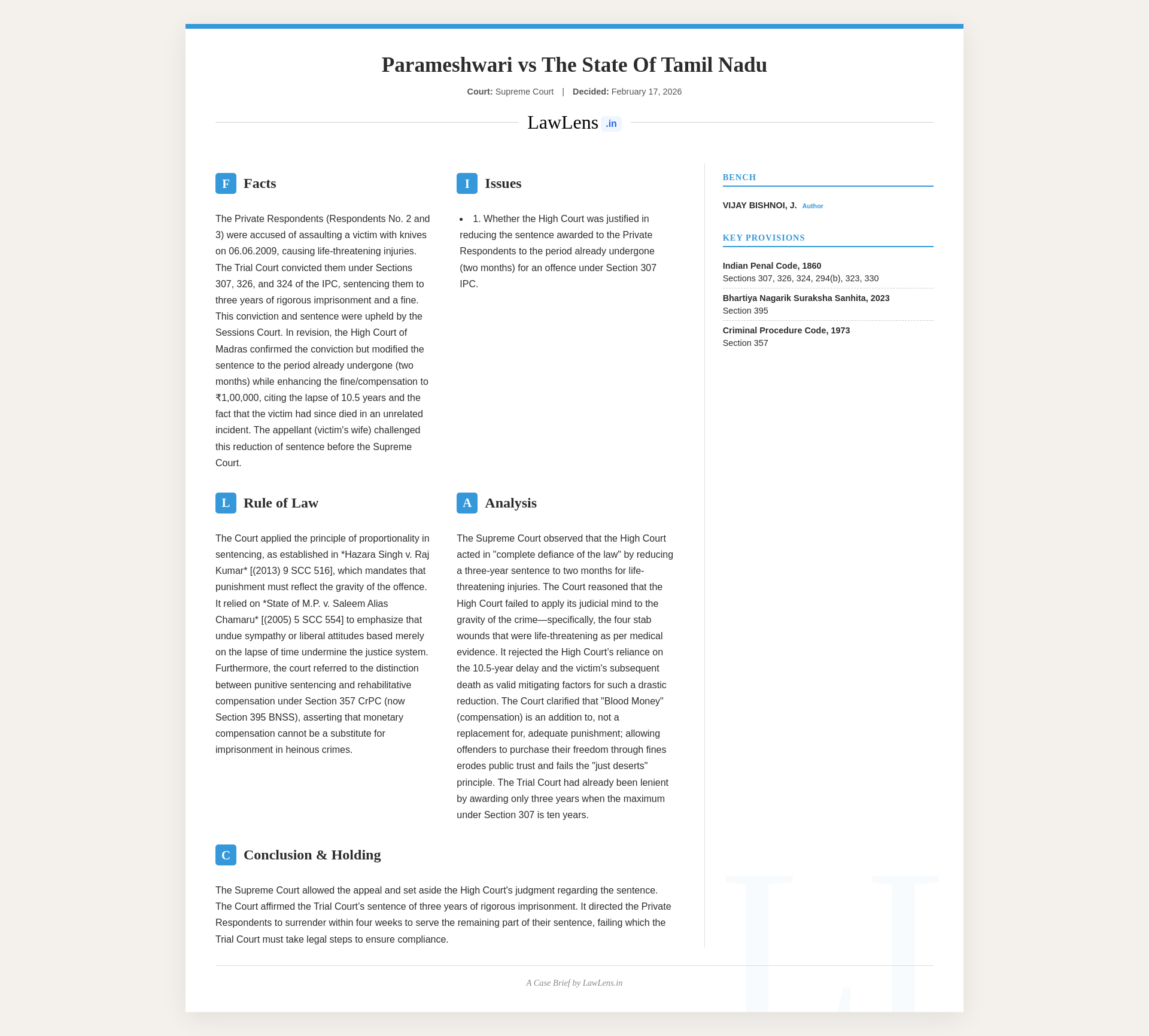
Bhartiya Nagarik Suraksha Sanhita, 2023 - Section 395- The provision of victim compensation is not an alternative to the sentence or punishment imposed, however, the compensation is just an addition to the sentence already awarded. The misplaced understanding of various courts in treating compensation as a substitute of sentence is both a matter of concern and a practice which should be condemned. Compensation payable to the victim is only restitutory in nature, and it cannot be considered as equivalent to or a substitute for punishment. Punishment is punitive in nature, and its object is to create an adequate deterrence against the said crime and to send a social message to the miscreants that any violation of the moral turpitude of society would come with consequences, which cannot merely be “purchased by money”. The practice of enhancing the compensation payable to the victim and reducing the sentence, especially in cases of grave offence, is dangerous as it might send a wrong message to society that the offenders/accused persons can absolve themselves from their liability by merely paying a monetary consideration. (Para 29- 34)
Criminal Trial - Sentencing - Retribution is not the ultimate aim of our criminal justice system, rather it hinges on principles of reformation and restitution. The criminal justice system aims to achieve the twin objectives of creating a deterrence against crime and also providing an opportunity for reformation to the offender. Due consideration has also been provided by our legal system to the rights of the victim, who essentially are the first sufferers of the crime. (Para 28) Basic factors, which are to be kept in mind by the courts while dealing with imposition of sentence : A. Proportionality: Adherence to the principle of “just deserts” ought to be the primary duty of the courts. There should be proportionality between the crime committed and the punishment awarded, keeping in consideration the gravity of the offence. B. Consideration to Facts and Circumstances: Due consideration must be given to the facts and circumstances of the case, including the allegations, evidence and the findings of the trial court. C. Impact on Society: While imposing sentences, the courts shall bear in mind that crimes essentially impair the social fabric of the society (of which the victim(s) is/are an indispensable part) and erodes public trust. The sentence should be adequate to maintain the public trust in law and administration, however, caution should also be taken, and the Court shall not be swayed by the outrage or emotions of the public and must decide the question independently. D. Aggravating and Mitigating Factors: The courts, while deciding the sentence or modifying the sentence, must weigh the circumstances in which the crime was committed, and while doing so, the court must strike a fair balance between the aggravating and the mitigating factors. (Para 34)
Case Info
Case name:Parameshwari v. State of Tamil Nadu & Ors.
Neutral citation:2026 INSC 164
Coram:Hon’ble Mr. Justice Rajesh BindalHon’ble Mr. Justice Vijay Bishnoi (author of the judgment)
Judgment date:17 February 2026 (New Delhi)
Case laws and citations referred:
- State of Madhya Pradesh v. Suresh, (2019) 14 SCC 151
- State of Madhya Pradesh v. Kashiram & Ors., (2009) 4 SCC 26
- State of Madhya Pradesh v. Mohan & Ors., (2013) 14 SCC 116
- Hazara Singh v. Raj Kumar & Ors., (2013) 9 SCC 516
- Ahmed Hussein Vali Mohammed Saiyed & Anr. v. State of Gujarat, (2009) 7 SCC 254
- Guru Basvaraj @ Benne Settappa v. State of Karnataka, (2012) 8 SCC 734
- State of M.P. v. Saleem @ Chamaru & Anr., (2005) 5 SCC 554
- Sevaka Perumal v. State of T.N., (1991) 3 SCC 471 : 1991 SCC (Cri) 724
- Dennis Councle McGautha v. State of California, 402 US 183 : 28 L Ed 2d 711 (1971)
- Ravji v. State of Rajasthan, (1996) 2 SCC 175 : 1996 SCC (Cri) 225
- State of Punjab v. Saurabh Bakshi, (2015) 5 SCC 182
- State of Punjab v. Dil Bahadur, (2023) 18 SCC 183
- Shivani Tyagi v. State of U.P. & Anr., 2024 SCC OnLine SC 842
Statutes / laws referred:
- Indian Penal Code, 1860: Sections 294(b), 307, 323, 324, 326
- Code of Criminal Procedure, 1973: Section 357 (discussed via its successor provision)
- Bharatiya Nagarik Suraksha Sanhita, 2023: Section 395 (victim compensation)
Brief summary (three sentences):The Supreme Court considered whether the Madras High Court was justified in reducing the sentence of the accused, who had inflicted life‑threatening stab injuries and were convicted under Sections 307, 324 and 326 IPC, from three years’ rigorous imprisonment to the period already undergone, while enhancing the fine. Emphasising proportionality in sentencing, the need to protect society, and that victim compensation under CrPC/BNSS is not a substitute for punishment, the Court strongly criticised the High Court’s “undue sympathy” and its approach of effectively allowing serious offenders to “purchase” leniency with money. The Supreme Court set aside the High Court’s order, restored the trial court’s sentence of three years’ rigorous imprisonment (as affirmed by the appellate court), and directed the accused to surrender and serve the remaining sentence.
This #SupremeCourt judgment begins with a verse from Shukra Niti Sara ! pic.twitter.com/t9kzCJHrUU
— CiteCase 🇮🇳 (@CiteCase) February 17, 2026
Victim compensation provisions cannot be treated as substitute of sentence.#SupremeCourt lays down guidelines for sentencing in criminal cases ! https://t.co/QowAbKGdmH pic.twitter.com/yoZ4iiPNXr
— CiteCase 🇮🇳 (@CiteCase) February 17, 2026