Neelu @ Nilesh Koshti v. State of Madhya Pradesh 2026 INSC 173 - S.27 Evidence Act - Missing Report Lodging Delay - DNA Testing - Motive
"The basic idea embedded in Section 27 is the doctrine of confirmation by subsequent events"

Indian Evidence Act 1872 - Section 27 : For evidence under Section 27 to be admissible, the information must emanate from an accused who is in police custody - The basic idea embedded in Section 27 is the doctrine of confirmation by subsequent events - when a fact is discovered on the strength of information obtained from a prisoner, such discovery serves as a guarantee of the truthfulness of the information supplied - whether the information is confessional or non-inculpatory in nature, if it results in the discovery of a fact, it becomes reliable information- The mere recovery of an object does not constitute the discovery of fact envisaged in the section -The "fact discovered" embraces not merely the object recovered, but the place from which the object was produced and the knowledge of the accused as to its existence, and that the information given must relate distinctly to that effect. (Para 22) [Context: In this case, the information given by the appellant-accused while in Police custody distinctly relates to the fact discovered, namely, recovery of the dead body of the deceased concealed in a sack and thrown in a specific well. SC held: This constitutes a "distinct fact" as contemplated under Section 27 of the Evidence Act, as the recovery of the body from that precise location could only have been made on the basis of information furnished by someone who had personal knowledge of its disposal. The recovery embodies the "doctrine of confirmation by subsequent events" - the actual discovery of the body from the exact location disclosed by the appellant is a guarantee that the information supplied by him is true. The fact discovered embraces the place from where the object was recovered (the well near Tasaali Dhaba) and the knowledge of the appellant as to its existence at that location. This information is not within public domain or capable of discovery through routine investigation. These circumstances constitute a formidable link in the chain pointing towards the culpability of the appellant.]
Code of Criminal Procedure 1973 - A delay in lodging a missing report, by itself, does not vitiate the prosecution’s case. When a family member goes missing, the family naturally hopes for the person’s return and often conduct their own search before approaching the Police. The delay of three days in the present case, is neither excessive nor unusual in such circumstances. (Para 16)
DNA Testing - The absence of DNA testing does not vitiate the identification when credible and consistent testimonies of witnesses who knew the deceased personally are available on record. (Para 25)
Body Decomposition - The rate of decomposition of body will change drastically in different environments. Putrefaction of the body in water is slower, especially when it is protected by clothing. (Para 25)
Motive - In cases based on circumstantial evidence, motive is not an absolute necessity when the chain of circumstances is otherwise complete and points conclusively to the guilt of the accused. (Para 27)
Case Info
Basic Case Information
Case name and neutral citation:Neelu @ Nilesh Koshti v. State of Madhya Pradesh, 2026 INSC 173
Coram:Justice Prashant Kumar MishraJustice Vipul M. Pancholi
Judgment date:20 February 2026 (New Delhi)
Case laws and citations referred
- Sharad Birdhichand Sarda v. State of Maharashtra, (1984) 4 SCC 116
- Shivaji Sahabrao Bobade v. State of Maharashtra, (1973) 2 SCC 793 : 1973 SCC (Cri) 1033 : 1973 Cri LJ 1783
- Delhi Administration v. Bal Krishan and Others, (1972) 4 SCC 659
- Udai Bhan v. State of Uttar Pradesh, 1962 SCC OnLine SC 229
- Bodhraj @ Bodha and Others v. State of Jammu and Kashmir, (2002) 8 SCC 45
- Pulukuri Kottayya and Others v. King Emperor, AIR 1947 PC 67 : 1946 SCC OnLine PC 47
- Mulakh Raj and Others v. Satish Kumar and Others, (1992) 3 SCC 43 : 1992 SCC (Cri) 482 : 1992 SCC OnLine SC 378
Reference is also made to Jaising P. Modi, A Textbook of Medical Jurisprudence and Toxicology, 26th Edition (re: putrefaction).
Statutes / laws referred
- Indian Penal Code, 1860
- Section 302 (murder)
- Section 201 (causing disappearance of evidence of offence)
- Indian Evidence Act, 1872
- Section 25
- Section 26
- Section 27 (information received from accused in police custody leading to discovery of fact)
- Electricity Act reference is only to the designation of the Special Judge (Electricity Act 03), not on merits.
Brief summary (three sentences)
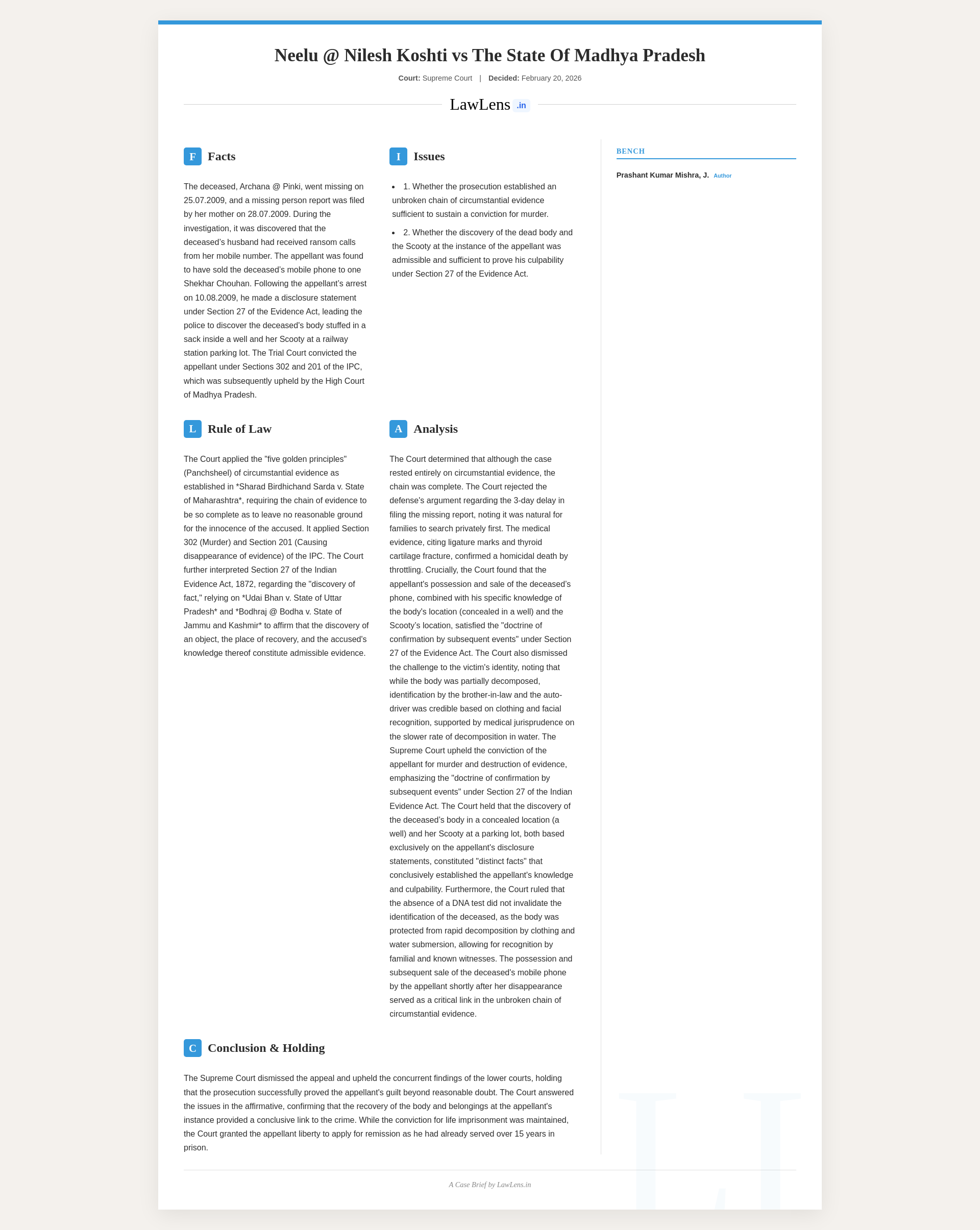
The Supreme Court upheld the concurrent conviction of the appellant for the murder of Archana @ Pinki and for causing disappearance of evidence, affirming life imprisonment under Section 302 IPC and seven years under Section 201 IPC. Relying on a complete chain of circumstantial evidence—ransom calls from the deceased’s phone, the appellant’s subsequent possession and sale of that phone, recovery of the dead body and Scooty at his disclosure under Section 27 Evidence Act, medical proof of homicidal death, and identification of the body—the Court held that no other reasonable hypothesis except the appellant’s guilt was possible. The appeal was dismissed, but noting that the appellant has undergone more than 15 years of imprisonment, the Court granted him liberty to seek remission, to be considered by the State under the applicable policy.