Mahendra Prasad Agarwal v. Arvind Kumar Singh 2026 INSC 175 - Consider Jurisprudence
"When a claim of a right is legal and justified, relief must follow. The Constitutional or statutory remedies are not intended for academic discourse."

Practice and Procedure- “consider jurisprudence” - to throw the ball out of the Court, is counterproductive and harms the system - When a claim of a right is legal and justified, relief must follow. The Constitutional or statutory remedies are not intended for academic discourse. If a case deserves relief, it must be granted then and there, unflinchingly if need be. Balancing of equities is not to be confused with avoiding or postponing the relief. These are not matters of law, but of its working and practice. Unlike law and its procedures, good practices that evolve over a period of time are far more precious than written laws, as it is in this practice that we see acceptance and internalization of the spirit of law. It is necessary to recognize, nurture and develop good practices which become habits. These habits come from the shared belief, values and attitudes that breathe vitality into rule of law. Legal culture integrates collective beliefs, fostering habits. It is necessary and in fact compelling to keep our remedies simple, effective and efficient. (Para 14-15)
Practice and Procedure - To invoke contempt jurisdiction for quick relief even when appealable orders have already been passed - Bad Practice. (Para 17)
Case Info
Here’s the structured information from the judgment:
Basic Details
Case name: Mahendra Prasad Agarwal v. Arvind Kumar Singh & Ors.
Neutral citation: 2026 INSC 175
Coram:Justice Pamidighantam Sri NarasimhaJustice Alok Aradhe
Judgment date: 10 February 2026
Caselaws and citations
The judgment, as provided, does not cite or discuss any other reported cases or precedents. It is largely self‑contained and focuses on the procedural history and the High Court’s handling of the matter.
Statutes / laws referred
The Court notes that the original proceedings were initiated by invoking the jurisdiction of the High Court under Article 226 of the Constitution of India. No other specific statutory provisions or rules are expressly referred to in the text you’ve shared.
Brief summary (three sentences)
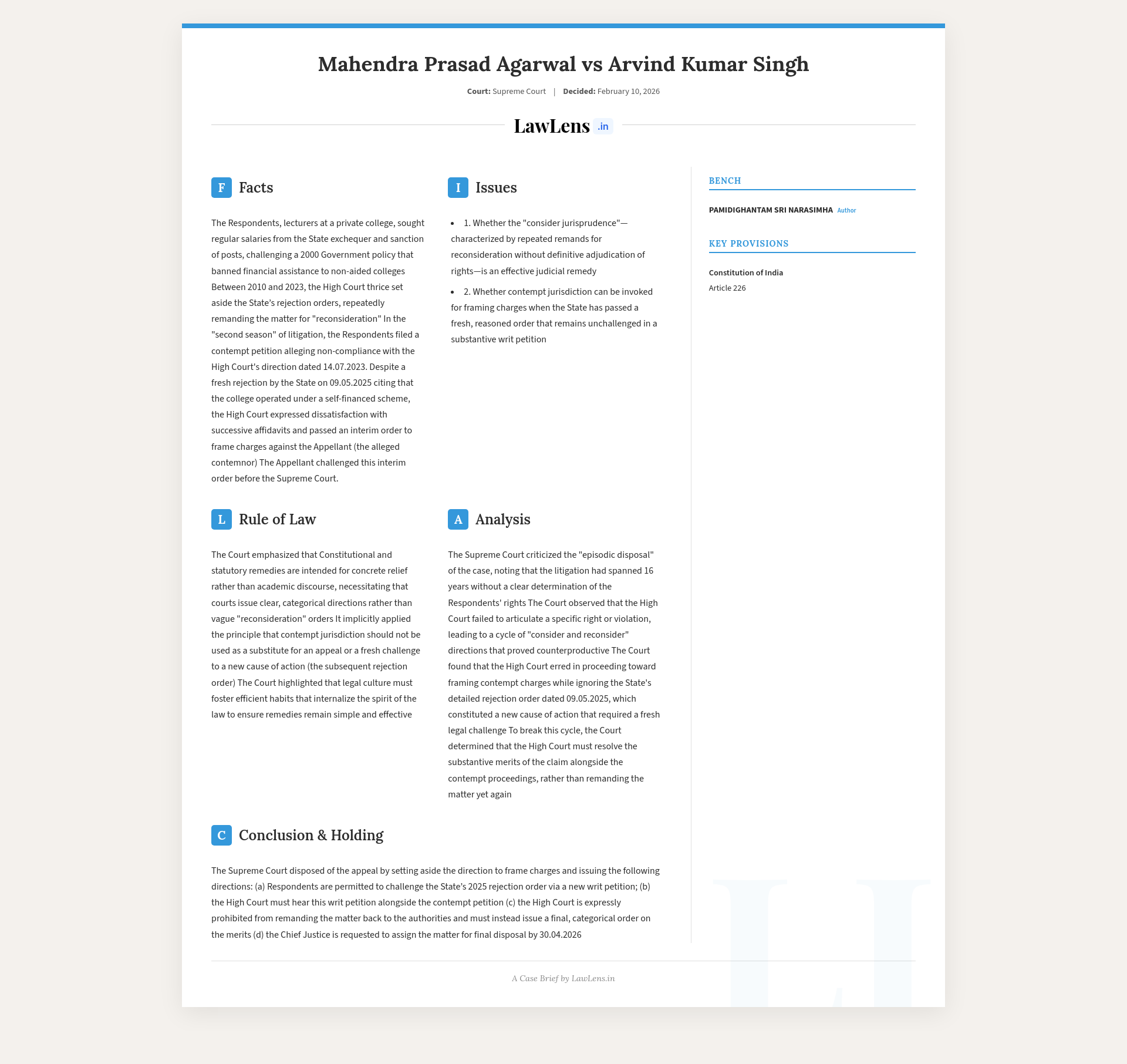
The case concerns a challenge to a High Court order in contempt proceedings arising from repeated “consider/reconsider” directions on lecturers’ claims for regular salary from the State exchequer after a government policy (21.08.2000) stopping financial assistance to non‑aided colleges. The Supreme Court criticises the High Court’s episodic directions and the broader practice of vague “consider” orders and using contempt jurisdiction to seek quick relief where clear, appealable orders already exist, noting that the State’s latest speaking order dated 09.05.2025 has not been directly challenged. It permits the lecturers to file a fresh writ against that order, directs the High Court to decide the writ on merits without remanding, to issue clear and categorical directions (or dismiss with reasons), and disposes of the civil appeal with a request for final disposal by 30 April 2026.