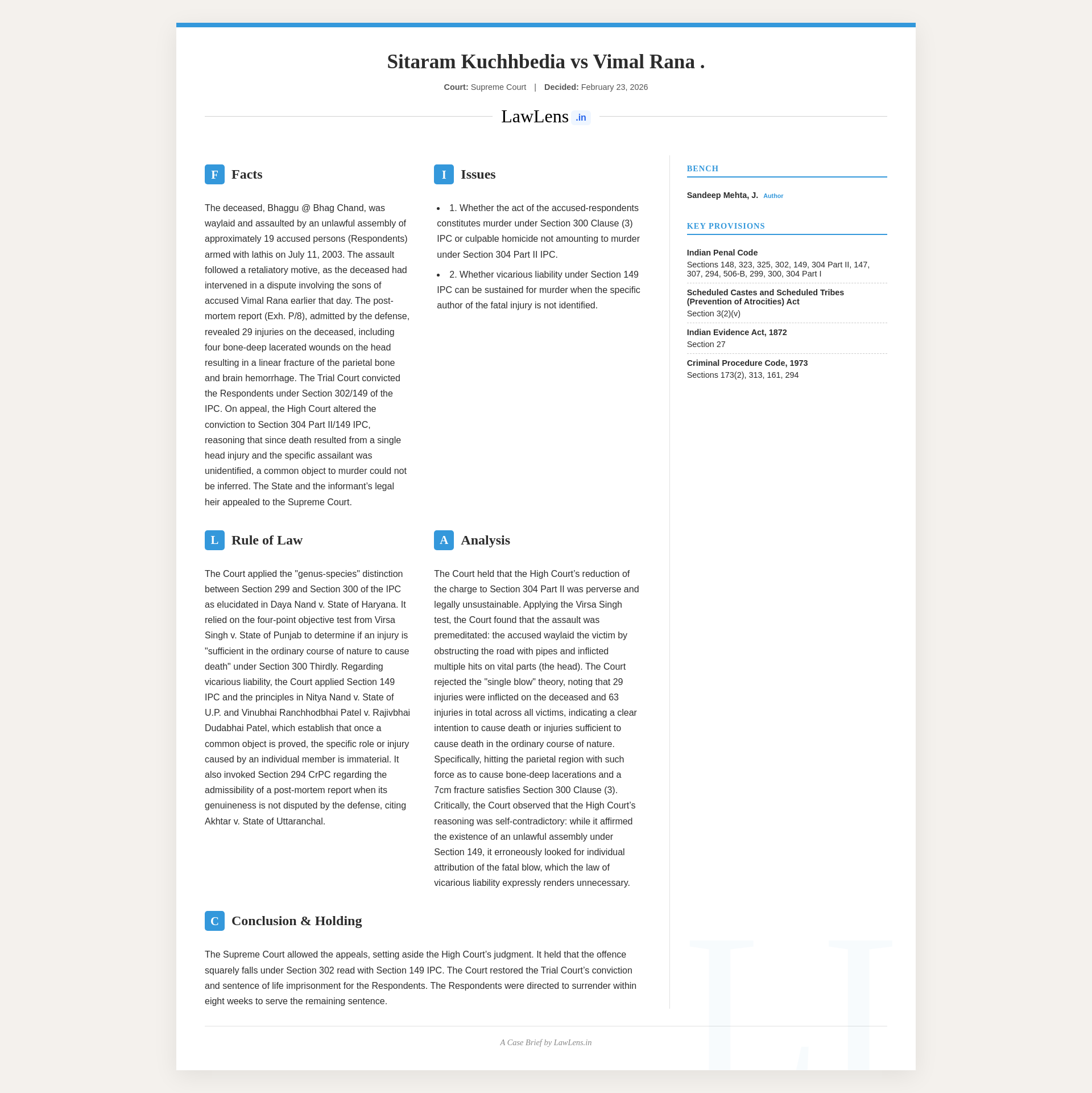
Sitaram Kuchhbedia v. Vimal Rana 2026 INSC 178 - Unlawful Assembly - Murder
Even though the weapons of offence were lathis, which in the abstract may not always be characterised as a deadly weapon, their lethality depends upon the manner of use, the part of the body targeted, and the force employed

Indian Penal Code 1860 - Section 300 - The determination of intention, being a state of mind, is seldom susceptible to a rigid or mechanical formula. It must necessarily be gathered from the cumulative effect of the circumstances proved on record, including the nature of the weapon used, the part of the body targeted, the manner of assault, the number of injuries, and the circumstances surrounding the occurrence. (Para 57) Even though the weapons of offence were lathis, which in the abstract may not always be characterised as a deadly weapon, their lethality depends upon the manner of use, the part of the body targeted, and the force employed - When repeated blows are inflicted on the parietal and temporal regions with lathis, resulting in bone-deep lacerations causing fractures and brain damage and culminating in coma, it cannot be said that the assailants lacked the intention to inflict such bodily injury as was sufficient in the ordinary course of nature to cause death.. (Para 60-62)
Criminal Trial - When the defence chose to admit the post-mortem report, which was accordingly marked, the absence of oral testimony of the doctor does not create any material infirmity in the prosecution's case. (Para 64)
Indian Penal Code 1860 - Section 149- Once it is established that an unlawful assembly existed and the accused-respondents intended to commit murder of deceased-Bhaggu in furtherance of the common object of such assembly, the individual attribution of the fatal injury fades into insignificance. It is immaterial as to which accused delivered the fatal injury, once the offence is shown to have been committed in furtherance of the common object of the unlawful assembly. (Para 66-67)
Case Info
Here’s the information extracted from the judgment you shared:
Case name and neutral citationThe case is Sitaram Kuchhbedia v. Vimal Rana and Others, decided as Criminal Appeal Nos. 1837–38 of 2011 (with Criminal Appeal Nos. 1835–36 of 2011). The neutral citation given is 2026 INSC 178.
Coram (Bench)The judgment is authored and signed by Justice Sanjay Karol and Justice Sandeep Mehta.
Judgment dateThe judgment is dated 23 February 2026.
Case laws and citations referred toThe judgment refers to, among others:
- Daya Nand v. State of Haryana, (2008) 15 SCC 717 : AIR 2008 SC 1823
- State of Andhra Pradesh v. Rayavarapu Punnayya, (1976) 4 SCC 382 : 1977 CrLJ 1
- Abdul Waheed Khan @ Waheed v. State of Andhra Pradesh, 2002 SCC OnLine SC 792 : 2002 Supp (1) SCR 703
- Augustine Saldanha v. State of Karnataka, 2003 SCC OnLine SC 905 : 2003 CrLJ 4458
- Thangiya v. State of T.N., (1977) 4 SCC 600 (2) : 2005 CrLJ 684
- Rajinder v. State of Haryana, 2005 SCC OnLine SC 227 : 2006 CrLJ 2926
- Virsa Singh v. State of Punjab, 1958 SCR 1495 : 1958 CrLJ 818
- Rajwant v. State of Kerala, AIR 1966 SC 1874
- Pulicherla Nagaraju v. State of A.P., (2006) 11 SCC 444
- Chunni Bai v. State of Chhattisgarh, 2025 SCC OnLine SC 955
- Mahadeo Sahni and Others v. State of Bihar, (2002) 6 SCC 656
- Akhtar v. State of Uttaranchal, (2009) 13 SCC 722
- Nitya Nand v. State of U.P., (2024) 9 SCC 314
- Krishnappa v. State of Karnataka, (2012) 11 SCC 237 : (2013) 1 SCC (Cri) 621
- Vinubhai Ranchhodbhai Patel v. Rajivbhai Dudabhai Patel, (2018) 7 SCC 743 : (2018) 3 SCC (Cri) 340
- Ramu Gope v. State of Bihar, 1968 SCC OnLine SC 74 : AIR 1969 SC 689
Statutes / laws referred toKey provisions discussed and applied include:
- Indian Penal Code, 1860 (IPC): Sections 147, 148, 294, 506-B, 299, 300, 302, 304 Part I & Part II, 323, 325, 149
- Code of Criminal Procedure, 1973 (CrPC): Sections 173(2), 294, 313
- Indian Evidence Act, 1872: Section 27
- Scheduled Castes and the Scheduled Tribes (Prevention of Atrocities) Act, 1989: Section 3(2)(v)
Brief summary in three sentencesThe case concerned a group assault in which the deceased, Bhaggu @ Bhag Chand, suffered 29 injuries (including multiple bone‑deep head wounds) and died, and the trial court convicted the accused under Section 302/149 IPC, sentencing them to life imprisonment. The High Court re‑appreciated the evidence, held that only one head injury was fatal and that the common object was not to commit murder, and consequently altered the conviction to Section 304 Part II/149 IPC with a reduced sentence of six years. The Supreme Court held that the assault was premeditated, involved repeated blows on a vital part with a clear common object, applied Section 300 “thirdly” and Section 149 IPC, set aside the High Court’s dilution, and restored the conviction under Section 302/149 IPC with life imprisonment, directing the accused to surrender within eight weeks.