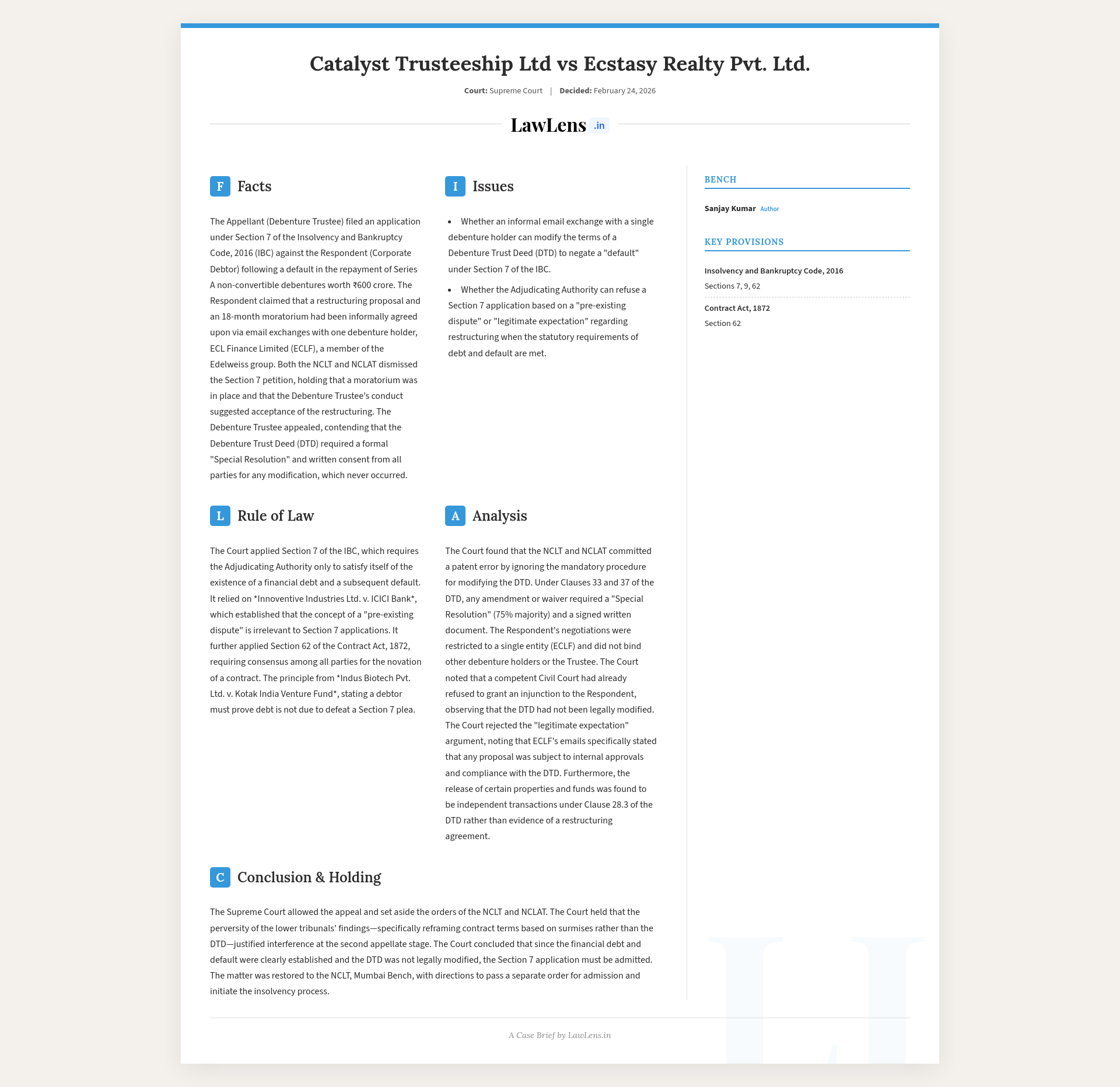
Catalyst Trusteeship Ltd. v. Ecstasy Realty Pvt. Ltd. 2026 INSC 186 - S.7 IBC - Indirectly Raising Pre-Existing Dispute Defence
Insolvency and Bankruptcy Code 2016 - Section 7 - indirect way of raising a pre-existing dispute

Insolvency and Bankruptcy Code 2016 - Section 7,9- A corporate debtor is entitled to establish that the financial debt is not due and no default had occurred in that regard to defeat a financial creditor’s application for corporate insolvency resolution process under Section 7 of the Code. However, such an exercise cannot assume an indirect way of raising a pre-existing dispute, which would be available only to ward off an operational creditor’s claim under Section 9 of the Code. (Para 18)
Insolvency and Bankruptcy Code 2016 - Section 62- Ordinarily, Supreme Court would not choose to reappreciate a matter on facts when the jurisdictional National Company Law Tribunal and, in appeal, the National Company Law Appellate Tribunal have recorded concurrent findings. The exception to this self-imposed rule would be when the perversity of such concurrent findings is clearly established. (Para 22)
Case Info
Case name and neutral citation
- Case name: Catalyst Trusteeship Ltd. v. Ecstasy Realty Pvt. Ltd.
- Neutral citation: 2026 INSC 186
Coram
- Bench: Sanjay Kumar, J. and K. Vinod Chandran, J.
Judgment date
- Date of judgment: 24 February 2026
Caselaws cited
- Innoventive Industries Limited v. ICICI Bank and another, (2018) 1 SCC 407
- Indus Biotech Private Limited v. Kotak India Venture (Offshore) Fund and others, (2021) 6 SCC 436
Statutes / laws referred
- Insolvency and Bankruptcy Code, 2016
- Section 7 (initiation of CIRP by financial creditor)
- Section 62 (appeal to Supreme Court)
- Indian Contract Act, 1872
- Section 62 (novation of contract)
- Debenture Trust Deed dated 27.03.2018 (contractual clauses: in particular clauses 1.1, 22–23 of Schedule 2, 28.3, 33, 37)
Three‑sentence brief summary
The Supreme Court held that the National Company Law Tribunal and the NCLAT had perversely refused admission of a Section 7 IBC application by Catalyst Trusteeship Ltd. against Ecstasy Realty Pvt. Ltd. by wrongly assuming that a restructuring with an 18‑month moratorium was in place. The Court found that any loan restructuring or waiver required compliance with the Debenture Trust Deed—written consent of debenture holders through the prescribed procedure and a written amendment—which admittedly never occurred, and that emails exchanged only with one debenture holder (ECL Finance) could not bind other debenture holders or the debenture trustee. Setting aside the NCLT and NCLAT orders, the Supreme Court directed that the Section 7 petition be admitted and CIRP steps proceed in accordance with law.