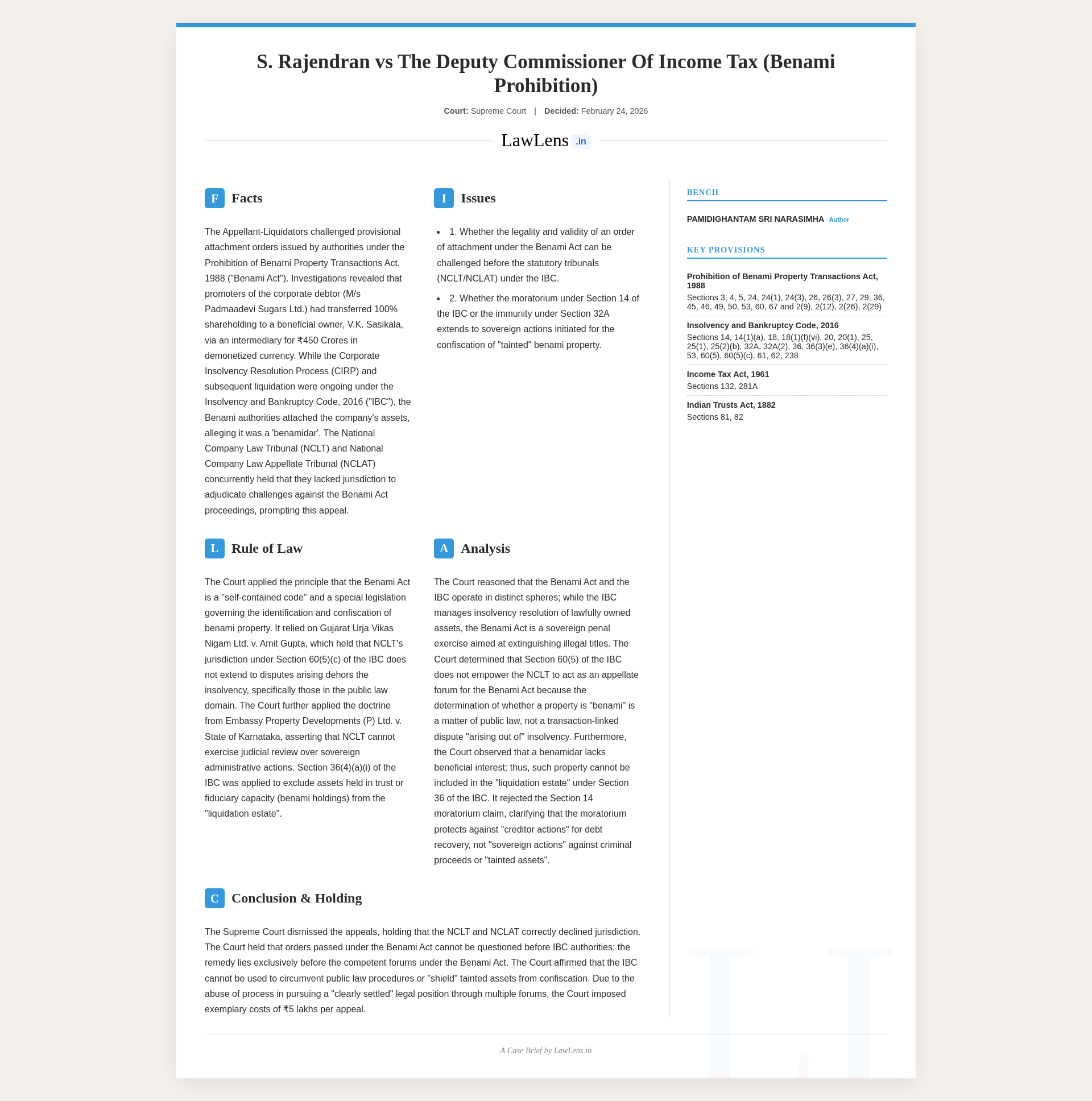
S. Rajendran v. Deputy Commissioner of Income Tax (Benami Prohibition) 2026 INSC 187 - IBC - Benami Act - Attachment Order
Can Attachment Order under Benami Act be challenged before NCLT under IBC?

Insolvency and Bankruptcy Code 2016 - Section 60(5) - Prohibition of Benami Property Transactions Act, 1988 - The NCLT cannot, in exercise of insolvency jurisdiction, disregard or nullify a statutory vesting effected under another enactment. The IBC does not provide an indirect route to challenge sovereign acts validly undertaken under a penal statute - Permitting the NCLT to examine the correctness of attachment or adjudication under the Benami Act by invoking Section 60(5) would amount to elevating it to the status of a judicial review forum over sovereign action, The IBC, concerned as it is with insolvency resolution and value maximisation of lawfully owned assets, cannot be employed as a mechanism to dilute or override statutory proceedings undertaken in the public law sphere for confiscation of tainted property- Benami Act is a complete and self-contained code governing identification, provisional attachment, adjudication and confiscation of benami property, supported by a distinct appellate hierarchy. Exclusive jurisdiction over such determinations is conferred upon authorities constituted under the Benami Act. The IBC neither displaces this statutory mechanism nor empowers the NCLT to reopen findings rendered thereunder. (Para 20)
Insolvency and Bankruptcy Code 2016 - Section 36 - Prohibition of Benami Property Transactions Act, 1988 - Property held benami is, by definition, held in a fiduciary or representative capacity for the real owner. Section 36(4)(a)(i) excludes assets held in trust for third parties from the liquidation estate -A benamidar possesses no beneficial interest and that title vests in the person who provided consideration. Where the corporate debtor is merely an ostensible holder, the property never forms part of its estate and cannot be administered in liquidation - Once the Adjudicating Authority under the Benami Act has concluded that the corporate debtor is a benamidar, beneficial ownership stands negated. The legality and validity of such determinations are subject matter of appeal under the provisions of Benami Act alone. Insolvency proceedings cannot be utilised to convert property held for another into distributable assets for creditors. The IBC contemplates distribution of the debtor’s estate, not assets impressed with a trust or held on behalf of a third party. (Para 21-22)
Insolvency and Bankruptcy Code 2016 - Section 32A - is event-based and triggered only upon approval of a resolution plan or completion of a liquidation sale to an unconnected third party. Absent such approval, the immunity does not arise. The provision does not validate defective title nor retrospectively convert benami property into assets of the corporate debtor. (Para 23)
Insolvency and Bankruptcy Code 2016 - Section 14- The moratorium under Section 14 is intended to preserve the debtor’s estate for orderly resolution; it does not interdict sovereign proceedings in rem for attachment or confiscation under penal statutes. Such proceedings are distinct from creditor enforcement and proceed on an independent statutory footing - The moratorium is intended to protect the corporate debtor from "creditor actions" aimed at debt recovery, not to shield "tainted assets" from sovereign actions against crime. (Para 24)
Case Info
Case name and neutral citation:S. Rajendran v. The Deputy Commissioner of Income Tax (Benami Prohibition) & Ors., 2026 INSC 187
Coram:Justice Pamidighantam Sri Narasimha and Justice Atul S. Chandurkar
Judgment date:24 February 2026 (NEW DELHI; FEBRUARY 24, 2026)
Case laws and citations referred:
- Innoventive Industries Ltd. v. ICICI Bank, (2018) 1 SCC 407
- Solidaire India Ltd. v. Fairgrowth Financial Services Ltd., (2001) 3 SCC 71
- Bacha F. Guzdar v. Commissioner of Income Tax, Bombay, (1954) 2 SCC 563
- Indian Overseas Bank v. RCM Infrastructure Ltd., (2022) 8 SCC 516
- Kailash Assudani v. Commissioner of Income Tax, 2017 SCC OnLine MP 2384
- Swiss Ribbons (P) Ltd. v. Union of India, (2019) 4 SCC 17
- Embassy Property Developments (P) Ltd. v. State of Karnataka, (2020) 13 SCC 308
- State Bank of India v. Union of India, 2026 INSC 153
- LIC of India v. D.J. Bahadur, (1981) 1 SCC 315
- Gobind Sugar Mills Ltd. v. State of Bihar, (1999) 7 SCC 76
- State of Gujarat v. Patel Ramjibhai Danabhai, (1979) 3 SCC 347
- Commercial Tax Officer, Rajasthan v. Binani Cements Ltd., (2014) 8 SCC 319
- Vodafone Idea Cellular Ltd. v. Ajay Kumar Agarwal, (2022) 6 SCC 496
- Sarwan Singh v. Kasturi Lal, (1977) 1 SCC 750
- S. Vanitha v. Deputy Commissioner, Bengaluru Urban District, (2021) 15 SCC 730
- Bank of India v. Ketan Parekh, (2008) 8 SCC 148
- Gujarat Urja Vikas Nigam Ltd. v. Amit Gupta, (2021) 7 SCC 209
- Controller of Estate Duty, Lucknow v. Aloke Mitra, (1981) 2 SCC 121
Statutes / laws referred:
- Prohibition of Benami Property Transactions Act, 1988 (Benami Act) – especially Sections 2(9), 2(12), 2(26), 2(29), 3, 4, 5, 24, 26, 27, 29, 45, 46, 53, 60, 67
- Insolvency and Bankruptcy Code, 2016 – especially Sections 14, 18, 20, 25, 32A, 36, 53, 60(5), 61, 238
- Income Tax Act, 1961 – particularly Sections 132 and 281A (historical background)
- Indian Trusts Act, 1882 – especially repealed Sections 81 and 82 (historical context of benami)
- Mines and Minerals (Development and Regulation) Act (MMDR) – cited via Embassy Property (context of public law domain)
- Telegraph Act, Indian Wireless Telegraphy Act and TRAI Act – referenced via SBI v. UOI for conflict of special statutes
Three‑sentence brief summary:The Supreme Court held that orders of provisional attachment and adjudication passed under the Prohibition of Benami Property Transactions Act, 1988 cannot be challenged before the NCLT/NCLAT in proceedings under the Insolvency and Bankruptcy Code, 2016, and must instead be assailed only before the forums constituted under the Benami Act. It ruled that benami proceedings are sovereign, in rem, penal actions in the public law domain, that benami property is not beneficially owned by the corporate debtor and therefore does not form part of the liquidation estate under Section 36 IBC, and that Section 14 moratorium and Section 32A IBC neither override nor cure tainted title. Finding the liquidators’ recourse to IBC fora an abuse of process intended to bypass the Benami Act mechanism, the Court dismissed all the appeals with exemplary costs of Rs. 5 lakhs each, payable to SCAORA.