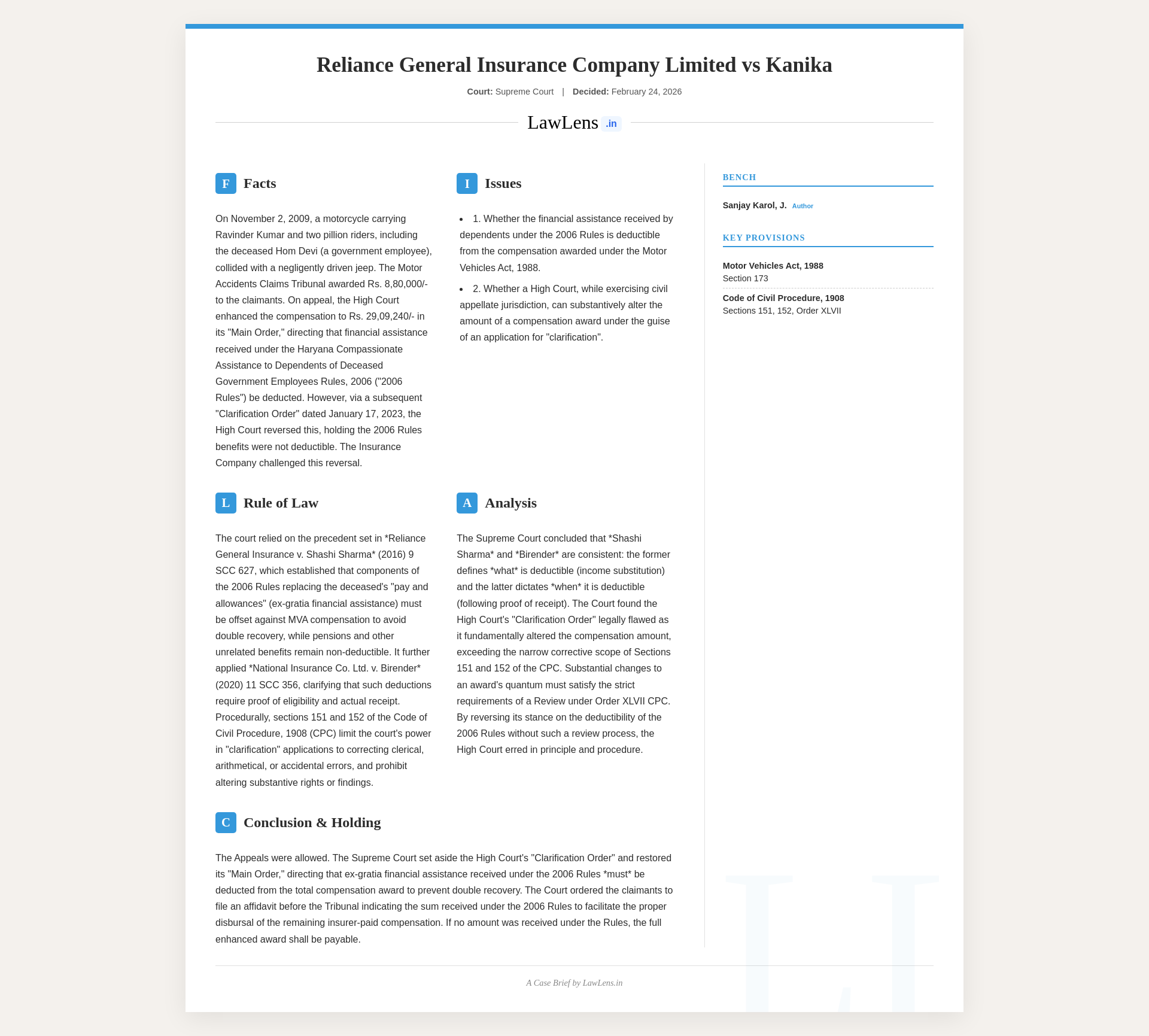
Reliance General Insurance Company Limited v. Kanika 2026 INSC 188 - Compassionate Assistance Scheme - Motor Accident Compensation - Deduction - CPC
Can the amount in terms of Compassionate Assistance Rules be deducted from the Motor Accident Compensation awarded?

Motor Vehicle Act 1988 - Motor Accident Compensation- Haryana Compassionate Assistance to Dependents of Deceased Government Employees Rules, 2006 - Whether the amount in terms of the 2006 Rules has to be deducted from the compensation awarded by the Tribunal or not? Deduction is permissible only to the extent that financial assistance overlaps with the same pecuniary loss for which compensation is awarded under the MVA, most notably the loss of income. Benefits that are not in the nature of income substitution, or that are otherwise unconnected to the accident-related loss, are not deductible - Eligibility or actual receipt must be established on record before any deduction is effected- Compensation under the MVA be determined in full, with a declaration mechanism to adjust the award later if overlapping assistance is in fact received. (Para 6-7)
Code of Civil Procedure 1908 - Section 151,152 - Order XLVII - High Court may correct clerical or accidental errors under Section 152 CPC, or issue limited clarificatory directions under Section 151 CPC to give effect to what was originally decided. However, it cannot, for example, alter findings on negligence, modify the quantum of compensation, redistribute liability, or otherwise affect substantive rights under the guise of clarification. Any such exercise would, in law, amount to a review in substance and must satisfy the strict requirements of review under Order XLVII CPC.
Code of Civil Procedure 1908 - Section 152 - Section 152 CPC permits correction only of clerical, arithmetical mistakes or errors arising from accidental slips or omissions- Section 152 is attracted only where the error is accidental and does not extend to re-determining issues or altering the substance of the decree - the provision cannot be used to modify, add to, or subtract from the terms of a judgment once pronounced - Section 152 cannot be invoked to change the operative part of a judgment on merits; it is confined to correcting clerical or accidental errors and cannot be pressed into service to vary substantive rights. (Para 7.1)
Code of Civil Procedure 1908 - Section 151 - The inherent powers cannot be exercised in a manner inconsistent with the express provisions of the Code, or in other words that these inherent powers have to be exercised, with due respect to the other provisions of the Code. They exist to supplement the procedure, not to override it. (Para 7.2)
Case Info
Basic details
Case name and neutral citation:Reliance General Insurance Company Limited v. Kanika & Ors., 2026 INSC 188
Coram:Hon’ble Mr. Justice Sanjay KarolHon’ble Mr. Justice Augustine George Masih
Judgment date:24 February 2026 (New Delhi)
Case laws and citations referred
- Reliance General Insurance Co. Ltd. v. Shashi Sharma, (2016) 9 SCC 627
- National Insurance Co. Ltd. v. Birender & Ors., (2020) 11 SCC 356
- Helen C. Rebello v. Maharashtra SRTC, (1999) 1 SCC 90 : 1999 SCC (Cri) 197
- United India Insurance Co. Ltd. v. Patricia Jean Mahajan, (2002) 6 SCC 281 : 2002 SCC (Cri) 1294
- Jayalakshmi Coelho v. Oswald Joseph Coelho, (2001) 4 SCC 181
- Neeraj Kumar Sainy v. State of U.P., (2017) 14 SCC 136
- State of Punjab v. Darshan Singh, (2004) 1 SCC 328
- Padam Sen v. State of Uttar Pradesh, AIR 1961 SC 218
- My Palace Mutually Aided Coop. Society v. B. Mahesh, (2022) 19 SCC 806
Statutes / rules referred
- Motor Vehicles Act, 1988 (Section 173 in particular – civil appellate jurisdiction of High Court)
- Code of Civil Procedure, 1908 – Sections 151 and 152, and Order XLVII (review)
- Haryana Compassionate Assistance to Dependents of Deceased Government Employees Rules, 2006
Three‑sentence brief summary
The Supreme Court held that financial assistance received under the Haryana 2006 Rules, to the extent it corresponds to pay and allowances (i.e., income substitution), must be deducted from motor accident compensation to avoid double recovery, in line with Reliance General Insurance v. Shashi Sharma, while other benefits like pension, PF, life insurance, etc., remain non‑deductible. It clarified that National Insurance Co. Ltd. v. Birender does not conflict with Shashi Sharma, but only regulates the stage and manner of such deduction, requiring proof of eligibility/receipt and permitting later adjustment via affidavit. The Court further ruled that the High Court could not, under the guise of a “clarification” application, substantively alter the compensation awarded (which in substance amounted to a review), set aside the clarification/review order, restored the original (Main) order and directed deduction of any overlapping 2006 Rules benefits after affidavit before the Tribunal.