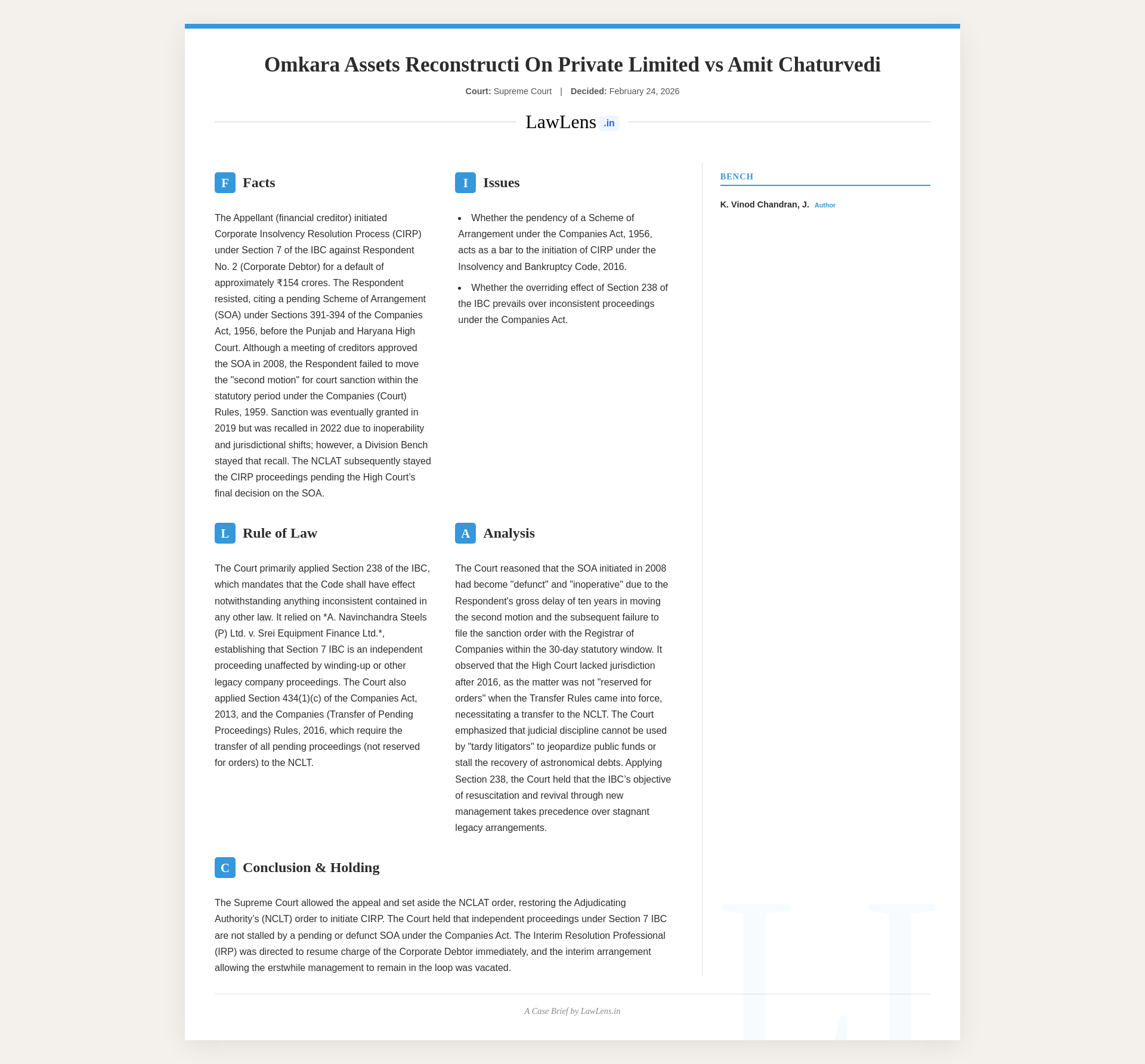
Omkara Assets Reconstruction Private Limited v. Amit Chaturvedi 2026 INSC 189 - IBC - Companies Act - Tardy Litigators

Insolvency and Bankruptcy Code 2016 ; Companies Act, 2013- Section 230 - A compromise or an arrangement under Section 230 of the Companies Act, 2013 can also be entered into in an IBC proceeding at the appropriate stage.(Para 20)
Tardy Litigators - Judicial discipline, though a corner stone of justice, equity and fairness; ensuring continued public trust in judicial institutions, cannot be urged by tardy litigators engaged in fractious and opulent litigations aimed at jeopardizing public funds and putting the economy in a hostage situation. In cases having economic implications like the present one, at stake is not only public funds but rehabilitation of an industry, in the larger national interest, wherein financial probity is also of pre-eminence. (Para 16)
Case Info
Here’s the extracted information from the judgment you shared:
Basic Case Details
Case name and neutral citation:Omkara Assets Reconstruction Private Limited v. Amit Chaturvedi and Ors., 2026 INSC 189
Coram:Justice Sanjay Kumar and Justice K. Vinod Chandran (author)
Judgment date:24 February 2026 (NEW DELHI; FEBRUARY 24, 2026.)
Statutes / Laws Referred
The Court refers to and applies, among others:
- Insolvency and Bankruptcy Code, 2016 (IBC)
- Section 7 (initiation of CIRP)
- Section 14 (moratorium)
- Section 238 (overriding effect)
- Companies Act, 1956
- Sections 391–394 (Scheme of Arrangement)
- Companies Act, 2013
- Section 230 (compromise/arrangement in winding up/IBC context)
- Section 434(1)(c) and its provisos (transfer of pending proceedings)
- Companies (Court) Rules, 1959
- Rules 78, 79, 81 (timelines for reporting meeting result, second motion, filing with ROC)
- Companies (Transfer of Pending Proceedings) Rules, 2016 (Rule 3)
- Securitisation and Reconstruction of Financial Assets and Enforcement of Security Interest Act, 2002 (SARFAESI Act)
- Recovery of Debts and Bankruptcy Act, 1993 (RDB Act)
Case Law and Citations Referred
- Sunil Kumar Sharma v. ICICI Bank Ltd., 2025 SCC OnLine SC 145
- NCLAT (AT)(Ins.) No. 1158–1162 of 2024, approved by the Supreme Court; relied on to show that a long‑pending but never‑implemented scheme of arrangement cannot derail IBC proceedings.
- A. Navinchandra Steels (P) Ltd. v. Srei Equipment Finance Ltd., (2021) 4 SCC 435
- Cited extensively (esp. para 25) to reaffirm that:
- Petitions under Sections 7/9 IBC are independent of company‑court winding up;
- IBC is a special statute focused on revival, which prevails over the Companies Act;
- Only when “corporate death is inevitable” should revival via IBC give way to pure winding up;
- Compromise/arrangement under Section 230, Companies Act, 2013 can also be explored within IBC (e.g. in liquidation).
- Alpha Corp Development Pvt. Ltd. v. Euthoria Developers Pvt. Ltd., CAPP No. 2 of 2017, judgment dated 31.03.2017 (Punjab & Haryana High Court)
- Division Bench decision used by the Company Judge below; Supreme Court explains why that logic (about reserved orders and transfer to NCLT) does not apply here, because the second motion under Section 391 was not within time and was not “reserved for orders” when the 2016 Transfer Rules came into force.
Three‑Sentence Brief Summary
The Supreme Court holds that a stale and procedurally defective Scheme of Arrangement under Sections 391–394 of the Companies Act, 1956—never brought into effect within statutory timelines and based on 2008 dues—is defunct and cannot be used to stall Corporate Insolvency Resolution Proceedings under the IBC. Emphasizing Section 238 IBC and relying on A. Navinchandra Steels, the Court reiterates that Section 7 IBC proceedings are independent, that revival under the IBC is to be preferred over older company‑court mechanisms, and that only near‑certain “corporate death” justifies not transferring or proceeding under IBC. It therefore sets aside the NCLAT order that had kept the IBC application in abeyance, restores the NCLT’s order admitting the Section 7 application, revives the moratorium, and allows the Interim Resolution Professional to proceed without the earlier constraint of keeping management in the loop.