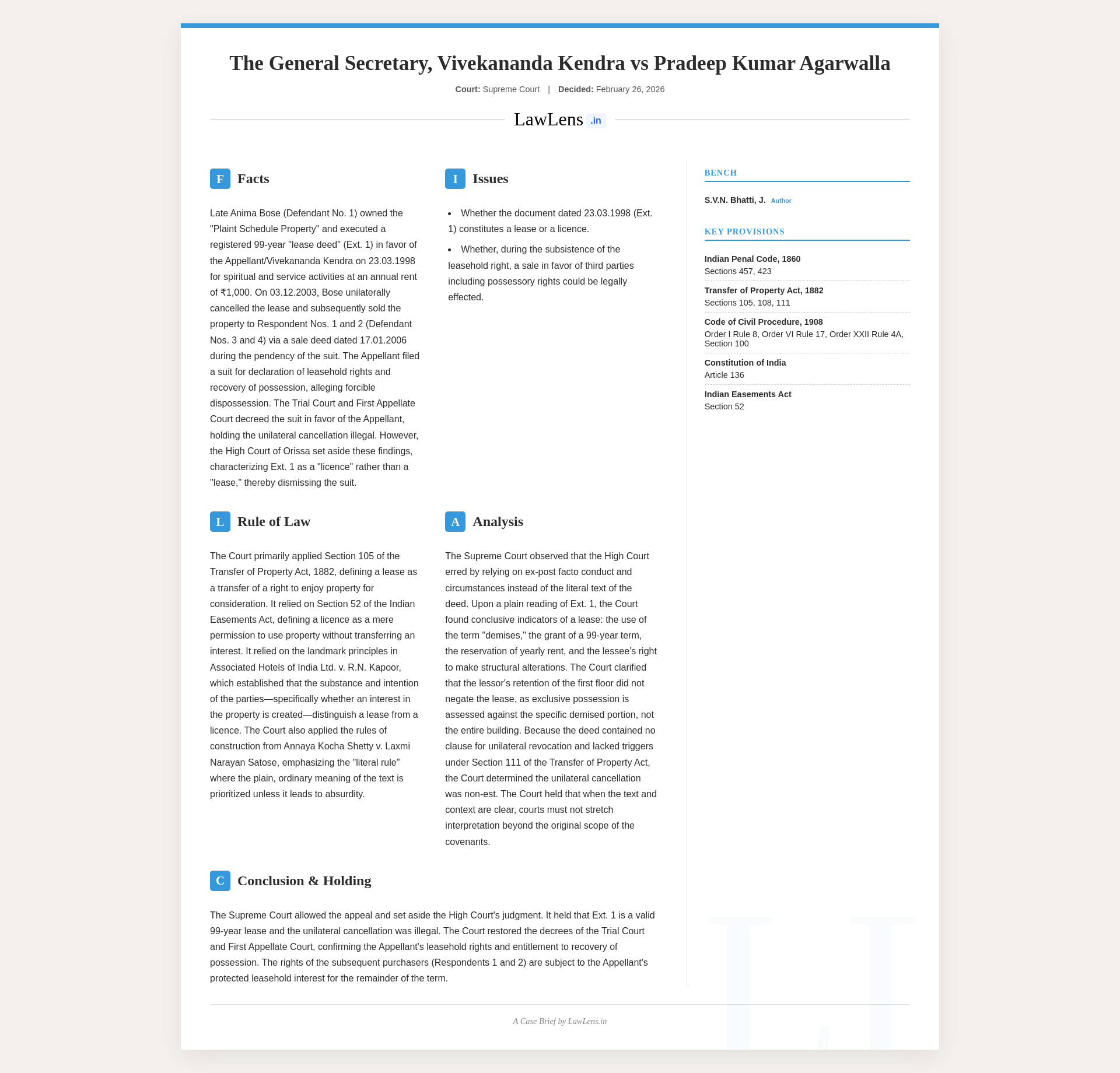
General Secretary, Vivekananda Kendra v. Pradeep Kumar Agarwalla 2026 INSC 199 - Lease and License - Interpretation Of Contracts

Transfer of Property Act - Section 108 ; Indian Easements Act - Section 52 - Lease and License -1) To ascertain whether a document creates a licence or lease, the substance of the document must be preferred to the form; (2) the real test is the intention of the parties — whether they intended to create a lease or a licence; (3) if the document creates an interest in the property, it is a lease; but, if it only permits another to make use of the property, of which the legal possession continues with the owner, it is a licence; and (4) if under the document a party gets exclusive possession of the property, prima facie, he is considered to be a tenant; but circumstances may be established which negative the intention to create a lease.” The decisive consideration in determining whether an agreement creates the relationship of lessor and lessee or merely that of licensor and licensee is the intention of the parties. This intention has to be ascertained on a consideration of all the relevant provisions in the agreement. (Para 15-16)
Contract Law - Interpretation -If the words in a contract/deed are clear, there is very little the courts must do in the construction of the contract in determining the intention of the parties. In furtherance of determining the intention, the deed must be read as a whole to ascertain the true meaning of its clauses, and the words of each clause should be interpreted harmoniously. This intention must be derived directly from the plain and ordinary meaning of the text itself. Furthermore, these words should be understood exactly as the intended parties would commonly use them. The covenants must be applied precisely as written, neither diluted into irrelevance nor stretched beyond their original scope. If the construction of the contract/deed, through its words and context, does not provide the court with the parties’ intention, the court may have regard to the circumstances surrounding its creation and the subjectmatter to which it was designed and intended to apply. (Para 19) While the circumstances of a deed are not the safest guide for interpreting a crystallised document, courts may rely on it when the document’s purport is unclear through literal construction. However, courts must exercise far greater restraint when inferring the parties’ intention from circumstances arising after the creation of the terms. For, the conduct may not be in tandem with either the literal expression or the purpose of the document. (Para 20) Interpreting intention through purposive construction or through ex-post facto circumstances is unnecessary when the intention is understood from the plain and ordinary meaning of the text -Nomenclature alone of the document is not the decisive factor of the nature of a document; it is the text and the context that point to the obligations undertaken by the parties to a written document. (Para 21)