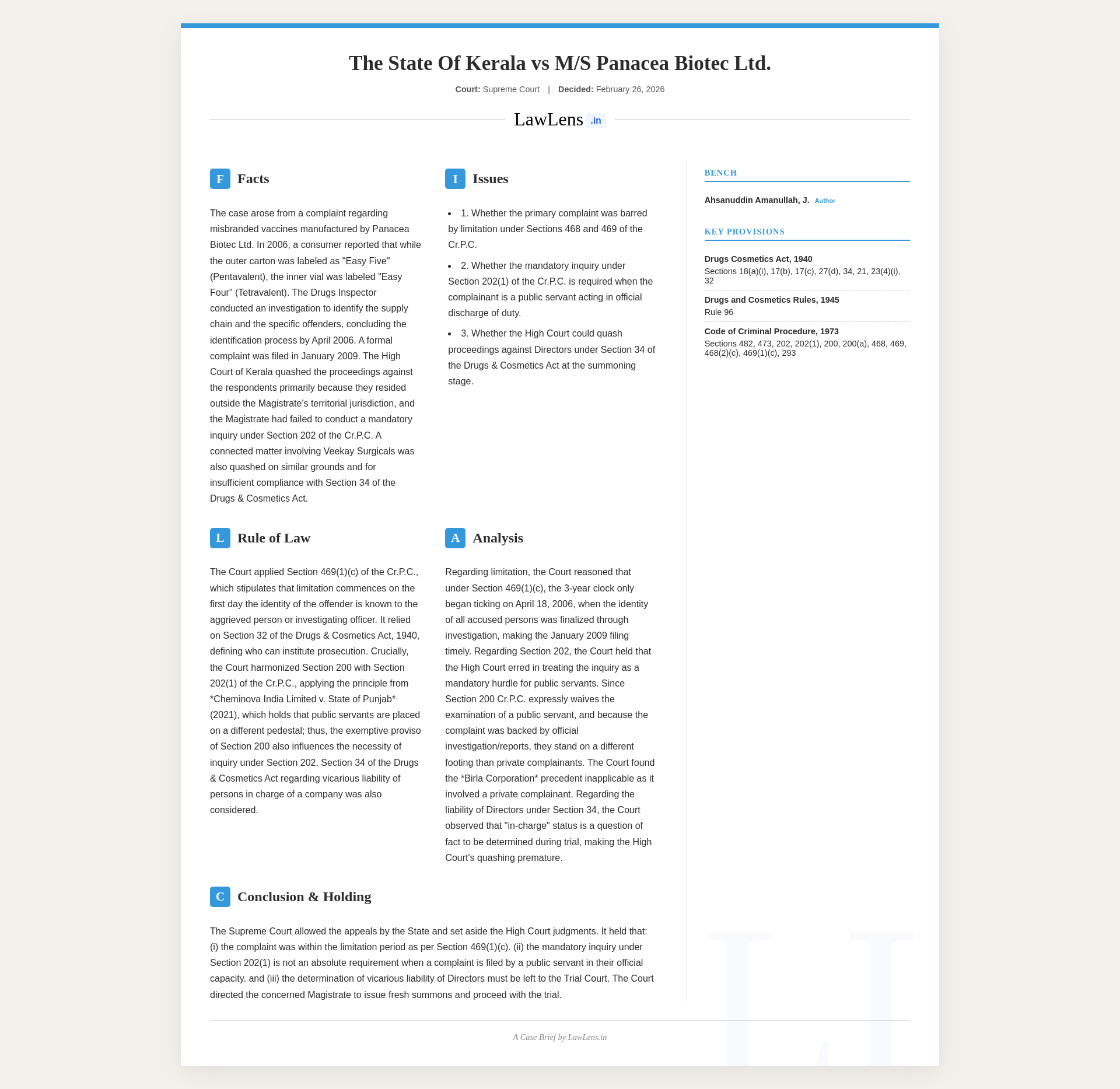
State of Kerala vs Panacea Biotec Ltd 2026 INSC 200 - S.202 CrPC -Public Servants
"public servant placed on a different pedestal..."

Code of Criminal Procedure 1973 - Section 200,202- Public servants discharging their duties in their official capacity(ies),are given a different footing qua when they were complainant(s), vis-a-vis complaints made in private capacity. [Context: High Court quashed the Complaint Case qua the accused on the ground that they resided beyond the territorial jurisdiction of the CJM and yet the CJM failed to conduct the mandatory statutory enquiry under Section 202 - Allowing appeal, SC restored the complaint]
Code of Criminal Procedure 1973 - Section 469(1)(c)- The period of limitation would commence from the ‘first day on which the identity of the offender is known to the person aggrieved by the offence or to the police officer making investigation into the offence, whichever is earlier.’ Thus, Section 469(1)(c) of the Code clearly contemplates that the identity of the offender may emerge during ‘investigation into the offence’. (Para 33)
Case Info
Case Information
Case name and neutral citation:State of Kerala & Anr. v. M/s Panacea Biotec Ltd. & Ors., 2026 INSC 200
Coram
Bench: Justice Ahsanuddin Amanullah and Justice S.V.N. Bhatti
Judgment Date
26 February 2026 (pronounced at New Delhi)
Caselaws and Citations Referred
- Cheminova India Limited v. State of Punjab, 2021 SCC OnLine SC 573; (2021) 8 SCC 818
- Birla Corporation Limited v. Adventz Investments and Holdings Limited, (2019) 16 SCC 610
Statutes / Laws Referred
- Code of Criminal Procedure, 1973
- Section 200 (Examination of complainant)
- Section 202 (Postponement of issue of process)
- Sections 468, 469, 473 (Limitation for taking cognizance)
- Section 192, Section 293 (referred in reasoning)
- Drugs and Cosmetics Act, 1940
- Sections 17(b), 17(c) (Misbranding)
- Section 18(a)(i)
- Section 21 (Appointment of Inspectors)
- Section 27(d) (Punishment)
- Section 32 (Cognizance of offences) – both pre‑ and post‑2008 amendment
- Section 34 (Offences by companies)
- Drugs and Cosmetics Rules, 1945
- Rule 96 (Labelling requirements)
Three‑Sentence Brief Summary
The Supreme Court held that the prosecutions under the Drugs and Cosmetics Act against Panacea Biotec and, in the companion matter, Veekay Surgicals were within limitation because the period under section 468 CrPC began when the identity of the offenders became known to the Drug Inspector under section 469(1)(c), not from the initial private complaint date. It further held that, where the complaint is filed by a public servant acting in discharge of official duty, non‑holding of an inquiry under section 202(1) CrPC before issuing process to accused residing outside the magistrate’s jurisdiction does not vitiate cognizance, applying Cheminova and reading sections 200 and 202 CrPC harmoniously. Consequently, the Court set aside the Kerala High Court’s quashing orders, restored the summoning/cognizance orders, directed substitution/arraying of the responsible persons in charge of the companies, and clarified that questions under section 34 of the Drugs and Cosmetics Act are factual matters for trial.