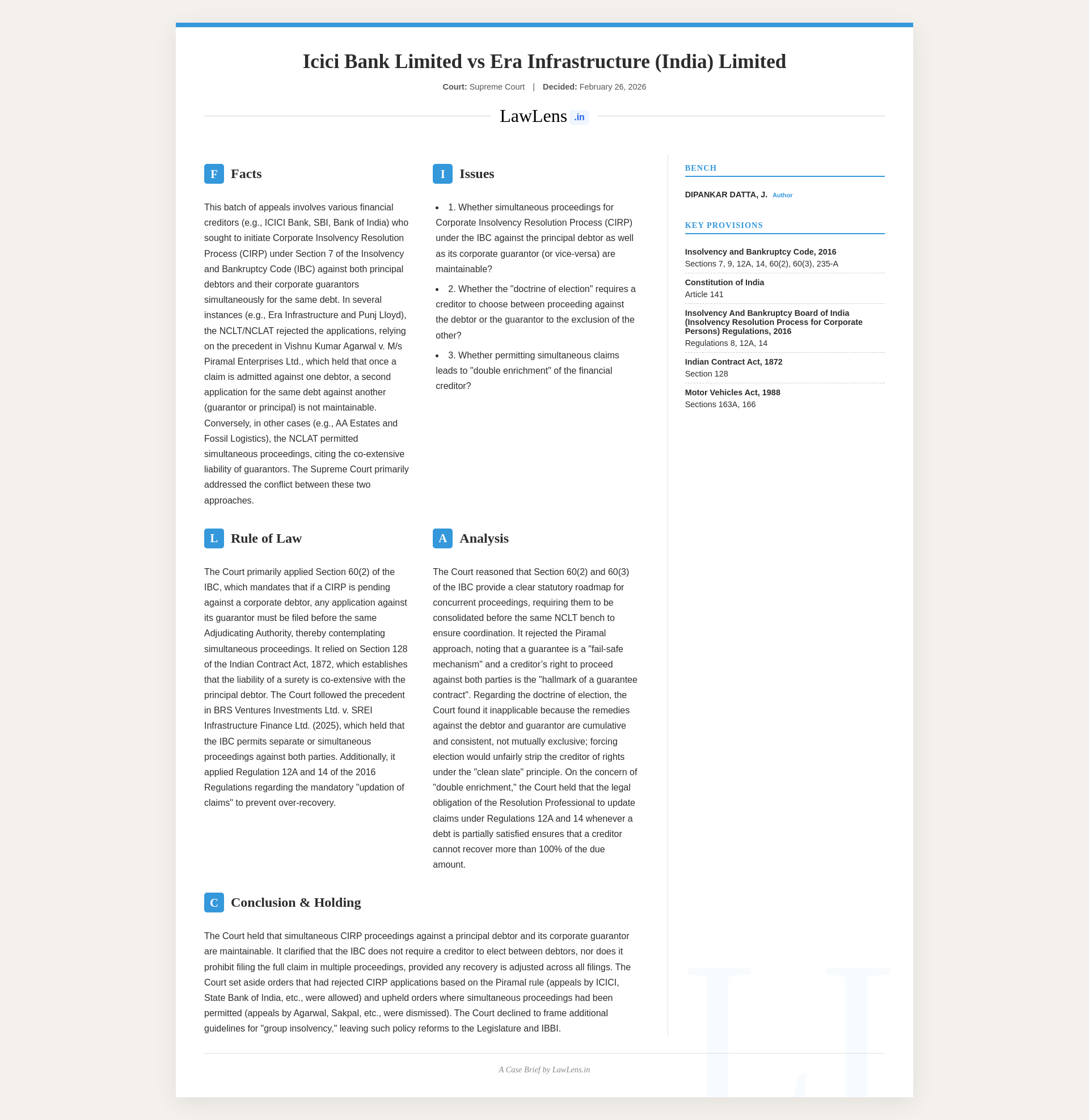
ICICI Bank Limited v. Era Infrastructure (India) Limited 2026 INSC 201 - IBC - Simultaneous Proceedings Against Corporate Debtor & Principal Guarantor

Insolvency and Bankruptcy Code 2016 - Section 7 - The liability of the principal borrower and surety is coextensive- IBC permits separate or simultaneous proceedings to be initiated under Section 7 by a financial creditor against the corporate debtor and the corporate guarantor. (Para 77-78)
Insolvency and Bankruptcy Code 2016 - Section 7 - IBC is a product of a well-thought, deliberated, and extensively researched policy framework. The rules and regulations, too, are framed thereunder after rigorous research. Furthermore, though the IBC primarily operates in the judicial and quasi-judicial arena, its effects are far reaching, often affecting banking, economy, and other sectors. (Para 104)
Insolvency and Bankruptcy Code 2016 - Section 7 ,9- The question as to whether or not an application under section 7 or section 9 should be admitted, would have to be answered upon an analysis of two major aspects, i.e., default and legally enforceable debt, i.e., debt that has fallen due- The test for admission of an application under section 7 is different from that under section 9 of the IBC, i.e., if there is a bona fide dispute as regards the debt due, an application under section 9 would not be admitted; however, presence of such dispute is inconsequential insofar as an application under section 7 is concerned. If the analysis of the aforesaid two aspects leads to affirmative results, i.e., if the records before the NCLT convincingly demonstrate default and legally enforceable debt (which is not disputed in case of operational creditor), admission would be inevitable irrespective of the motive with which the application might have been filed. (Para 71)
Insolvency and Bankruptcy Code 2016 - Section 7 ,9- The common ground provided under both section 7 as well as section 9 for lodging an application before the Adjudicating Authority (NCLT) is default only. None of the two sections bar approach to the NCLT for the purpose of recovery. (Para 70)
Interpretation of Statute - The fundamental principle of statutory interpretation: The plain language of the statute governs its express terms with all other interpretive aids, including the preamble and the secondary sources serving only to clarify, and not contradict, that meaning. In simple terms, when the words of statute are clear and unambiguous, it must be given effect to as it stands. A right created by statute cannot be restricted or taken away, except by express statutory provision or necessary implication. (Para 84)
Doctrine of Election - When election of remedies or claims is intended by the statute, such a provision must be expressly provided for. For instance, under the Motor Vehicles Act, 1988, claimants must choose between seeking compensation under Section 163A (structured formula) or Section 166 (fault-based claim), as both are alternative and not cumulative remedies. Section 163A provides no-fault liability, enabling claimants to receive compensation on a fixed formula based on the second schedule without proving negligence or wrongful conduct of the driver or owner, whereas Section 166 requires the claimant to prove negligence and just compensation is then determined as per the guidance provided by judicial decisions pronounced from time to time. (Para 92)
Quote - The Judge is not to innovate at pleasure. He is not a knight errant roaming at will in pursuit of his own ideal of beauty or of goodness.
Case Info
Basic Case Information
Case name and neutral citation:ICICI Bank Limited v. Era Infrastructure (India) Limited & Ors., 2026 INSC 201
Coram:Justice Dipankar Datta and Justice Augustine George Masih
Judgment date:26 February 2026 (New Delhi)
Key Case Laws Cited
Some of the principal precedents referred to include:
- BRS Ventures Investments Ltd. v. SREI Infrastructure Finance Ltd. & Anr., (2025) 1 SCC 456
- Eera v. State (NCT of Delhi), (2017) 15 SCC 133
- Mobilox Innovations v. Kirusa Software, (2018) 1 SCC 353
- Dena Bank v. C. Shivakumar Reddy, (2021) 10 SCC 330
- Ebix Singapore (P.) Ltd. v. Educomp Solutions Ltd. (CoC), (2022) 2 SCC 401
- HPCL Bio Fuels Ltd. v. Shahaji Bhanudas Bhad, 2024 SCC OnLine 3190
- Transmission Corpn. of A.P. Ltd. v. Equipment Conductors & Cables Ltd., (2019) 12 SCC 697
- Swiss Ribbons (P) Ltd. v. Union of India, (2019) 4 SCC 17
- Essar Steel (India) Ltd. (CoC) v. Satish Kumar Gupta, (2020) 8 SCC 531
- Innoventive Industries Ltd. v. ICICI Bank, (2018) 1 SCC 407
- Axis Bank Ltd. v. Vidarbha Industries Power Ltd., (2022) 8 SCC 352
- Ghanshyam Mishra & Sons (P) Ltd. v. Edelweiss ARC, (2021) 9 SCC 657
- State Bank of India v. V. Ramakrishnan, (2018) 17 SCC 394
- A.P. State Financial Corporation v. Gar Re-rolling Mills, (1994) 2 SCC 647
- Transcore v. Union of India, (2008) 1 SCC 125
- Maitreya Doshi v. Anand Rathi Global Finance Ltd., (2023) 17 SCC 606
- Bank of Bihar Ltd. v. Damodar Prasad, AIR 1969 SC 297
- State Bank of India v. Indexport Registered & Ors., AIR 1992 SC 1740
- Tettempudi Salalith v. SBI, (2024) 1 SCC 24
Also repeatedly discussed:
- NCLAT decision in Vishnu Kumar Agarwal v. Piramal Enterprises Ltd., 2019 SCC OnLine NCLAT 81
- NCLAT decision in SBI v. Athena Energy Ventures (P) Ltd., (2021) 226 Comp Cas 744
Main Statutes / Provisions Referred
- Insolvency and Bankruptcy Code, 2016
- Sections 3(12) (definition of “default”)
- Sections 5(8) (financial debt)
- Sections 7 and 9 (initiation of CIRP by financial/operational creditors)
- Section 12A (withdrawal of admitted CIRP)
- Section 14 (moratorium – in background discussion)
- Section 60(1)–(3) (adjudicating authority; corporate debtor and guarantor)
- Section 235A (general penalty)
- Insolvency and Bankruptcy Board of India (Insolvency Resolution Process for Corporate Persons) Regulations, 2016
- Regulation 8 and Form C (filing of financial creditor claims)
- Regulation 12A (updation of claim)
- Regulation 14 (determination and revision of amount of claim)
- Indian Contract Act, 1872
- Section 128 (co‑extensive liability of surety and principal debtor)
- Earlier insolvency / recovery framework (discussed in history section)
- Presidency Towns Insolvency Act, 1909 (repealed)
- Provincial Insolvency Act, 1920 (repealed)
- Companies Act, 1956 and Companies Act, 2013 (winding up/liquidation background)
- Sick Industrial Companies (Special Provisions) Act, 1985 (SICA)
- Recovery of Debts and Bankruptcy Act, 1993 (formerly Recovery of Debts Due to Banks and Financial Institutions Act, 1993)
- Securitisation and Reconstruction of Financial Assets and Enforcement of Security Interest Act, 2002 (SARFAESI)
- Motor Vehicles Act, 1988 (only as an example to explain election of remedies)
- Insolvency Law Committee Reports (2018 and February 2020) and IBBI policy material (for context on guarantors and concurrent proceedings)
Three‑Sentence Brief Summary
The Supreme Court holds that simultaneous CIRP proceedings can be maintained against a principal corporate debtor and its corporate guarantor for the same debt, affirming that their liabilities are co‑extensive and that the IBC (especially section 60(2)) permits such concurrent processes. It rejects the NCLAT’s restrictive view in Vishnu Kumar Agarwal v. Piramal, clarifies that there is no doctrine of election compelling a creditor to split or cap claims between debtor and guarantor, and that safeguards in the Code and Regulations (including mandatory updation of claims) prevent double recovery. Applying this, the Court allows the appeals where CIRP was wrongly refused on the Piramal reasoning, dismisses those challenging correctly admitted simultaneous proceedings, and declines to frame detailed “group insolvency” guidelines, leaving that to legislative and IBBI reform.