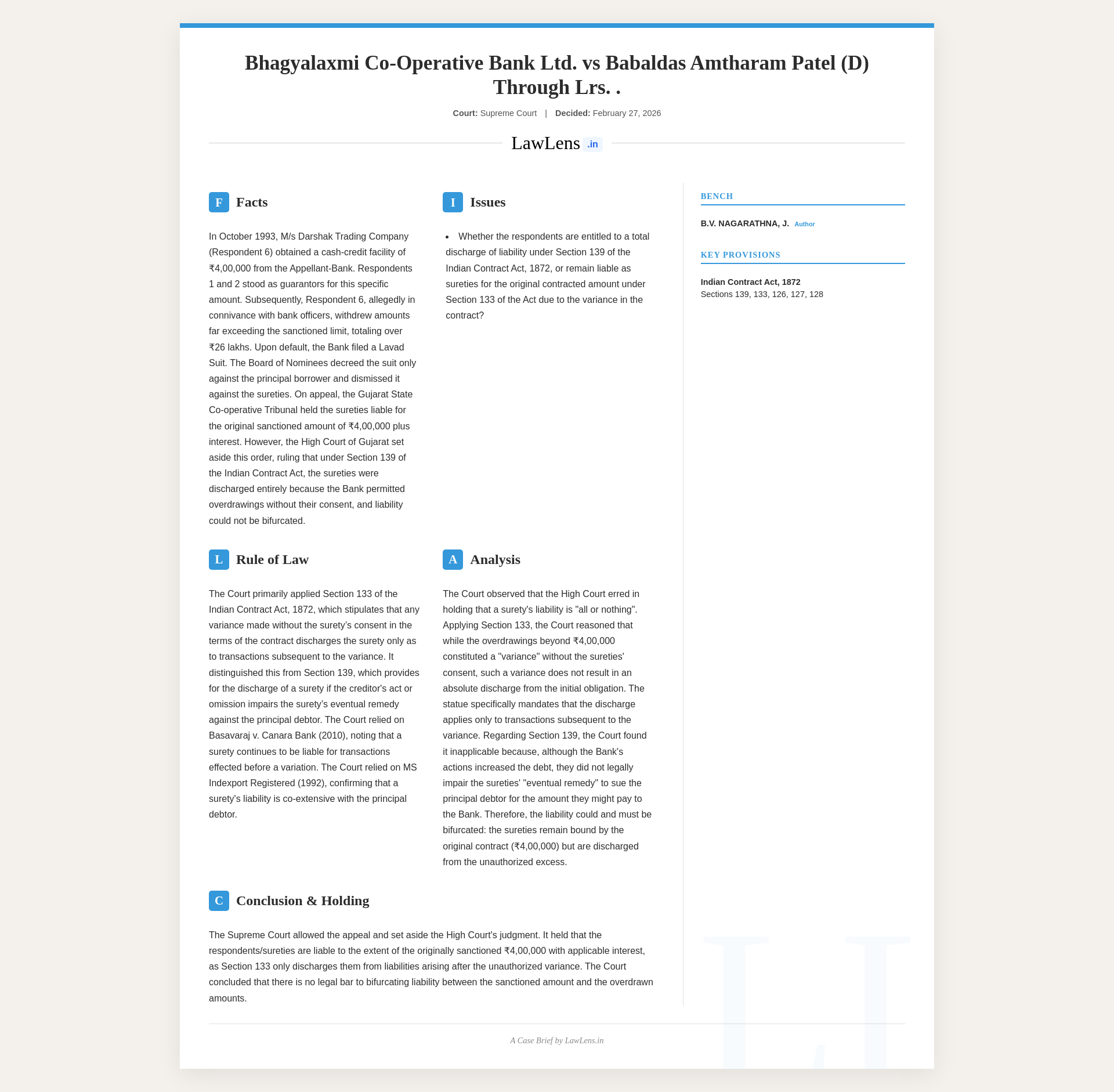
Bhagyalaxmi Co‑operative Bank Ltd. v. Babaldas Amtharam Patel (D) 2026 INSC 205 -Ss.133,139 Contract Act - Surety

You can read our notes on this judgment in our Supreme Court Daily Digests. If you are our subscriber, you should get it in our Whatsapp CaseCiter Community at about 9pm on every working day. If you are not our subscriber yet, you can register by clicking here:
Indian Contract Act 1872- Section 139 - In order to attract Section 139 of the Act, there must not only be an act inconsistent with the rights of the surety, or the omission to do an act which it is the creditor’s or employer’s duty to do, but it is essential that thereby the eventual remedy of the surety is impaired. Thus, a surety will be discharged by acts or omissions of the creditor which, though not having the legal consequences of discharging the principal, impair the eventual remedy of the surety against him. (Para 6.1) For Section 139 to apply, the creditor must (1) either act in a manner that is inconsistent with the surety’s rights or omit to act in a manner that the creditor is duty bound to and (2) such act or omission must impair the eventual remedy of the surety as against the principal debtor- No bar can be placed on the creditor so as to restrict their ability to recover the amounts owed from the sureties before proceeding as against the principal debtor. (Para 7.1)
Indian Contract Act 1872- Section 133 - Under Section 133 of the Act, any modification of the contract between the creditor and the principal debtor, that 21 has been made without the consent of the sureties, cannot subsequently bind them. Critically, however, a plain reading of the said provision reveals that such discharge of the surety is not absolute in nature. The surety is discharged only in respect of transactions that occurred subsequent to the variance of the terms of the contract. (Para 7)
Case Info
Case Information
Case name and neutral citation:Bhagyalaxmi Co‑operative Bank Ltd. v. Babaldas Amtharam Patel (D) through LRs & Others, 2026 INSC 205
Coram:Justice B.V. Nagarathna and Justice Ujjal Bhuyan
Judgment date:27 February 2026 (New Delhi)
Case laws and citations referred
- Radha Kanta Pal v. United Bank of India Ltd., AIR 1955 Cal 217
- Bishwanath Agarwala v. State Bank of India, AIR 2005 Jhar 69
- State Bank of India v. M/s Indexport Registered, (1992) 3 SCC 159
- Syndicate Bank v. Channaveerappa Beleri, (2006) 11 SCC 506
- H.R. Basavaraj (Dead) by his LRs v. Canara Bank, (2010) 12 SCC 458
- T. Raju Setty v. Bank of Baroda, AIR 1992 Kar 108
- State of Maharashtra v. Dr. M.N. Kaul (D) by his LRs, AIR 1967 SC 1634
- Pirthi Singh v. Ram Charan Aggarwal, AIR 1944 Lah 428
- Bhagwan Das v. M. Ghulam Mahommad, AIR 1935 Lah 863
- Ram Prasad v. Gordhan, AIR 1934 All 616
- Jose Inacio Lourence v. Syndicate Bank, (1989) 65 Comp Cas 698
- Probodh Kumar Das v. Gillanders Arbuthnot & Co., AIR 1934 Cal 699
- Calvert v. London Dock Co., (1838) 2 Keen 638
- Bonar v. Macdonald, (1850) 3 HLC 226
(Chitty on Contracts and Pollock & Mulla on the Indian Contract & Specific Relief Acts are also cited as secondary authorities.)
Statutes / laws referred
The judgment primarily interprets provisions of the Indian Contract Act, 1872, particularly:
- Section 126 – Contract of guarantee, surety, principal‑debtor and creditor
- Section 127 – Consideration for guarantee
- Section 128 – Surety’s liability (co‑extensive with that of principal‑debtor)
- Section 133 – Discharge of surety by variance in terms of contract
- Section 139 – Discharge of surety by creditor’s act or omission impairing surety’s eventual remedy
Brief summary (three sentences)
The borrower obtained a cash‑credit facility of Rs. 4,00,000 from the appellant bank, for which respondents 1 and 2 stood as sureties, but the bank later allowed the borrower to overdraw far beyond the sanctioned limit. The Supreme Court held that under Section 133 of the Contract Act, the sureties are discharged only for transactions subsequent to the unauthorised variance (i.e., the excess overdrawing) and remain liable for the originally sanctioned Rs. 4,00,000 with applicable interest, rejecting the High Court’s view that they must be liable for the entire amount or not at all. It further held that Section 139 was not attracted because, although the bank’s conduct affected the sureties’ rights in respect of the excess, their eventual remedy against the principal debtor was not impaired.