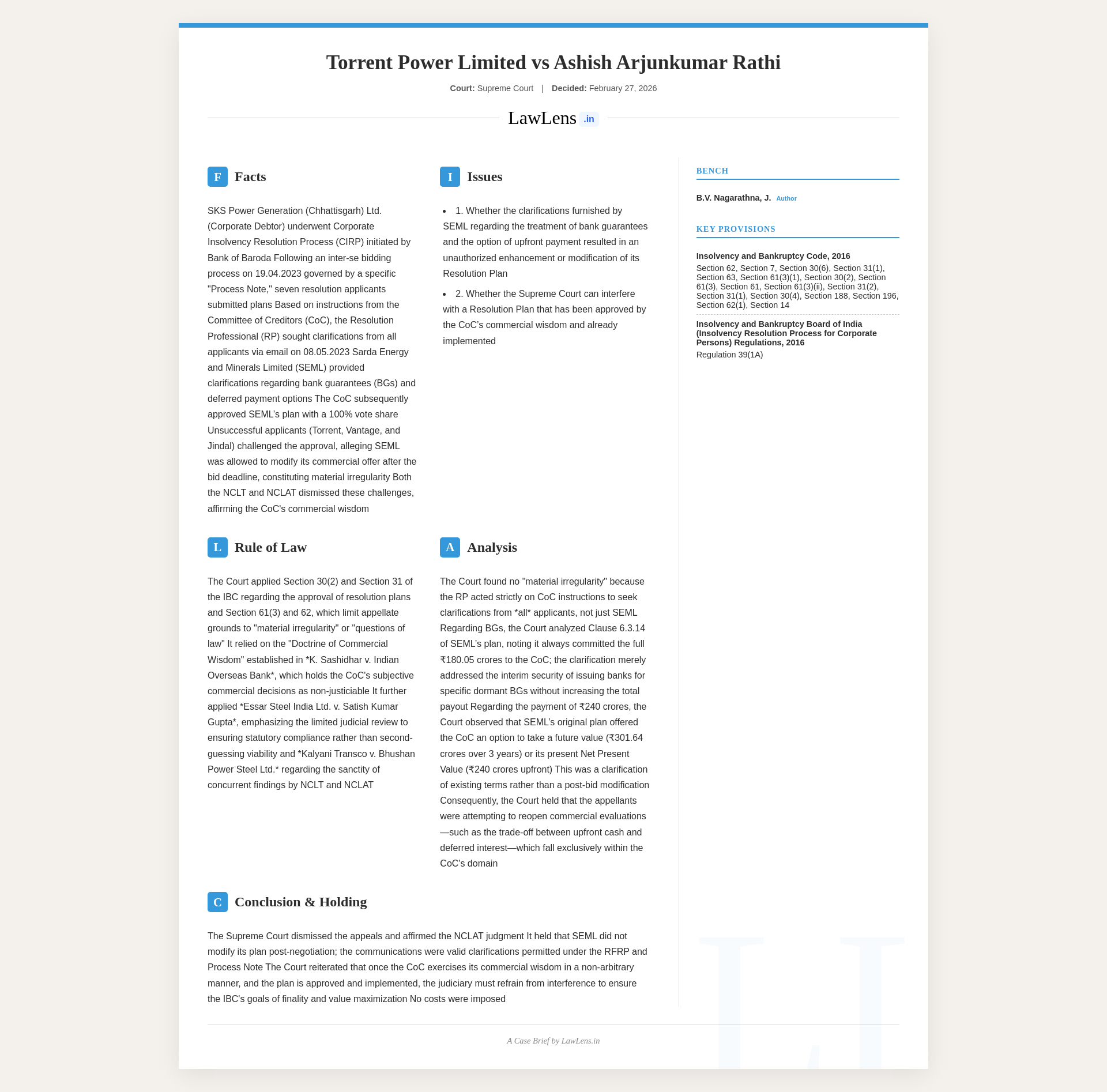
Torrent Power Ltd. v. Ashish Arjunkumar Rathi 2026 INSC 206 - IBC - Commercial Wisdom - CoC
"Commercial wisdom of the CoC enjoys primacy and cannot be supplanted by judicial review.."

Insolvency and Bankruptcy Code, 2016 (IBC) - Section 30, 61,62 -Commercial wisdom of the CoC enjoys primacy and cannot be supplanted by judicial review -The commercial wisdom of the CoC cannot be interfered with by the NCLT, the NCLAT or Supreme Court (Para 12.1-5) Where the RP acts on the instructions of the CoC, such conduct cannot, by any stretch of imagination, be characterised as a “material irregularity” within the meaning of Section 61(3)(ii). To hold otherwise would be to conflate the statutorily distinct roles of the RP and the CoC and to indirectly subject decisions of the CoC to judicial review, contrary to the scheme of the IBC. (Para 8.1)
Insolvency and Bankruptcy Code, 2016 (IBC) - Section 62 - When a concurrent view has been taken by two adjudicating authorities, unless it is found that such a view was in ignorance of the mandatory statutory provisions or was based on irrelevant considerations or was ex-facie arbitrary or perverse, an interference would not be permissible- Predictability and finality are thus essential to maintaining a robust insolvency regime. (Para 8.3)
Insolvency and Bankruptcy Code, 2016 (IBC) - Section 30,61 - Judicial intervention beyond the narrow statutory confines undermines both predictability and finality. Recognising this, the IBC deliberately confines judicial review to strict statutory compliance under Sections 30(2) and 61(3). Respecting these limits will preserve the economic sense of the IBC and ensure that insolvency remains a predictable, time-bound, and market-driven process.
Case Info
Case name and neutral citation
Torrent Power Ltd. v. Ashish Arjunkumar Rathi & Others, 2026 INSC 206
Coram
Justice B.V. Nagarathna and Justice R. Mahadevan
Judgment date
27 February 2026 (New Delhi)
Key case laws cited (with citations)
- Committee of Creditors of Essar Steel India Limited v. Satish Kumar Gupta, (2020) 8 SCC 531
- K. Sashidhar v. Indian Overseas Bank, (2019) 12 SCC 150
- Kalparaj Dharamshi v. Kotak Investment Advisors Ltd., (2021) 10 SCC 401
- Kalyani Transco v. Bhushan Power & Steel Ltd., 2025 SCC OnLine SC 2093
- Pratap Technocrats Private Ltd. v. Monitoring Committee of Reliance Infratel Limited, (2021) 10 SCC 623
- Swiss Ribbons Private Ltd. v. Union of India, (2019) 4 SCC 17
Statutes / laws referred
The principal statute is the Insolvency and Bankruptcy Code, 2016 (IBC), including in particular:
- Section 7 (initiation of CIRP by financial creditor)
- Section 30(2) and Section 30(6) (requirements and approval of resolution plan)
- Section 31(1)–(2) (approval of resolution plan by NCLT)
- Section 39(1A) of the CIRP Regulations, 2016 (negotiation process)
- Section 61(3) (grounds of appeal to NCLAT against approval of resolution plan)
- Section 62 (appeal to Supreme Court on question of law)Other references:
- Insolvency and Bankruptcy Board of India (Insolvency Resolution Process for Corporate Persons) Regulations, 2016
- Request for Resolution Plan (RFRP), Process Note, Form‑G and related CIRP instruments.
Three‑sentence brief summary
The Supreme Court dismissed appeals by unsuccessful resolution applicants (Torrent, Vantage, Jindal) challenging approval of Sarda Energy and Minerals Ltd.’s resolution plan for SKS Power Generation (Chhattisgarh) Ltd., holding that their grievances did not fit any ground under Section 61(3) IBC and raised no question of law under Section 62. The Court found that the so‑called “post‑bid” clarifications on bank guarantees and the Rs. 240 crore deferred/upfront component did not modify or enhance SEML’s offer, that the Resolution Professional had only acted on the Committee of Creditors’ instructions, and that there was no “material irregularity.” Emphasising the primacy of the CoC’s commercial wisdom, the concurrent findings of NCLT and NCLAT, and the need for speed, predictability and finality in the IBC regime, the Court affirmed the NCLAT judgment and cautioned against strategic litigation by unsuccessful bidders seeking to re‑open commercial decisions through courts.