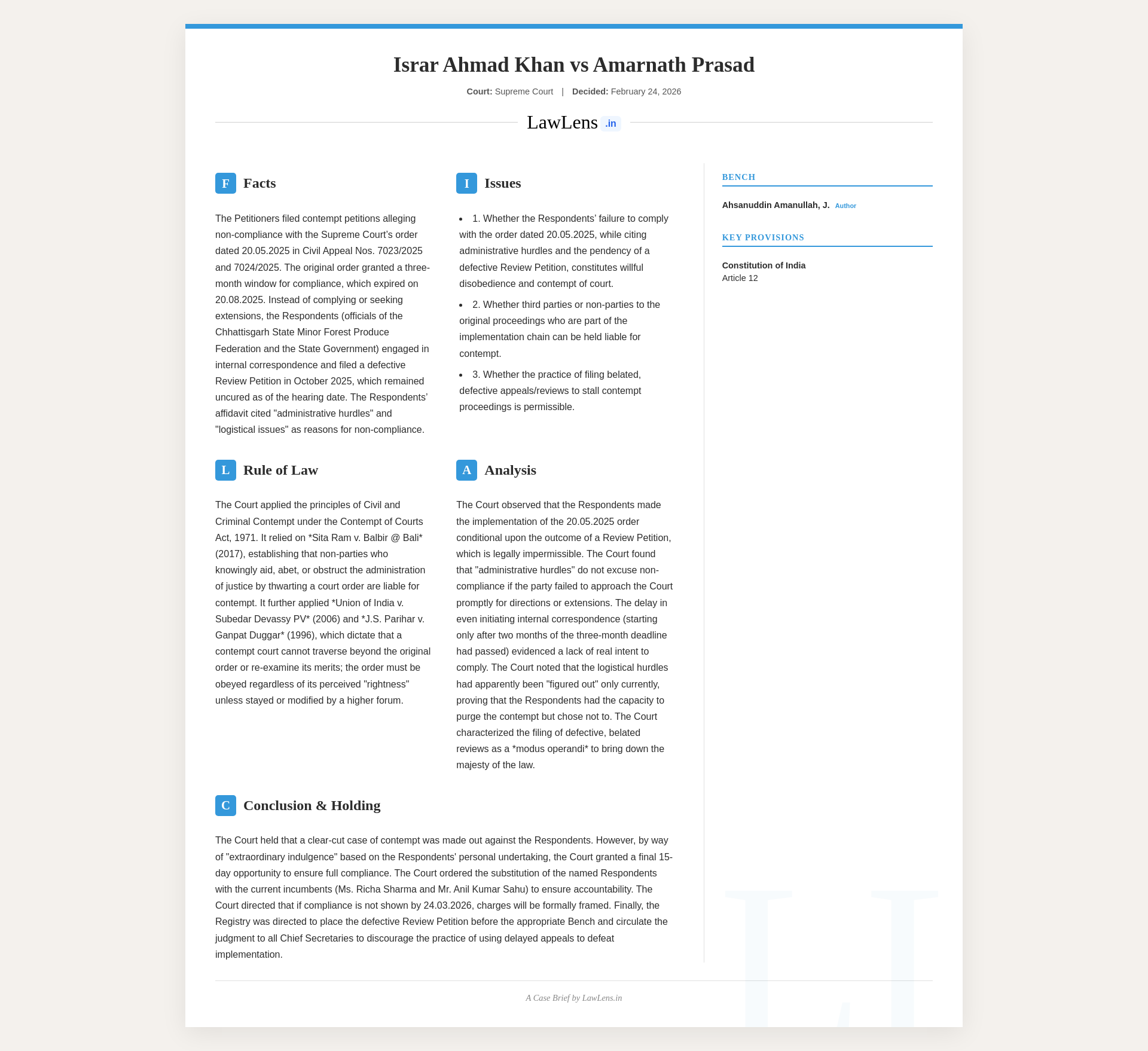
Israr Ahmad Khan v. Amarnath Prasad 2026 INSC 209 - Contempt - Third Parties - Belated Filing Of Appeals

Contempt of Court -How third-parties/non-parties to the original proceedings can also be proceeded against for contempt? A party, once becomes or is made aware of an Order of this Court, if yet acts in wilful default or deliberate non-compliance or any such like conduct against/in breach of the Order concerned, makes itself liable to face the full wrath of Contempt Jurisdiction. (Para 21-23)
Contempt of Court - When in seisin of a contempt application, the question before the Court is only whether or not the decision, of which contempt is alleged- Belated/Delayed Appeals To Delay/Defeat Implementation - Practice Deprecated-By such modus operandi, disobedient litigants act brazenly which has the further effect of bringing down the authority and majesty of the Courts and the rule of law, interfering in the administration of justice. The same may well, in certain situations, border on criminal contempt - The High Courts should deal with such unscrupulous litigants, moreso when they happen to be ‘State’, within the meaning of Article 12 of the Constitution, or like bodies, with an iron hand. Unless the High Courts, so also this Court deal with these aspects firmly, we run the clear risk of erosion of the unflinching faith that the ordinary litigants of this country repose in the Judiciary at all levels. It is the solemn duty of all of us manning the Courts across the hierarchy to ensure that the public faith never wavers. (Para 27-30)
Case Info
Case Information
Case name and neutral citation:Israr Ahmad Khan v. Amarnath Prasad & Ors. with Md. Hanif v. Amarnath Prasad & Ors., 2026 INSC 209
Coram:Hon’ble Mr. Justice Ahsanuddin Amanullah and Hon’ble Mr. Justice R. Mahadevan
Judgment date:24 February 2026 (NEW DELHI)
Jurisdiction / type of matter:Supreme Court of India – Extraordinary and Inherent Contempt JurisdictionContempt Petition (Civil) No. 5/2026 in C.A. No. 7023/2025Contempt Petition (Civil) No. 6/2026 in C.A. No. 7024/2025
Case laws and citations referred
- Sita Ram v. Balbir @ Bali, (2017) 2 SCC 463
- Seaward v. Paterson, (1895–99) All ER Rep 1127 : (1897) 1 Ch 545 (CA)
- Z Ltd. v. A‑Z and AA‑LL, (1982) 1 All ER 556 : 1982 QB 558 : (1982) 2 WLR 288 (CA)
- Attorney General v. Times Newspapers Ltd., (1991) 2 All ER 398 : (1992) 1 AC 191 : (1991) 2 WLR 994 (HL)
- Union of India v. Subedar Devassy P.V., (2006) 1 SCC 613
- K.G. Derasari v. Union of India, (2001) 10 SCC 496 : 2002 SCC (L&S) 756
- Niaz Mohd. v. State of Haryana, (1994) 6 SCC 332 (distinguished)
- J.S. Parihar v. Ganpat Duggar, (1996) 6 SCC 291
- Snehasis Giri v. Subhasis Mitra, (2023) 18 SCC 529
Statutes / legal provisions referred or implicated
The judgment is framed in contempt jurisdiction and proceeds on principles of:
- Contempt of Courts (civil and criminal contempt concepts, though the Contempt of Courts Act, 1971 is not cited by section number, its scheme clearly underlies the reasoning).
- Article 129 and Article 142 of the Constitution are not expressly named in the extract but are implicitly the source of the Supreme Court’s contempt and enforcement powers.
- Reference to “State” within the meaning of Article 12 of the Constitution of India (in para 30, while discussing the State and like bodies as litigants).
No specific statutory section (like CPC, CrPC, or a particular service statute) is quoted in the text provided; the focus is entirely on contempt doctrine and constitutional obligations to obey Supreme Court orders.
Brief summary in three sentences
The Supreme Court found a clear, wilful non‑compliance with its earlier order dated 20.05.2025 in Civil Appeals No. 7023/2025 and 7024/2025, criticising the Chhattisgarh authorities and federation officers for offering only excuses, delaying action, and improperly treating a defective review petition as a ground to withhold obedience. Relying on precedents such as Sita Ram v. Balbir and Union of India v. Subedar Devassy P.V., the Court reiterated that contempt proceedings are confined to examining compliance, that even non‑parties who, knowing of the order, aid or perpetuate disobedience can be held liable, and that the correctness of the original judgment cannot be re‑argued in contempt. While holding that charges could justifiably be framed, the Court granted a last and final 15‑day opportunity to purge the contempt by full compliance, directed substitution/impleadment of the actual responsible officers, issued procedural directions regarding the pending review, and strongly deprecated the growing practice of filing delayed appeals or reviews merely to stall enforcement of court orders.