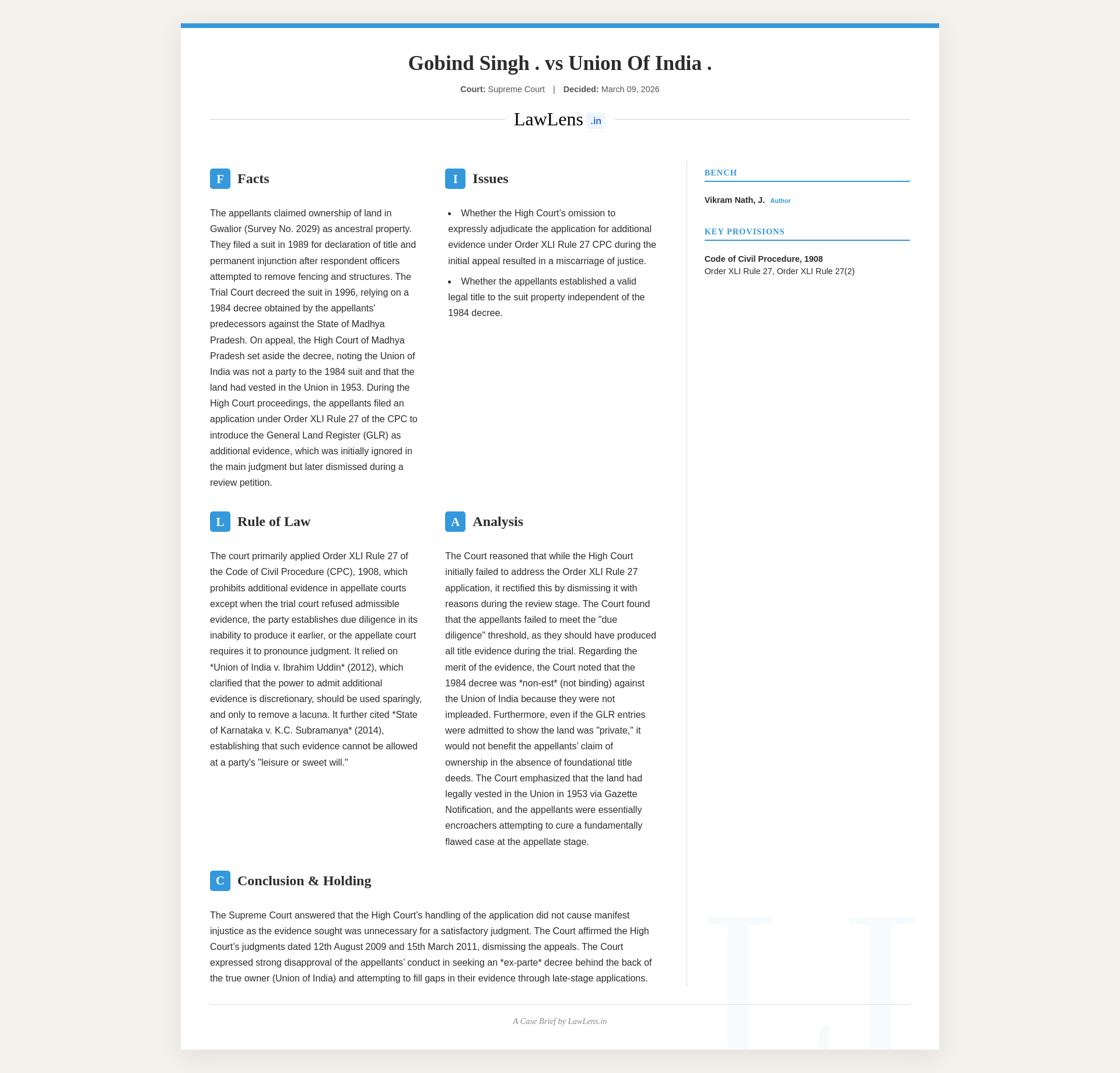
Gobind Singh vs Union of India 2026 INSC 211 -Order XLI Rule 27 CPC

Code of Civil Procedure 1908 - Order XLI Rule 27 - The appellate court’s inquiry, while considering an application for leading additional evidence, is confined to examining whether such evidence is necessary to remove a lacuna in the case. More importantly, the appellate court may permit additional evidence only upon being satisfied that the conditions expressly stipulated under Order XLI Rule 27 of CPC are fulfilled. The parties do not possess any vested or automatic right to seek admission of additional evidence at the appellate stage -unless the requirements stipulated under Order XLI Rule 27 of CPC are strictly satisfied, a party cannot be permitted to adduce additional evidence at the appellate stage. Such permission cannot be granted as a matter of course, nor can additional evidence be introduced at the whim or convenience of a litigating party- Where the appellate court permits additional evidence to be adduced, Order XLI Rule 27(2) of CPC casts a mandatory obligation upon the court to record the reasons for such admission. (Para 11)
General Land Register - Mere recording of the land in suit as private land in the GLR does not in any manner benefit the claim of ownership. (Para 11.11)
Case Info
Basic Case Information
Case name: Gobind Singh and Others v. Union of India and Others
Neutral citation: 2026 INSC 211
Coram:Justice Vikram NathJustice Sandeep Mehta
Judgment date: 09 March 2026 (New Delhi)
Caselaws and Citations Referred
The judgment expressly refers to and relies on:
- Union of India v. Ibrahim Uddin, (2012) 8 SCC 148 – on the scope and limits of additional evidence under Order XLI Rule 27 CPC.
- State of Karnataka v. K.C. Subramanya, (2014) 13 SCC 468 – reiterating that additional evidence at appellate stage is permissible only when the strict preconditions of Order XLI Rule 27 CPC are met.
Statutes / Laws Referred
The Court primarily refers to procedural and substantive civil law principles, including:
- Code of Civil Procedure, 1908 (CPC)
- Order XLI Rule 27 CPC – production of additional evidence in the Appellate Court (quoted and analysed in detail).
- General principles of declaratory suits and burden of proof for title, and law of adverse possession against the State/Union, i.e., that perfection of rights by adverse possession cannot be claimed in the manner attempted by the plaintiffs against the Union/State on the facts of this case.
Three‑Sentence Brief Summary
The appellants claimed declaration of title and injunction over land in Morar Cantonment, Gwalior, based on long possession and an earlier ex parte decree obtained against the State, and sought to file additional evidence (General Land Register entries) at the appellate stage. The Supreme Court held that the earlier decree was not binding on the Union of India, the appellants had failed to prove an independent title or a legally sustainable plea of adverse possession, and their attempt to introduce additional evidence under Order XLI Rule 27 CPC did not satisfy the strict statutory conditions. Affirming the Madhya Pradesh High Court’s judgments and criticising the appellants’ conduct as unscrupulous, the Court dismissed the appeals and upheld the dismissal of the suit.