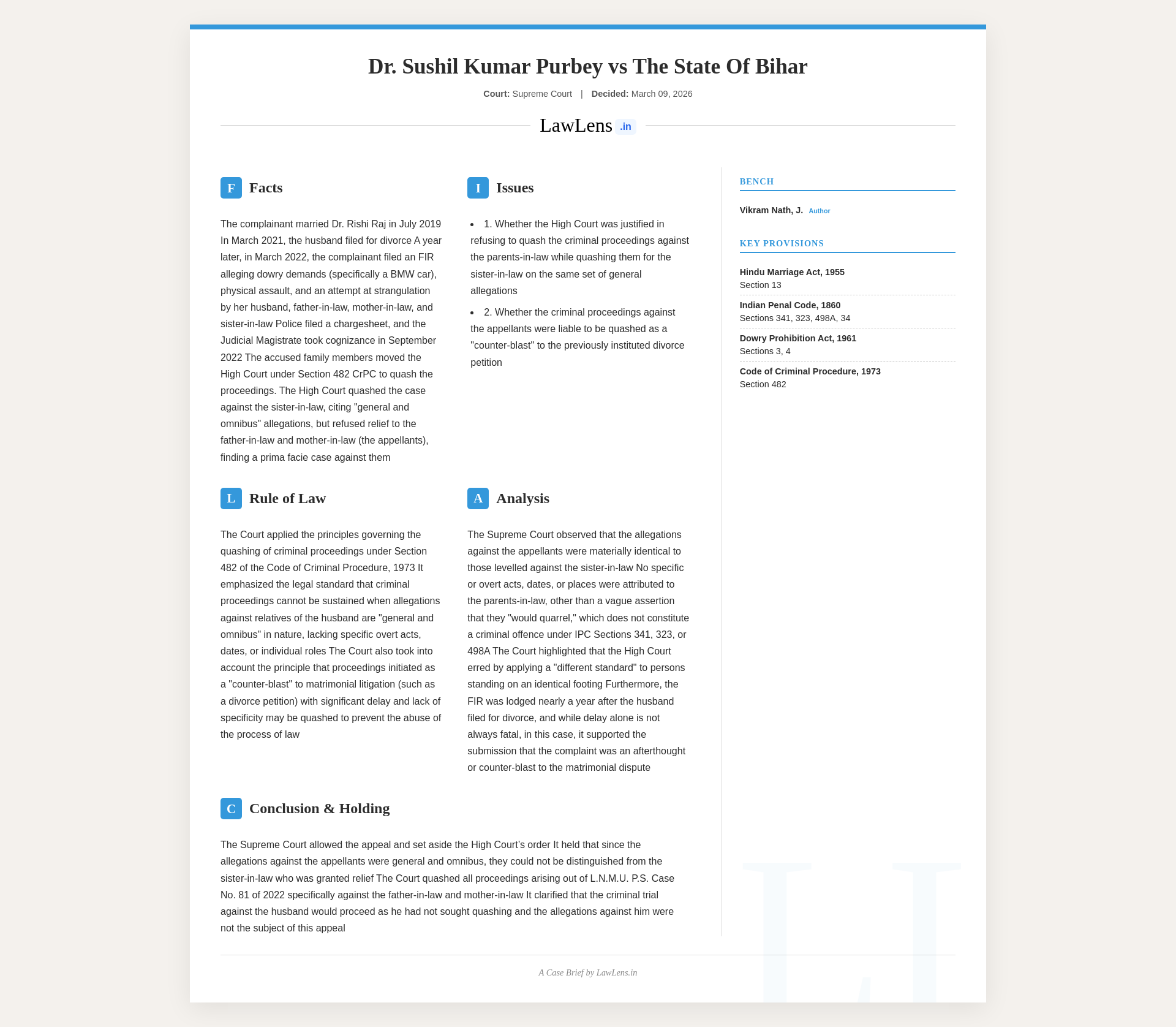
Sushil Kumar Purbey v. State of Bihar 2026 INSC 212 - S.498A IPC - Dowry Prohibition Act -Parents-In-Law

Indian Penal Code, 1860 - Section 498A ; Dowry Prohibition Act, 1961 - Code of Criminal Procedure 1973 - Section 482- While quashing criminal proceedings against parents in law, SC noted: the marriage was solemnised in July 2019, and the husband filed the divorce petition as early as March 2021. The criminal complaint against the appellants was, however, lodged only in March 2022, nearly a year after the filing of the divorce petition. Though this delay, standing alone, would not constitute a sufficient ground for quashing the criminal proceedings against the appellants. However, viewed in conjunction with the absence of any specific allegations attributable to them, the delay lends credence to the submission that the criminal complaint against the in-laws may have been instituted by way of a counter-blast to the divorce proceedings initiated by the husband. When these two considerations are read together, we are satisfied that the continuation of the criminal proceedings against the present appellants cannot be sustained. (Para 8)
Case Info
Basic Case Details
Case name: Dr. Sushil Kumar Purbey & Anr. v. The State of Bihar and Ors.Neutral citation: 2026 INSC 212Court: Supreme Court of India, Criminal Appellate JurisdictionCoram: Justice Vikram Nath and Justice Sandeep MehtaJudgment date: 09 March 2026 (New Delhi)
Statutes / Laws Referred
The judgment refers to and proceeds under:
- Section 13 of the Hindu Marriage Act, 1955 (divorce petition filed by husband)
- Sections 341, 323, 498A and 34 of the Indian Penal Code, 1860
- Sections 3 and 4 of the Dowry Prohibition Act, 1961
- Section 482 of the Code of Criminal Procedure, 1973
Case Laws and Citations
The extracted text you’ve provided does not show any cited precedents or case law by name; it is a fact‑based application of settled principles on quashing (general/omnibus allegations against in‑laws). If you need the specific precedents discussed, they are not visible in this portion and would have to be checked against the full official PDF or report version.
Three‑Sentence Brief Summary
The complainant, after her husband filed a divorce petition, lodged an FIR and complaint alleging cruelty and dowry demands against her husband, parents‑in‑law (the appellants), and sister‑in‑law. The High Court quashed proceedings only against the sister‑in‑law on the ground that allegations against her were general and omnibus, but refused similar relief to the parents‑in‑law. The Supreme Court held that the allegations against the parents‑in‑law were materially identical, found no specific overt acts attributed to them and noted the timing of the complaint vis‑à‑vis the divorce, and therefore quashed the criminal proceedings against them while leaving the case against the husband to continue.