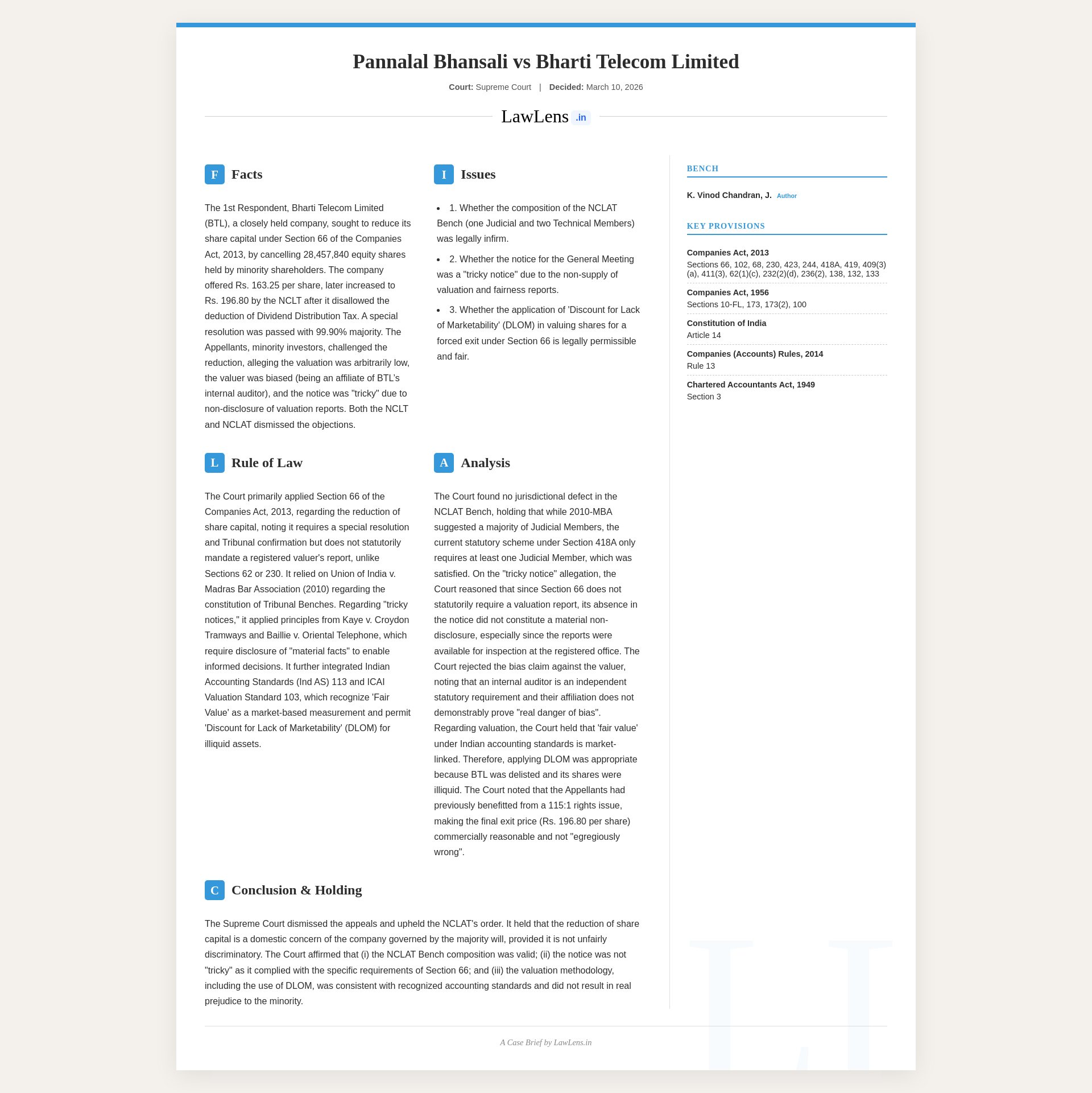
Pannalal Bhansali v. Bharti Telecom Limited 2026 INSC 213- Companies Act - NCLT/NCLAT Composition
Supreme Court Clarifies On Practice of a majority of Technical Members sitting in a Bench of the NCLT or the NCLAT

Companies Act 2013 - Practice of a majority of Technical Members sitting in a Bench of the NCLT or the NCLAT - The provisions as of now do not require a majority of Judicial Members in the Larger Benches of the NCLT or the NCLAT - As of now, the Companies Act permits a Single Bench to sit only in the NCLT and that too a Bench of a Judicial Member. The NCLAT as provided in Section 418A always comprises of two Members, one of whom is a Judicial Member or such larger composition where the prescription is only of the presence of a Member from the Judicial side and not in the majority- All adjudicators first and foremost are or should be reasonable persons having resolute minds and unbiased views. Though judicial experience is valuable, administrative officers and technocrats; to whom judicious consideration is not alien in their long tenures of service dealing also with quasi-judicial matters, statutory appeals and the like, when permitted by the legislature to be included as Tribunal Members to aid, assist and promote a holistic adjudication of disputes and interpretation of laws, having administrative and technical ramifications, we cannot after permitting them to sit sideby-side treat them or their capabilities, with disdain or label them lower in status or in quality. (Para 16-21)
Companies Act 2013 - Section 423- When NCLT & NCLAT have recorded concurrent findings it is not for this Court to reappreciate evidence in the usual course. However, we are obliged to look into the question of whether there is any perversity in the findings, which it is trite is one of law. (Para 29)
Internal Auditor - Appointment as an internal auditor, does not bring in a bias with respect to the activities of the company which would essentially go against the scope and spirit of an audit carried out of the accounts of the company as an inhouse verification, which is also a statutory requirement, available for scrutiny before a statutory auditor. bias should be demonstrably real and present to vitiate an action. Where it is shown that there exists a real danger of bias the action would attract judicial chastisement while, if it is only a mere probability or even a preponderance of probability it cannot affect the action adversely. (Para 34)
Companies Act 2013 - Reduction of share capital- (i) reduction of share capital is a strictly domestic concern depending on the decision of the majority, (ii) if reduction of share capital is approved by a special resolution, the majority also has the right to decide how it should be carried out, (iii) reduction of share capital can be brought about by extinguishing some of the shares while retaining others even in the same class or making a proportionate reduction for all or even for some, while for others it is totally extinguished. The reduction thus can be in any manner and even if it is selective it is permissible. (Para 42)
Companies Act 2013 - Resolution - Abstention - In a democratic set up where the will of the majority reigns supreme, the abstainers are deemed to have left the choice to those who vote and they acquiesce to the majority will of those present and voting in the extraordinary general meeting. (Para 43)
Companies Act 2013 - Valuation - Unless the valuation is especially unreasonable it would be a wrong approach to reject a plausible rationale provided by the valuer on the mere ground that the objector has a different point of view. The test insofar as considering a sanction is as to whether (i) a fair and reasonable value was offered to the minority shareholders? (ii) The majority of the non-promoter shareholders have voted in favour of the resolution? (iii) the resolution read by any fair-minded and reasonable person, without microscopic scrutiny, finds it to be egregiously wrong offending the judicial conscience? (iii) the valuer has gone so off-track that the result of valuation return can only be wrong? (Para 48)
Case Info
Basic Case Information
- Case name: Pannalal Bhansali v. Bharti Telecom Limited & Ors. (with connected civil appeals)
- Neutral citation: 2026 INSC 213
- Court & jurisdiction: Supreme Court of India, Civil Appellate Jurisdiction
- Coram: K. Vinod Chandran, J. and Sanjay Kumar, J.
- Judgment date: 10 March 2026
Statutes / Laws Referred
From the judgment text, the key provisions and statutes referred include:
- Companies Act, 2013
- Section 66 – Reduction of share capital
- Section 68 – Buy-back of securities
- Section 102 – Explanatory statement to be annexed to notice calling general meeting
- Section 133 – Accounting standards
- Section 138 – Internal audit
- Section 230 – Compromises and arrangements with creditors and members
- Section 232 – Merger and amalgamation
- Section 236 – Purchase of minority shareholding
- Section 244 – Right to apply under oppression and mismanagement
- Sections 418A, 419, 423 – Benches of NCLAT/NCLT and appeal to Supreme Court
- Companies Act, 1956
- Section 173 – Explanatory statement for special business
- Section 100 – Reduction of share capital (analogous to present s.66)
- Chartered Accountants Act, 1949 – Section 3 (constitution of ICAI)
- Special Court (Trial of Offences relating to Transactions in Securities) Act, 1992 – relating to the Custodian
- Constitution of India – Article 14 (in the discussion of tribunal composition and equality before law)
The judgment also relies on Indian Accounting Standards (Ind AS 113) and ICAI Valuation Standard 103regarding fair value and Discount for Lack of Marketability (DLOM).
Caselaws and Citations Mentioned
Indian Supreme Court decisions:
- Union of India v. Madras Bar Association, (2010) 11 SCC 1 – “2010‑MBA” (tribunal composition and judicial/technical members)
- Madras Bar Association v. Union of India, (2015) 8 SCC 583 – “2015‑MBA” (NCLT/NCLAT qualifications and selection)
- State of M.P. v. B.R. Thakare, (2002) 10 SCC 338 – on jurisdictional defect and single-member benches
- LIC v. Escorts Ltd., (1986) 1 SCC 264 – shareholder rights and explanatory statements
- Claude‑Lila Parulekar v. Sakal Papers (P) Ltd., (2005) 11 SCC 73 – need for clear disclosure of special business in notices
- N.K. Bajpai v. Union of India, (2012) 4 SCC 653 – standard for “real danger of bias”
- Devas Multimedia (P) Ltd. v. Antrix Corpn. Ltd., (2023) 1 SCC 216 – limits of Supreme Court’s power under s.423 (no re‑appreciation of evidence)
- Mihir H. Mafatlal v. Mafatlal Industries Ltd., (1997) 1 SCC 579 – courts generally defer to expert valuation in schemes
Indian High Court decisions:
- In Re: Reckitt Benckiser (India) Ltd., 2005 SCC OnLine Del 674 – principles on reduction of share capital
- In Re: Cadbury India Limited, 2014 SCC OnLine Bom 4934 – fairness standard and prejudice in capital reduction
- Firestone Tyre & Rubber Co. v. Synthetics and Chemicals Ltd., (1971) Comp Cas 377 (Bom) – on practicality of inspection at registered office
Foreign / common law authorities:
- Foss v. Harbottle, 67 ER 189 – “proper plaintiff” rule and exceptions (including tricky notices)
- Kaye v. Croydon Tramways Co. Ltd., [1898] 1 Ch 358 – origin of “tricky notice” concept
- Baillie v. Oriental Telephone and Electric Co. Ltd., [1915] 1 Ch 503 – inadequate disclosure and tricky notice
- State of West Bengal v. Anwar Ali Sarkar, AIR 1952 SC 75 – cited for Article 14 equality reasoning (quoted in 2010‑MBA discussion)
- British and American Trustee and Finance Corporation v. Couper, (1894) SC 399 – nature of capital reduction as domestic concern
- Kiri Industries Ltd. v. Senda International Capital Ltd., [2022] SGCA(I) 5 (Singapore Court of Appeal) – DLOM in oppression/buy‑out context
- Thio Syn Kym Wendy v. Thio Syn Pyn, [2018] SGHC 54 – DLOM for privately held shares
- Liew Kit Fah v. Koh Keng Chew, [2020] 1 SLR 275 – DLOM in Singapore oppression jurisprudence
The judgment also refers to academic work: Douglas K. Moll, “Shareholder Oppression and ‘Fair Value’: Of Discounts, Dates and Dastardly Deeds in Close Corporations”, 54 Duke L.J. 293 (2004).
Three‑Sentence Brief Summary
The Supreme Court upheld Bharti Telecom Limited’s scheme under Section 66 of the Companies Act, 2013 to reduce its share capital by compulsorily purchasing and cancelling minority shareholders’ equity at Rs.196.80 per share, rejecting challenges to the manner, method and matter of valuation. It held that Section 66 does not mandate a formal valuation report, that using a valuer affiliated with the internal auditor and applying a Discount for Lack of Marketability were permissible given the unlisted, illiquid nature of the company’s shares and the safeguards of shareholder approval and NCLT/NCLAT scrutiny. Finding no “tricky notice”, no real prejudice or oppression, and no perversity in the concurrent factual findings below, the Court dismissed the appeals and declined to interfere with the capital reduction.