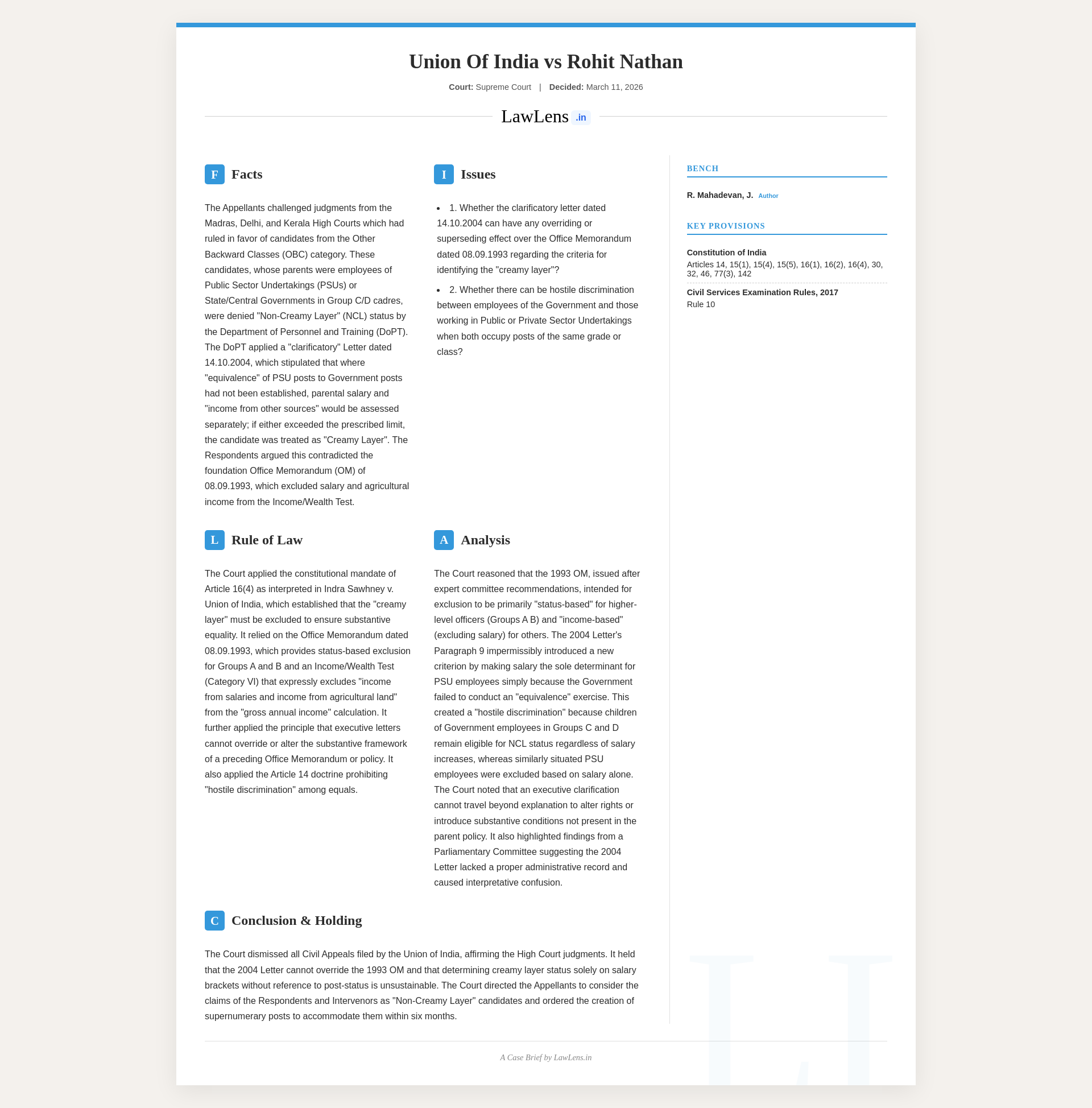
Union of India v. Rohith Nathan 2026 INSC 230 - UPSC -Reservation - Creamy Layer- Income
"While caste may be an indicator of historical disadvantage, it cannot be treated as the sole determinant of backwardness. "

Constitution of India - Article 15 - DoPT OM No. 36012/22/93-Estt.(SCT) -Determination of creamy layer status solely on the basis of income brackets, without reference to the categories of posts and status parameters enunciated in the 1993 OM is clearly unsustainable in law - income from salaries alone cannot be the sole criterion to decide whether a candidate falls within the creamy layer. The status as well as the category of post to which a candidate’s parent or parents belong is essential. The exclusion under Categories I to III of the Schedule is status-based rather than purely income-based, reflecting the policy understanding that advancement within the governmental service hierarchy denotes social progression independent of fluctuating salary levels. Mere determination of the status of a candidate as to whether he/she falls within the creamy layer or the non-creamy layer of the OBCs cannot be decided solely on the basis of the income. (Para 26,31) Any interpretation of the 1993 OM or the 2004 Letter that results in unequal treatment of similarly placed OBC candidates would not only be legally erroneous but constitutionally impermissible. [Context: Supreme Court upheld that the reasoning adopted by the High Court that treating similarly placed employees of private entities and PSUs differently from Government employees and their wards, while deciding their entitlement to reservation, would amount to hostile discrimination]
Constitution of India - Article 14,15 - Caste - Creamy Layer - While caste may be an indicator of historical disadvantage, it cannot be treated as the sole determinant of backwardness. The exclusion of the creamy layer among the backward classes is not a matter of mere policy preference but a constitutional imperative intended to ensure that the benefits of reservation reach those who are socially and educationally backward in the true sense of the phrase. The principle seeks to prevent relatively advanced segments within the backward classes from 58 siphoning off the advantages of affirmative action, so that the objective and purpose of the constitutional scheme of affirmative action, of which reservation is a reflection, are adhered to. (Para 33) The object of excluding the creamy layer is to ensure that socially advanced sections within the OBCs do not appropriate benefits meant for the genuinely backward; it is not to create artificial distinctions between equally placed members of the same social class. (Para 36)
Constitution of India - Article 14 - Adopting an interpretation that disadvantages one segment of the same backward class without rational justification would amount to treating equals as unequals and would thus become the antithesis of equality. (Para 40) To withstand scrutiny under Article 14, must satisfy the twin requirements of (i) intelligible differentia 59 distinguishing persons grouped together from others left out, and (ii) a rational nexus with the object sought to be achieved. If similarly situated persons are subjected to differential treatment without a constitutionally sustainable basis, such action would fall foul of Article 14. (Para 35)
Constitution of India - Article 162 - Instructions - A mere government letter cannot have the effect of overriding, overruling or superseding any proceeding in the nature of an executive instruction or an Office Memorandum issued in exercise of executive power under Article 162 of the Constitution. Clarificatory instruction cannot introduce a substantive condition that does not exist in the parent policy. If it travels beyond explanation and alters rights or liabilities, it ceases to be clarificatory and assumes the character of an amendment. (Para 24)
Constitution of India - Article 14,15 - 1. Caste may serve as an initial identifying marker but cannot be the exclusive determinant. 2. Economic condition is a relevant and rational refining criterion. 3. Reservation policy must balance social justice with broader societal interests. (Para 21.5)
Case Info
Case Information
Case name and neutral citation:Union of India and Others v. Rohith Nathan and Another, Etc. (with connected matters: Union of India v. Ketan and Others, Etc.; Union of India & Another v. Dr. Ibson Shah I. and Another), 2026 INSC 230
Coram:R. Mahadevan, J. and Pamidighantam Sri Narasimha, J.
Judgment date:11 March 2026 (delivered at New Delhi)
Case laws and citations referred
Judgment refers to, among others:
- Indra Sawhney v. Union of India and Others, 1992 Supp (3) SCC 217
- Indra Sawhney v. Union of India and Others, (2000) 1 SCC 168
- Ashok Kumar Thakur v. Union of India, (2008) 6 SCC 1 11
- Madhuri Patil v. Commissioner, Tribal Development, (1994) 6 SCC 241
- R.P. Bhardwaj v. Union of India, (2005) 10 SCC 244
- K. Sampath v. State of Tamil Nadu, MANU/TN/9958/2006
- Sushma Gosain v. Union of India, (1989) 4 SCC 468
- Dr. P.P.C. Rawani v. Union of India, (1992) 1 SCC 331
- Union of India v. Vijay Kumari, 1994 Supp (1) SCC 94
- Dr. D.K. Reddy v. Union of India, (1996) 10 SCC 177
- Delhi Administration v. Nand Lal Pant, (1997) 11 SCC 488
- Union of India v. Parul Debnath, (2009) 14 SCC 173
- M.R. Balaji v. State of Mysore, AIR 1963 SC 649
- State of Andhra Pradesh v. P. Sagar, 1968 (3) SCR 595
- K.C. Vasanth Kumar v. State of Karnataka, 1985 SCC OnLine SC 339
- K.S. Jayasree v. State of Kerala, (1976) 3 SCC 730
- R. Chitralekha v. State of Mysore, (1964) 6 SCR 368 : AIR 1964 SC 1823
- State of Kerala v. N.M. Thomas, MANU/SC/0479/1975 : (1976) I LLJ 376 SC
- Neil Aurelio Nunes v. Union of India, (2022) 4 SCC 645 (referred to for Government’s stand on EWS/OBC income criteria)
Statutes / constitutional provisions / instruments referred
The Court refers to and applies, among others:
- Constitution of India: Articles 14, 15(1), 15(4), 15(5), 16(1), 16(2), 16(4), 46, 77(3) and 142; Seventh Schedule (State List – State public services).
- Allocation of Business Rules, 1961 (re: competence of DoPT and other ministries).
- Wealth-tax Act (for wealth threshold in the income/wealth test).
- Civil Services Examination Rules, including Rule 10 (2017 Rules cited for cut‑off date for certificates) and Rules 24–25 (CSE 2016–17) on OBC status and cut‑off date.
- Office Memoranda / executive instruments:
- DoPT OM No. 36012/22/93-Estt.(SCT) dated 08.09.1993 (reservation for OBC in civil posts – “1993 OM” and Schedule including Category II and Category VI)
- DoPT OM dated 15.11.1993 (model OBC application form, excluding salary and agricultural income)
- DoPT OM dated 27.05.2013 (raising income limit for creamy layer to Rs. 6 lakh)
- DoPT OM dated 30.05.2014 (revised OBC-NCL certificate format)
- DoPT clarification letter No. 36033/5/2004-Estt.(Res.) dated 14.10.2004 (“2004 Letter” – particularly paras 7–10)
- DPE OM No. DPE-GM-/0020/2014-GM-FTS-1740 dated 25.10.2017 (gradation and creamy layer criteria in CPSEs)
- DoPT OM dated 20.12.2016 (implementing SC direction that CSE‑2016 selection/seniority will be subject to litigation outcome).
- Government of Kerala G.O. dated 31.05.2018 (equivalence of KSFE posts with State Government posts).
Brief summary (three sentences)
The Supreme Court holds that the DoPT’s 2004 clarification letter cannot override or alter the substantive scheme of the 1993 Office Memorandum on OBC creamy layer, and that salary income alone, especially without regard to the parent’s service category (Group A/B vs Group C/D), cannot be used to deny non‑creamy layer status. It further holds that treating children of PSU/private‑sector employees in equivalent grades differently from children of similarly placed Government servants, by counting salary only in the former case, amounts to hostile discrimination and violates Articles 14, 15 and 16. Accordingly, all Union appeals are dismissed, and the Union is directed to reconsider the claims of the respondent candidates and intervenors as OBC‑NCL in line with this judgment, creating supernumerary posts where necessary, within six months.