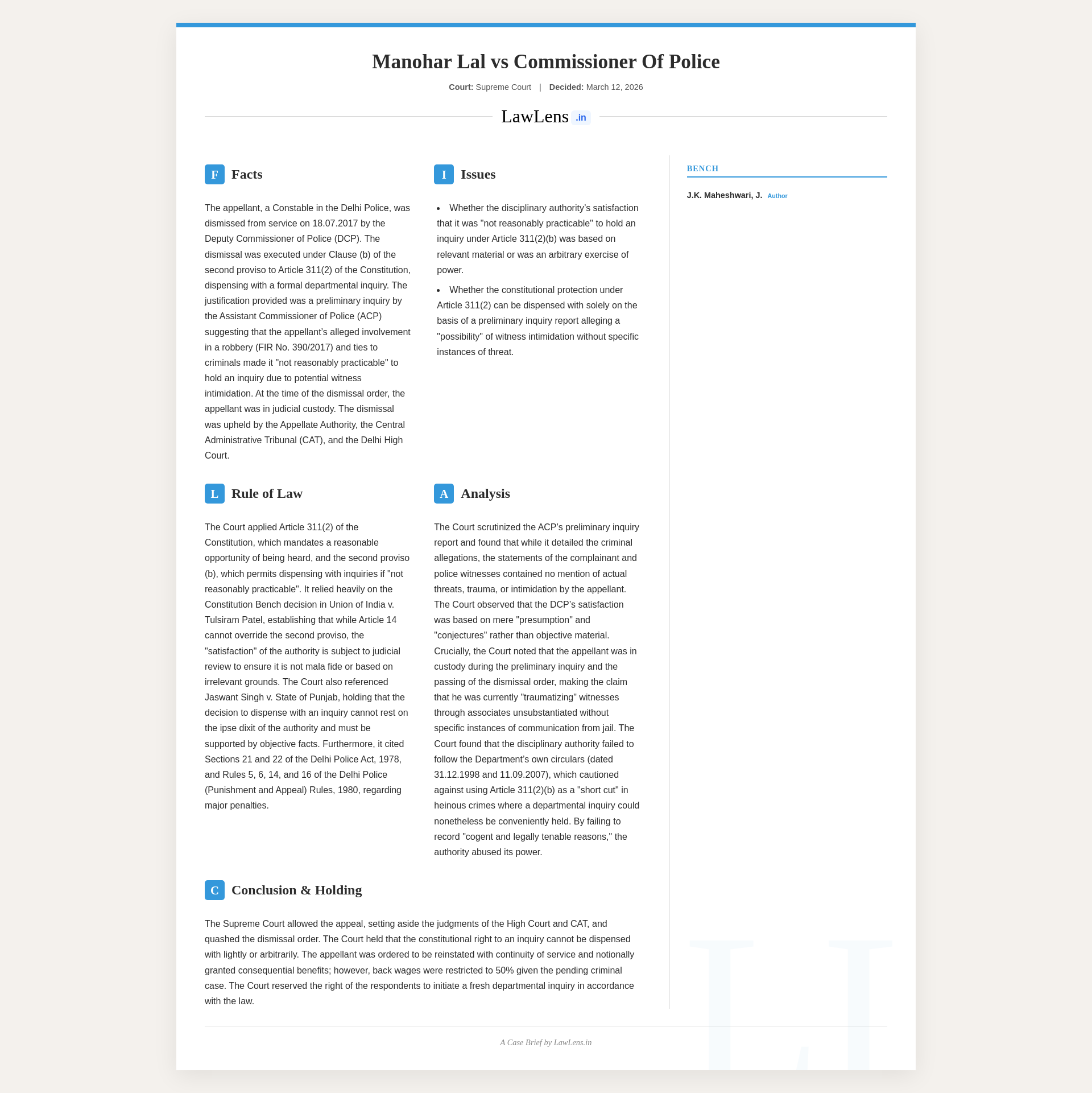
Manohar Lal v. Commissioner of Police 2026 INSC 234 - Article 311 Constitution

Constitution of India - Article 311(2),226- Despite the use of the words “this clause shall not apply” in the second proviso, it shall not make power of Article 311(2) inapplicable. In fact, second proviso to Article 311 is an exception for dispensing with the inquiry on satisfaction by recording the reasons in writing by such authority (Para 20)- An employee holding a post in Union or State ought not to be dismissed or removed by an authority subordinate to the one by which he was appointed- A person shall be dismissed or removed or reduced in rank after an inquiry supplying the charges if any against him and giving a reasonable opportunity of being heard in respect of those charges. The applicability of the said clause is restricted in a situation wherein his conduct led to his conviction of criminal charges or where the authority empowered who dismissed, removed or reduced in rank records reason in writing upon satisfaction that it is not ‘reasonably practicable’ to hold an enquiry against him. In addition, where such power has been exercised by the President or the Governor it may be in the interest of security of the State or if not expedient to hold such an enquiry, then exceptional power under clause (c) of second proviso to Article 311 ought to be exercised - In case such a decision invoking the extraordinary power is taken by the competent authority, the scope of judicial review is available to the Constitutional Courts wherein the reasons as assigned for satisfaction of the authority must be reasonable, valid, justified and in writing. In addition, the satisfaction as recorded must be the objective satisfaction on the basis of material brought on record which ordinarily the disciplinary authority may take as a prudent person. Otherwise, dispensing with the enquiry is not permissible in law. (Para 40-41)
Case Info
Basic Case Information
Case name: Manohar Lal v. Commissioner of Police & Ors.Neutral citation: 2026 INSC 234Coram: J.K. Maheshwari, J. and Atul S. Chandurkar, J.Judgment date: March 12, 2026Court: Supreme Court of India, Civil Appellate Jurisdiction, Civil Appeal No. 13860 of 2024
Statutes / Provisions Referred
- Article 311(1), 311(2) and second proviso clauses (a), (b), (c), and Article 311(3) of the Constitution of India
- Section 21 and Section 22 of the Delhi Police Act, 1978
- Delhi Police (Punishment and Appeal) Rules, 1980 – especially Rules 5, 6, 14, 16
- References to criminal law provisions only contextually (FIR No. 390/2017 under sections 419/457/380/392/412/34 IPC)
Case Law / Citations Referred
- Union of India and Anr. v. Tulsiram Patel and Others, (1985) 3 SCC 398
- Jaswant Singh v. State of Punjab and Ors., (1991) 1 SCC 362
- Ex. Const. Chhote Lal v. Union of India & Ors., (2000) 10 SCC 196
- Sudesh Kumar v. State of Haryana and Ors., (2005) 11 SCC 525
- Tarsem Singh v. State of Punjab, (2006) 13 SCC 581
- State of Punjab v. Harbhajan Singh, (2007) 15 SCC 217
- Reena Rani v. State of Haryana, (2012) 10 SCC 215
- Risal Singh v. State of Haryana, (2014) 13 SCC 244
Summary
The Supreme Court held that the dismissal of Constable Manohar Lal under Article 311(2)(b) of the Constitution, without holding a departmental enquiry, was unjustified because the disciplinary authority’s “reasonable apprehension” of threat or intimidation to witnesses was based only on presumptions without any concrete material. Applying and reiterating the principles in Tulsiram Patel and subsequent decisions, the Court found that the reasons recorded did not meet the strict standard for dispensing with an enquiry and that the authorities had failed to properly understand and apply those principles, despite departmental circulars. The Court therefore quashed the dismissal, directed reinstatement with continuity of service and 50% back wages, while leaving it open to the department to initiate a regular departmental enquiry in accordance with law.