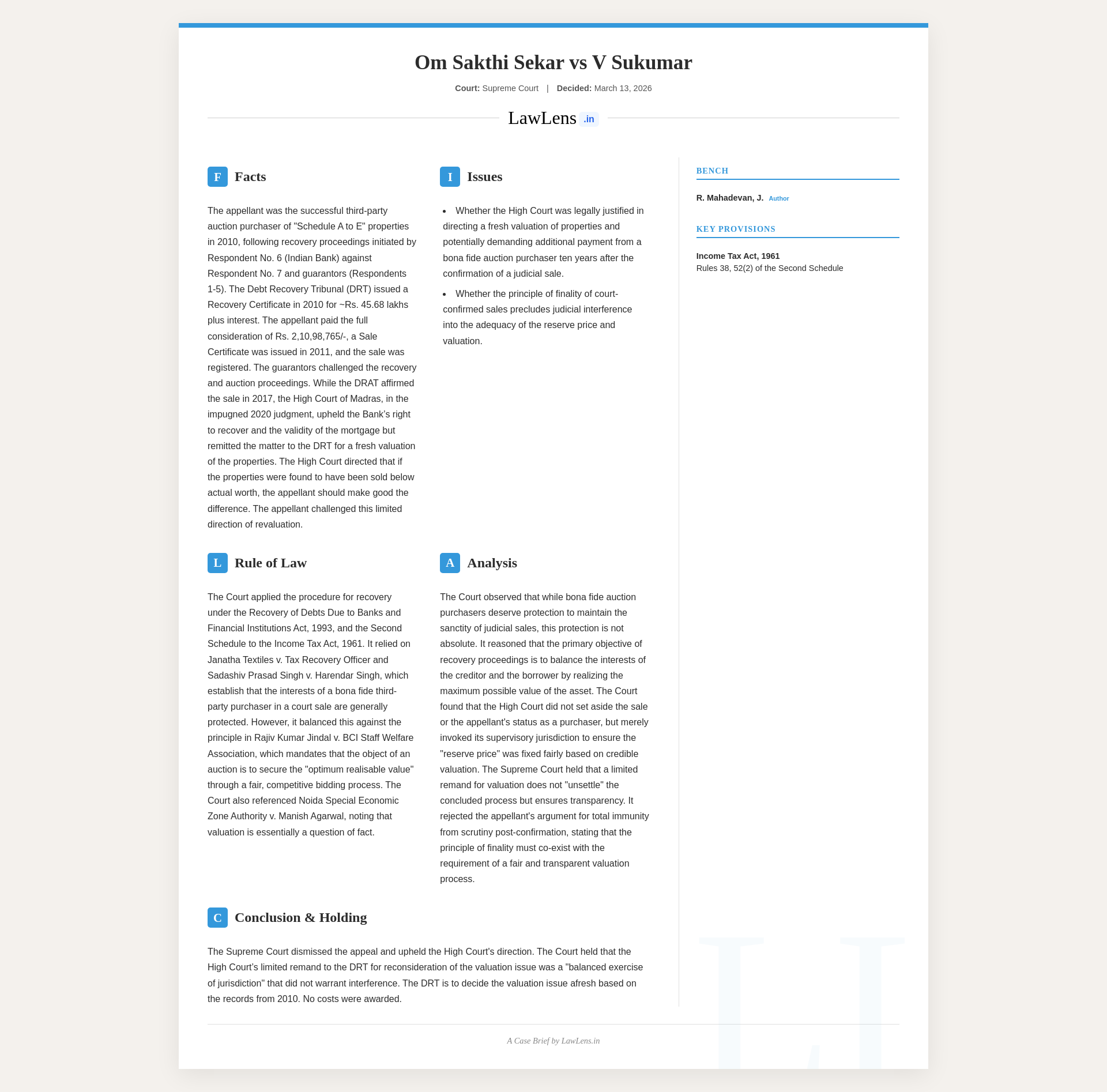
Om Sakthi Sekar v. V. Sukumar 2026 INSC 237 - Auction Sales - Recovery Proceedings
"The principle of finality attached to court-confirmed auction sales cannot operate to shield the process from judicial examination where the question relates to the adequacy of valuation or fixation of reserve price...."

Constitution of India - Article 226 - Auction Sales - The principle of finality attached to court-confirmed auction sales cannot operate to shield the process from judicial examination where the question relates to the adequacy of valuation or fixation of reserve price, particularly when such examination is necessary to ensure that the secured asset has fetched the best possible price. The requirement that the recovery process be fair, transparent and based on a proper assessment of value must co-exist with the principle of finality governing confirmed sales.- The rights of a bona fide auction purchaser deserve due protection and that confirmed court sales should not ordinarily be interfered with, but such protection is not absolute. Where credible issues are raised regarding the adequacy of valuation or the fairness of the process leading to the fixation of the reserve price, the supervisory jurisdiction of the Court may be invoked to ensure that the recovery proceedings have been conducted in a manner that secures the best possible value of the property. The objective of recovery proceedings is not merely to complete the sale but to realise the maximum value of the secured asset so as to balance the interests of the creditor and the borrower. (Para 15-18) [Context: Supreme Court upheld Madras High Court direction remitting to the Debts Recovery Tribunal the limited issue of valuation of mortgaged properties, despite upholding the validity of the auction sale in his favour.]
Case Info
Case Information Extracted
Case name and neutral citation:Om Sakthi Sekar v. V. Sukumar & Ors., 2026 INSC 237
Coram (Bench):Justice J.B. Pardiwala and Justice R. Mahadevan(Judgment authored by R. Mahadevan, J.)
Judgment date:13 March 2026 (New Delhi)
Case laws and citations referred
- Janatha Textiles v. Tax Recovery Officer, (2008) 12 SCC 582
- Sadashiv Prasad Singh v. Harendar Singh & Ors., (2015) 5 SCC 574
- Valji Khimji and Co. v. Official Liquidator of Hindustan Nitro Product (Gujarat) Ltd., (2008) 9 SCC 299
- Shaeb Khan v. Mohd. Yosufuddin & Ors., (2006) 4 SCC 476
- Central Bank of India v. C.L. Vimala & Ors., (2015) 7 SCC 337
- Rajiv Kumar Jindal v. BCI Staff Welfare Association, (2023) 238 Comp Cas 227 : 2023 SCC OnLine SC 507
- Govind Kumar Sharma & Anr. v. Bank of Baroda & Ors., SLP (C) No. 24155 of 2018, judgment dated 18.04.2024 (referred for refund-with-interest principle)
Statutes / laws referred
- Recovery of Debts Due to Banks and Financial Institutions Act, 1993
- SARFAESI Act, 2002 (only to clarify that it does not apply to this auction)
- Second Schedule to the Income Tax Act, 1961 – particularly Rules 38 and 52(2) (procedure governing recovery and auction by the Recovery Officer)
Three‑sentence brief summary
The case concerns a challenge by an auction purchaser to a Madras High Court direction remitting to the Debts Recovery Tribunal the limited issue of valuation of mortgaged properties, despite upholding the validity of the auction sale in his favour. The Supreme Court held that while the rights of a bona fide auction purchaser and the finality of confirmed court sales deserve protection, they do not absolutely bar judicial scrutiny of whether the reserve price and valuation ensured a fair and adequate realisation of the secured asset. Finding the High Court’s limited remand on valuation to be a balanced exercise that did not unsettle the confirmed sale or the bank’s recovery, the Supreme Court dismissed the civil appeal without costs.