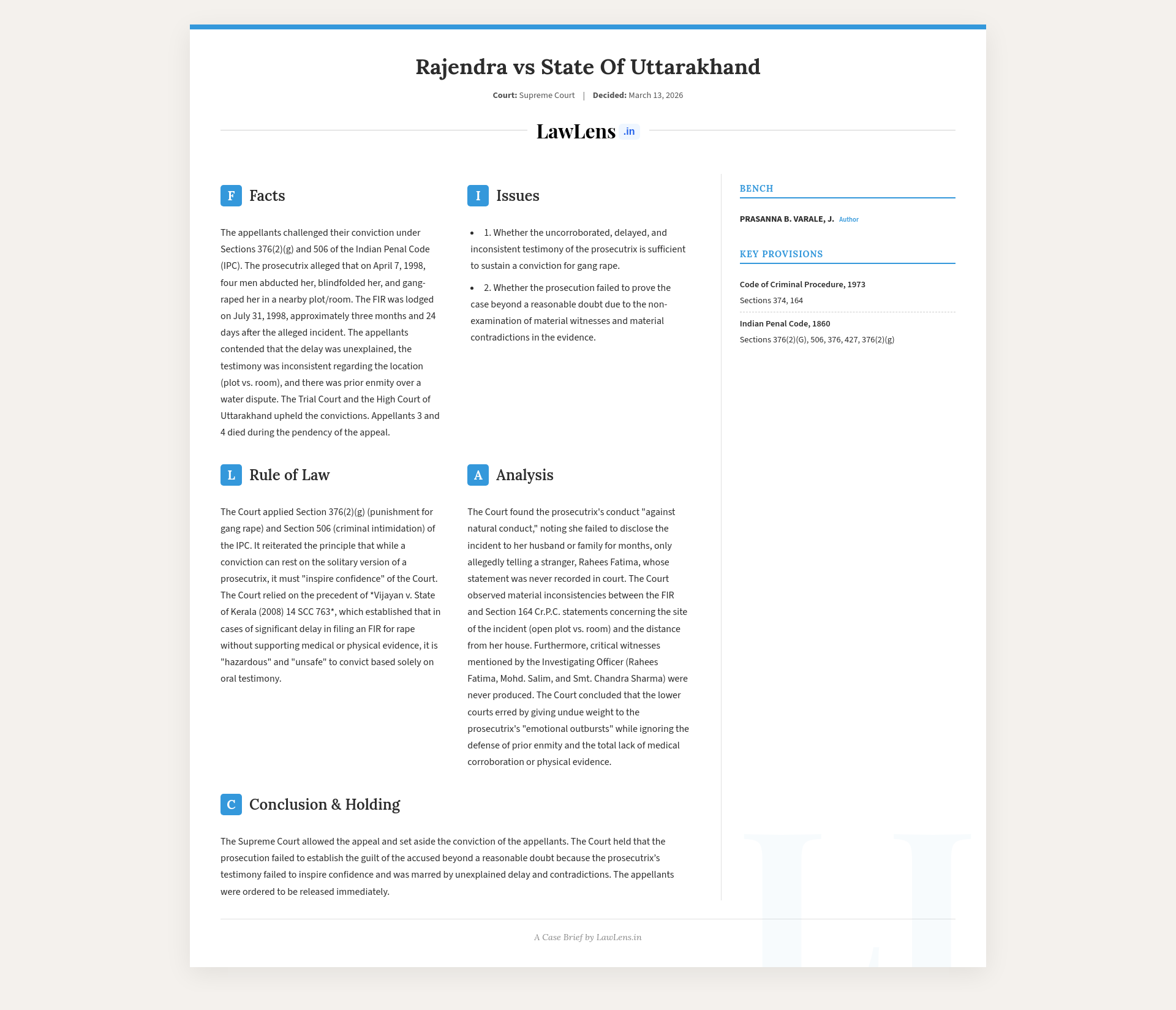
Rajendra v. State of Uttarakhand 2026 INSC 238 - Concurrent Rape Conviction Set Aside
"It would have been natural for the prosecutrix to disclose the incident to her family members after some time and not to somebody who is unknown to her and as such it is very difficult to accept the version of the prosecutrix. "

Indian Penal Code 1860 - Section 375 - The conviction can rest on the solitary version of the prosecutrix, provided it inspires confidence of the Court. [Context: In this case, SC set aside concurrent rape conviction observing inter alia thus: It would have been natural for the prosecutrix to disclose the incident to her family members after some time and not to somebody who is unknown to her and as such it is very difficult to accept the version of the prosecutrix. We find it hard to believe that such a grave incident was not disclosed by the complainant even to her husband at any point but was done so to a stranger woman who never deposed in front of the court. It is also to be observed that the whole case is based on the sole testimony of the prosecutrix and no other witnesses or evidence has been produced - The defence of prior enmity between the parties has also not been properly considered by the courts below and complete weightage has been given to the testimony of the prosecutrix and her emotional outbursts. ]
Case Info
Basic Case Details
Case name and neutral citation:Rajendra & Ors v. State of Uttarakhand, 2026 INSC 238
Coram:Justice Pankaj Mithal and Justice Prasanna B. Varale (judgment authored by Prasanna B. Varale, J.)
Judgment date:13 March 2026 (New Delhi)
Statutes / laws referred:
- Code of Criminal Procedure, 1973: Section 374, Section 164
- Indian Penal Code, 1860: Sections 376, 376(2)(g), 427, 506
Case laws and citations referred:
- Vijayan v. State of Kerala, (2008) 14 SCC 763
Brief Summary (Three Sentences)
The appellants were convicted by the Trial Court under Section 376(2)(g) and Section 506 IPC for gang rape and criminal intimidation, and their conviction was affirmed by the Uttarakhand High Court. The Supreme Court, however, found that the prosecution failed to prove its case beyond reasonable doubt owing to a delay of nearly four months in lodging the FIR, absence of medical or corroborative evidence, non‑examination of key witnesses, prior enmity between the parties, and material inconsistencies in the prosecutrix’s versions. Relying on the principle in Vijayan v. State of Kerala that conviction based solely on the prosecutrix’s testimony is unsafe when it does not inspire confidence and suffers from serious infirmities, the Court allowed the appeal and set aside the conviction, directing the appellants’ release if not required in any other case.