Hamsaanandini Nanduri v. Union of India 2026 INSC 246 - Code on Social Security, 2020 - Maternity Benefit - Adoption

Constitution of India- Articles 14, and 21 ; Code on Social Security, 2020 - Section 60(4) - Section 60(4) of the 2020 Code insofar it puts an age limit of three months on the age of the adoptive child, for the adoptive mothers to avail maternity benefit under the 2020 Code is violative of Articles 14, and 21 of the Constitution respectively. Therefore, the sub-section (4) of Section 60 should now be meaningfully read as:- “(4) A woman who legally adopts a child or a commissioning mother shall be entitled to maternity benefit for a period of twelve weeks from the date the child is handed over to the adopting mother or the commissioning mother, as the case may be.” (Para 167-168) Section 60(4) of the 2020 Code is discriminatory because first, it does not disclose a reasonable distinction between women who adopt a child below the age of three months and those who adopt a child aged three months or above. Secondly, the particular differentiation, which is sought to be made, has no nexus with the object sought to be achieved. Thirdly, the classification suffers from under-inclusiveness- In effect, operates unequally upon adoptive mothers who are similarly situated, resulting in discrimination without reasonable justification (Para 91-92)
Constitution of India- Articles 21 - The right of reproductive autonomy is not confined to the biological act of giving birth. Adoption is an equal exercise of the right to reproductive and decisional autonomy under Article 21 (Para 166) Adoption - An adopted child is no different from a so-called “natural” child, the only distinction is that the process of adoption is more visible and legally acknowledged. Thus, the act of adoption may carry an equally, if not more, profound affirmation of parenthood. There is no doubt that sharing of meaning, affection, and responsibility lies at the heart of both family creation and the adoption process. Reproductive autonomy cannot be narrowly understood as being limited to biological reproduction alone. Adoption, too, represents a conscious and meaningful exercise of the choice to create and nurture a family, and must be viewed as falling within the broader spectrum of reproductive decision-making. (Para 113)
Code on Social Security, 2020 - Section 60(4) -The object of maternity benefit is not associated with the process of childbirth but with the process of motherhood. The purpose of maternity protection does not vary with the manner in which the child is brought into the life of the beneficiary mother. Insofar as the roles, responsibilities, and caregiving obligations are concerned, women who adopt a child aged three months or above are similarly situated to women who adopt a child below the age of three months.(Para 166)
Paternity Leave - A provision for paternity leave serves an important purpose by enabling fathers to participate meaningfully in the early stages of a child’s life and development. It helps in dismantling gendered roles, encourages fathers to take an active role in child care, fosters a balanced understanding of parenting, and promotes gender equality within family and workplace. It also advances the best interests and welfare of the child, which are most effectively served when both parents are enabled to play meaningful and complementary roles in the child’s growth and development. [Context: Supreme Court urged Union to come up with a provision recognizing paternity leave as a social security benefit. We emphasize that the duration of such leave must be determined in a manner that is responsive to the needs of both the parent and the child. (Para 169)]
Interpretation of Statutes - A statutory provision cannot be examined in isolation or in the abstract, divorced from the practical realities within which it is expected to operate. Law is not unidimensional or myopic in its application. If a provision is framed without due regard to the administrative conditions in which it is to operate, the intention of the legislation would stand frustrated. The law must be understood not merely through its terminology, but also in terms of its ability to meaningfully address the conditions for which it has been enacted. The law cannot be merely symbolic or rather illusory. A legislative provision, more particularly, one which is beneficial in nature, must be capable of meaningful implementation so that the class for whose benefit it has been enacted is able to effectively avail the protection intended by the legislature. If the structure of the provision or the circumstances surrounding its operation make the benefit practically unattainable, the law risks becoming a mere formality on paper rather than an instrument of social welfare (Para 137-139)
Legislation - The legislature, while enacting a statute, bears the responsibility of ensuring that the law it enacts is capable of being implemented. The duty of the law maker does not end with the mere articulation of a right or benefit. The enforceability of that right is equally important. Accessibility of law does not mean formal existence, but the ability of individuals to avail the benefits. (Para 145)
Case Info
Basic Case Details
Case name: Hamsaanandini Nanduri v. Union of India & Ors.
Neutral citation: 2026 INSC 246
Court & Coram: Supreme Court of India, Original Civil JurisdictionBench: J.B. Pardiwala, J. and R. Mahadevan, J.
Judgment date: 17 March 2026 (pronounced at New Delhi)
Key Statutes / Laws Referred
Maternity and social security framework:
- Maternity Benefit Act, 1961
- Maternity Benefit (Amendment) Act, 2017
- Code on Social Security, 2020 – especially Section 60(4) (impugned provision) and Section 67 (creche facility)
Constitutional provisions:
- Articles 14, 19(1)(g), 21
- Directive Principles: Articles 39, 41, 42, 43, 51(c)
Adoption / child protection framework:
- Juvenile Justice (Care and Protection of Children) Act, 2015 – Sections 32, 35, 37, 38
- Juvenile Justice (Care and Protection of Children) Rules – Rule 19
- Adoption Regulations, 2022 (CARA Regulations) – especially Regs. 3, 6, 7, 11
- Guardians and Wards Act, 1890
Service / leave rules:
- Central Civil Services (Leave) Rules, 1972 – Rules 43, 43-A, 43-AA
International instruments:
- Universal Declaration of Human Rights (Article 25(2))
- International Covenant on Economic, Social and Cultural Rights (Articles 10, 12)
- ILO Maternity Protection Conventions (Nos. 3, 103, 183)
- CEDAW (Article 11)
- Convention on the Rights of the Child (Article 3)
Leading Case Law & Citations Cited
Indian Supreme Court:
- B. Shah v. Presiding Officer, Labour Court, (1977) 4 SCC 384
- Municipal Corpn. of Delhi v. Female Workers (Muster Roll), (2000) 3 SCC 224
- Suchita Srivastava v. Chandigarh Admn., (2009) 9 SCC 1
- State of W.B. v. Anwar Ali Sarkar, (1952) 1 SCC 1
- State of Gujarat v. Shri Ambica Mills Ltd., (1974) 4 SCC 656
- State of T.N. v. National South Indian River Interlinking Agriculturist Assn., (2021) 15 SCC 534
- K.S. Puttaswamy (Privacy-9J.) v. Union of India, (2017) 10 SCC 1
- Deepika Singh v. PGIMER, Chandigarh, (2023) 13 SCC 681
- K. Umadevi v. State of T.N., (2025) 8 SCC 263
- Citizenship Act, 1955, Section 6-A, In re, (2024) 16 SCC 105
- State of Kerala v. Unni, (2007) 2 SCC 365
- Lakshmi Kant Pandey v. Union of India, (1984) 2 SCC 244
- Dasari Anil Kumar v. Child Welfare Project Director, 2025 SCC OnLine SC 1689
High Courts (illustrative selection from judgment):
- Rama Pandey v. Union of India, 2015 SCC OnLine Del 10484
- Pratiba Himral v. State of H.P., 2021 SCC OnLine HP 9295
- Dev Shree Bandhe v. C.G. State Power Holding Co. Ltd., 2017 SCC OnLine Chh 1763
- Chanda Keswani v. State of Rajasthan, 2023 SCC OnLine Raj 3274
- State v. Ravina Yadav, 2024 SCC OnLine Del 4987
- Lata Goyal v. Union of India, 2025 SCC OnLine Chh 5572
- Susan K. John v. National Board of Examinations in Medical Sciences, 2026 SCC OnLine Ker 1333
- Pravinsinh Indrasinh Mahida v. State of Gujarat, 2021 SCC OnLine Guj 1293
Foreign and international decisions:
- Werner Van Wyk & Ors. v. Minister of Employment and Labour, [2025] ZACC 20 (South Africa Constitutional Court)
- Topčić-Rosenberg v. Croatia, App. No. 1939/11 (ECtHR)
- MIA v. State Information Technology Agency (Pty) Ltd., [2015] ZALCD 20 (Labour Court of South Africa)
- In re P & Ors., [2008] UKHL 38 (House of Lords)
- Suzanne Du Toit and Vos v. Minister for Welfare and Population Development, (2002) 13 BHRC 187 (South Africa CC)
(Plus many classic equal protection / US references quoted via Ambica Mills and National South Indian River Interlinking.)
Three‑Sentence Brief Summary
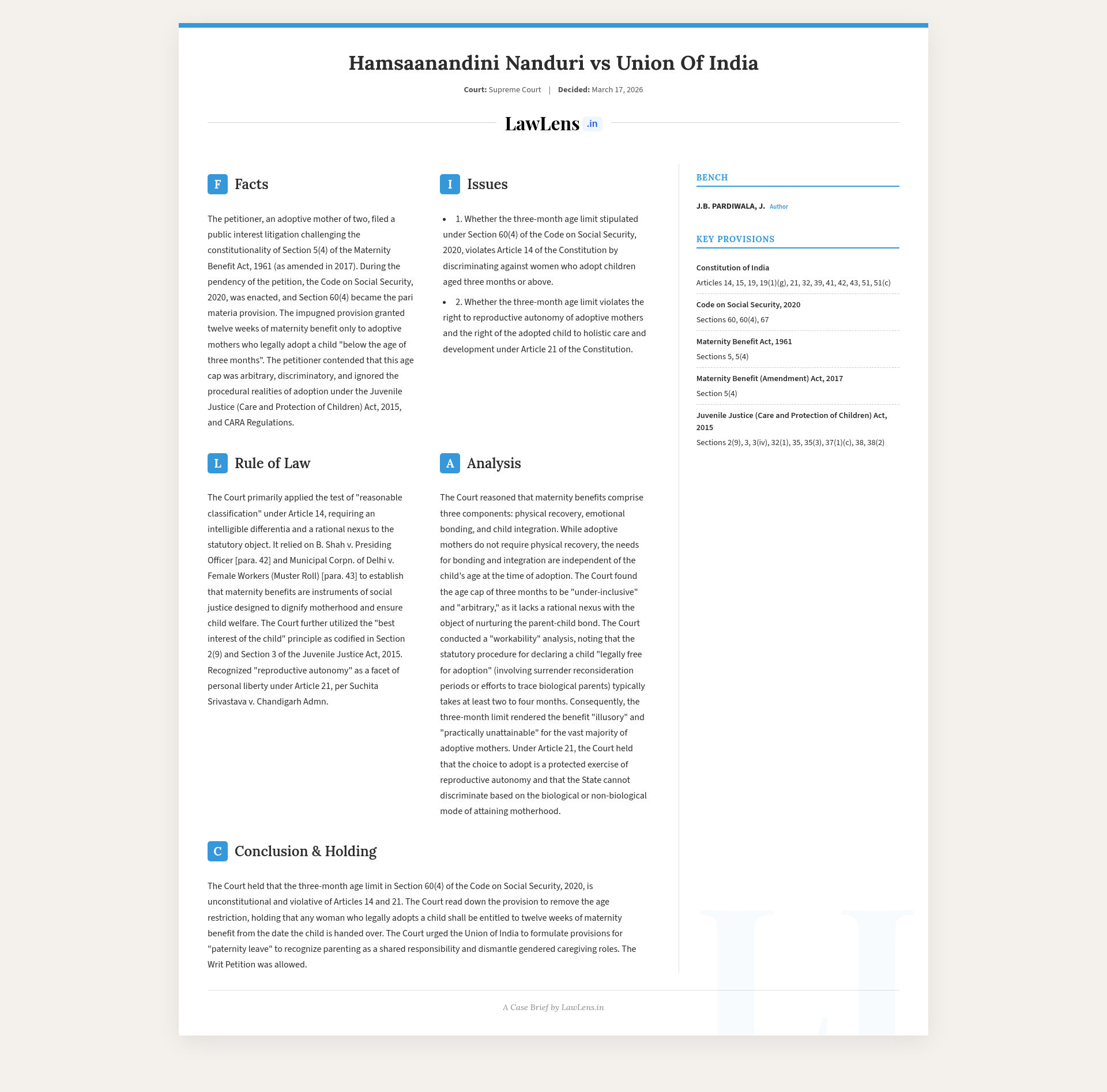
The Supreme Court struck down the three‑month age limit in Section 60(4) of the Code on Social Security, 2020, holding that restricting maternity benefits only to women who adopt children below three months is arbitrary, under‑inclusive, and violative of Articles 14 and 21. It held that maternity protection is about the process of motherhood and caregiving, not just biological childbirth, and that adoptive mothers of older children are similarly situated in terms of emotional bonding, caregiving, and the child’s best interests; adoption was expressly recognized as an exercise of reproductive autonomy and the “best interests of the child” were placed at the centre. The Court therefore “read down” Section 60(4) to entitle all women who legally adopt a child to 12 weeks’ maternity benefit from the date the child is handed over, and separately urged the Union to introduce a meaningful paternity leave regime as a social security benefit.
#SupremeCourt holds that the Code on Social Security 202 provision which puts an age limit of three months on the age of the adoptive child, for the adoptive mothers to avail maternity benefit is unconstitutional ! https://t.co/vUJQPXoz9u pic.twitter.com/2zceor6m6B
— CiteCase 🇮🇳 (@CiteCase) March 17, 2026
#SupremeCourt urges Centre to recognize "Paternity Leave" as a social security benefit. https://t.co/vUJQPXoz9u pic.twitter.com/d2oArdOW7K
— CiteCase 🇮🇳 (@CiteCase) March 17, 2026
#SupremeCourt takes note of a private member bill moved by @supriya_sule which seeks to extend paternity leave to adopting fathers ! https://t.co/vUJQPXoz9u pic.twitter.com/pMGl5lHwr9
— CiteCase 🇮🇳 (@CiteCase) March 17, 2026