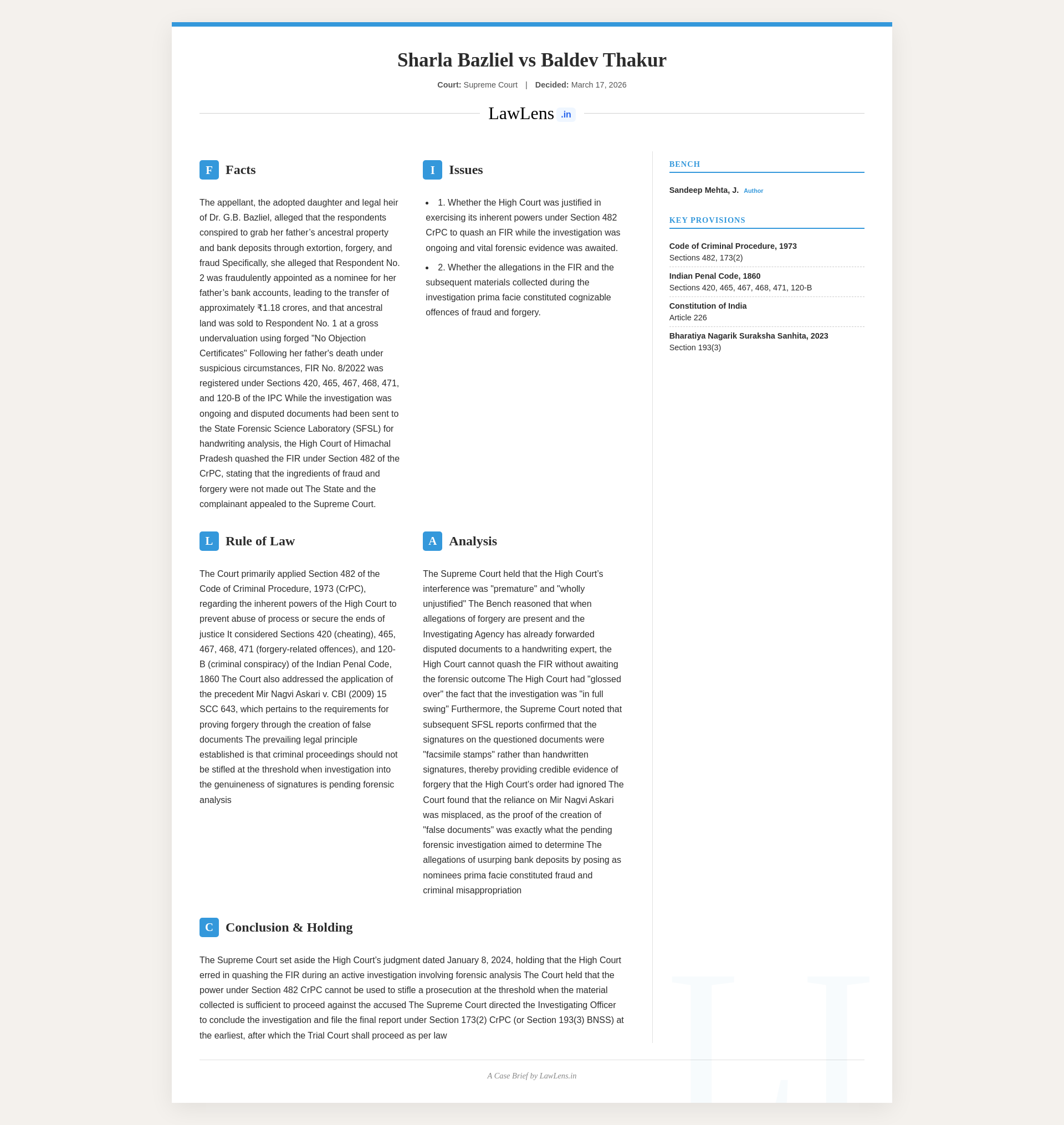
Sharla Bazliel v. Baldev Thakur 2026 INSC 252 - S.482 CrPC

Code of Criminal Procedure 1973 - Section 482 - Supreme Court set aside High Court judgment that quashed a FIR alleging fraud and forgery and observed: Once the Court was apprised that investigation into the genuineness of the signatures on the disputed/questioned documents was being undertaken and the signatures were in the process of being analysed by the SFSL, there was no reason whatsoever for the High Court to have proceeded to quash the FIR by exercising jurisdiction under Section 482 CrPC. (Para 17)
Case Info
Basic Case Details
Case name: Sharla Bazliel v. Baldev Thakur & Others (with State of Himachal Pradesh v. Baldev Thakur & Others)Neutral citation: 2026 INSC 252Court: Supreme Court of India, Criminal Appellate JurisdictionCoram: Vikram Nath, J. and Sandeep Mehta, J.Judgment date: 17 March 2026 (NEW DELHI; MARCH 17, 2026.)
Statutes / Laws Referred
The judgment refers to and applies:
- Code of Criminal Procedure, 1973
- Section 482 CrPC (inherent powers of High Court)
- Section 173(2) CrPC (corresponding to Section 193(3) of the Bharatiya Nagarik Suraksha Sanhita, 2023)
- Indian Penal Code, 1860
- Section 420 (Cheating)
- Section 465 (Punishment for forgery)
- Section 467 (Forgery of valuable security, will, etc.)
- Section 468 (Forgery for purpose of cheating)
- Section 471 (Using as genuine a forged document)
- Section 120-B (Criminal conspiracy)
- Bharatiya Nagarik Suraksha Sanhita, 2023
- Section 193(3) (noted as corresponding to Section 173(2) CrPC)
Case Laws and Citations Relied Upon
The High Court relied on, and the Supreme Court discussed:
- Mir Nagvi Askari v. CBI, (2009) 15 SCC 643The Supreme Court holds that the High Court’s reliance on this decision to quash the FIR was unjustified because the issue of forgery was still under active investigation, including handwriting/forensic examination.
Three‑Sentence Brief Summary
The appellant–complainant, Sharla Bazliel, alleged that the respondents, acting in conspiracy, exploited her father’s weakened mental and physical condition to forge documents, falsely project themselves as nominees, and grab his and the family’s movable and immovable properties, including large bank deposits and ancestral land. While the investigation was ongoing and key documents had been sent to the State Forensic Science Laboratory, the High Court prematurely exercised its inherent powers under Section 482 CrPC to quash the FIR, holding that fraud and forgery were not made out. The Supreme Court, noting subsequent SFSL reports indicating forged/facsimile signatures and gross undervaluation of property causing loss to the exchequer, set aside the High Court’s order, directed completion of investigation and/or continuation of trial, and clarified that its observations are confined to deciding the appeals.