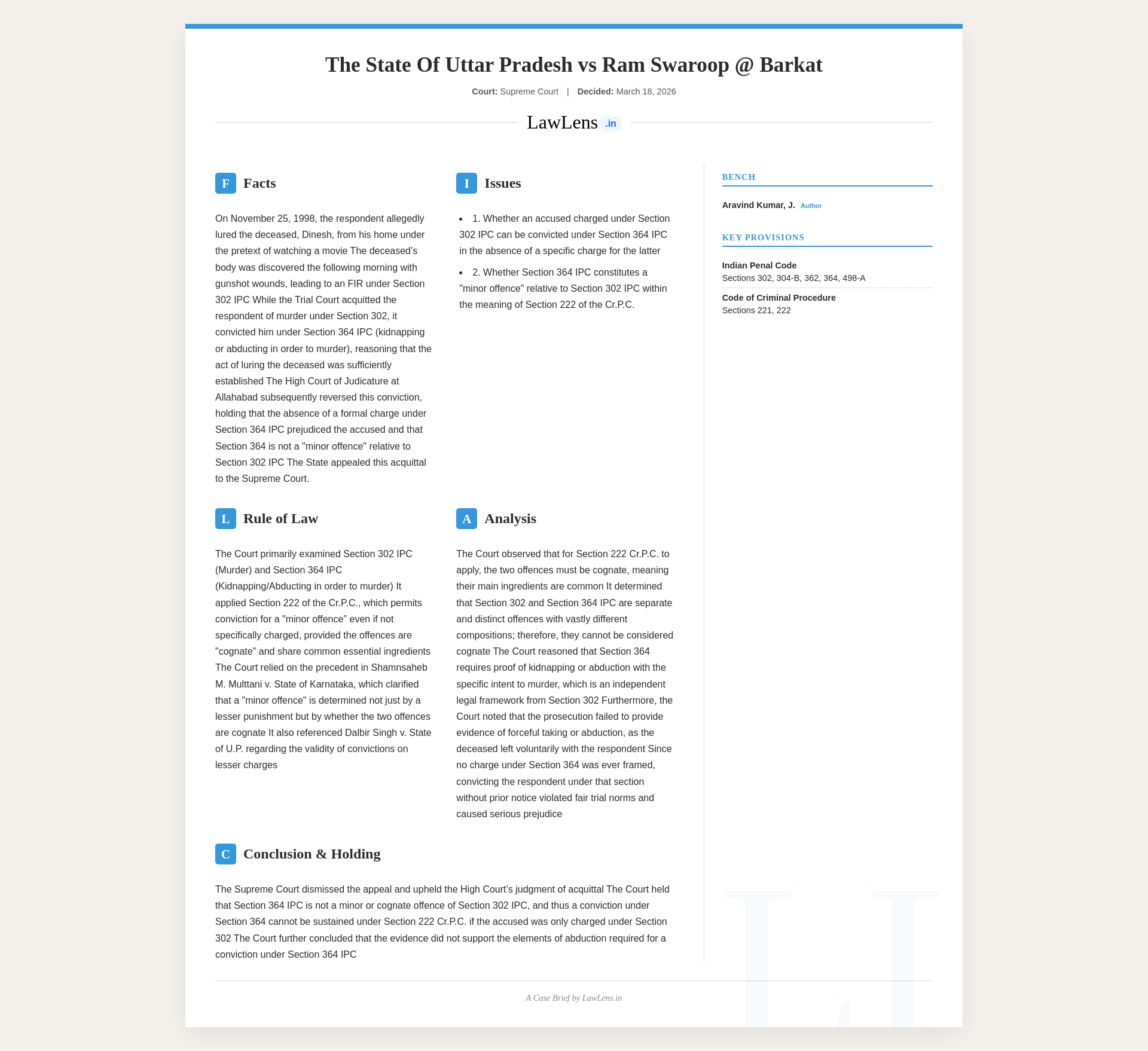
State of Uttar Pradesh v. Ram Swaroop @ Barkat 2026 INSC 256 - S.222 CrPC - Ss. 302,364 IPC

Code of Criminal Procedure 1973 - Section 222 - The expression “minor offence” found in Section 222 is not defined under the Code, it can be discerned from the context which is not merely that the prescribed punishment is less than the major offence - If the two offences are cognate offences and the main ingredients are common, the offence punishable with lesser sentence can be considered as a minor offence with reference to the other offence - Indian Penal Code 1860 - Section 302, 364 - The offence under Section 364 IPC cannot be said to be a lesser offence in relation to the offence under Section 302 IPC to be brought within the meaning of Section 222 of Cr.P.C- Section 364 IPC would indicate that if a person kidnaps or abducts any person in order that such person may be murdered or may be so disposed of as to be put in danger of being murdered would be punishable with imprisonment for life or rigorous imprisonment for a term which may extend to 10 years. This provision when compared with Section 302 would clearly indicate that they are separate and distinct offences and by no stretch of imagination can be construed as cognate offences. [Context: The Supreme Court dismissed the State of Uttar Pradesh’s appeal against the Allahabad High Court decision acquitting the respondent, who had been convicted by the trial court under Section 364 IPC despite being charged only under Section 302 IPC.] (Para 8-11)
Code of Criminal Procedure 1973 - Section 222 ; Indian Penal Code 1860 - Section 302,304B - The composition of the offence under Section 304-B is vastly different from the offence of murder indicated under Section 302 IPC and hence the former cannot be regarded as a minor offence vis-a-vis the latter. (Para 10)
Case Info
Case Information
Case name and neutral citation:State of Uttar Pradesh v. Ram Swaroop @ Barkat, 2026 INSC 256
Coram:Justice Aravind Kumar and Justice Augustine George Masih
Judgment date:18 March 2026 (New Delhi)
Case laws and citations referred
- Rafiq Ahmad @ Rafi v. State of Uttar Pradesh, (2011) 8 SCC 300
- Sangaraboina Sreenu v. State of Andhra Pradesh, (1997) 5 SCC 348
- Dalbir Singh v. State of U.P., (2004) 5 SCC 334
- Shamnsaheb M. Multtani v. State of Karnataka, (2001) 2 SCC 577
Statutes / laws referred
- Indian Penal Code, 1860
- Section 302 – Murder
- Section 304-B – Dowry death (used illustratively, via Multtani)
- Section 362 – Abduction (definition relied on by the trial court)
- Section 364 – Kidnapping or abduction in order to murder
- Code of Criminal Procedure, 1973
- Section 221 – Doubt as to which offence
- Section 222 – When a person is charged with one offence, he can be convicted of a minor offence
Three‑sentence summary
The Supreme Court dismissed the State of Uttar Pradesh’s appeal against the Allahabad High Court decision acquitting the respondent, who had been convicted by the trial court under Section 364 IPC despite being charged only under Section 302 IPC. Relying on the principles in Shamnsaheb M. Multtani and others, the Court held that Section 364 IPC is a separate and distinct offence, not a “minor” or cognate offence to Section 302 IPC for the purposes of Section 222 CrPC, especially when no specific charge under Section 364 was framed. The Court also noted the absence of allegations or evidence of abduction/force in the complaint and testimonies, and therefore found no ground to interfere with the High Court’s acquittal.