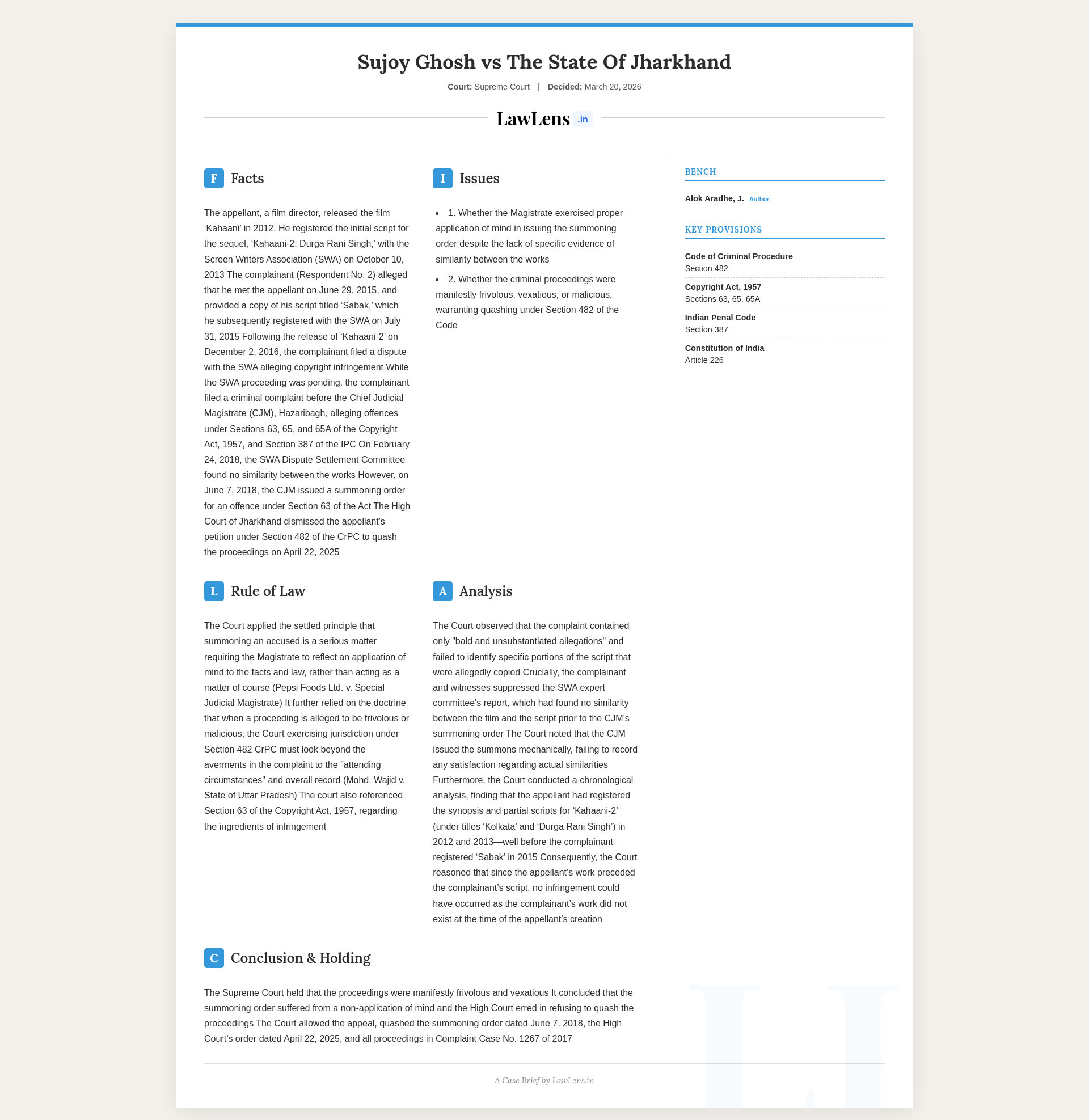
Sujoy Ghosh v. State of Jharkhand 2026 INSC 267 - CrPC/BNSS - Summoning Of Accused - Quashing - Attending Circumstances
"In frivolous or vexatious proceedings, the Court owes a duty to look into many other attending circumstances emerging from the record of the case, over and above the averments and, if need be, with due care and circumspection, and try to read in between the lines."

Code of Criminal Procedure 1973 - Section 204 - Summoning of an accused in a criminal case is a serious matter and criminal law cannot be set into motion as a matter of course. It is not that the complainant has to bring only two witnesses to support his allegations in the complaint to have the criminal law set into motion. The order of the Magistrate summoning the accused must reflect application of mind to the facts of the case and the law applicable thereto. The Magistrate must carefully scrutinise the evidence brought on record and determine whether any offence is prima facie made out. The Magistrate may even himself put questions to the complainant and his witnesses to elicit answers to find out the truthfulness of the allegations or otherwise, and then examine if any offence is prima facie committed by all or any of the accused. (Para 13) [Context: In this case, the appellant, film director Sujoy Ghosh, sought quashing of criminal proceedings alleging copyright infringement of the complainant’s script “Sabak” by his film “Kahaani‑2.” The Supreme Court held that the complaint and witness statements contained only bald, unsubstantiated allegations without identifying any similarity, that the expert Screen Writers Association committee had already found no similarity, and that the appellant’s script was registered well before the complainant’s work. Concluding that the summoning order showed non‑application of mind and that the proceedings were manifestly frivolous and vexatious, the Court quashed the summoning order, the High Court’s refusal to interfere, and the entire complaint.]
Code of Criminal Procedure 1973 - Section 482 - When an accused seeks quashing of either the FIR or criminal proceedings on the ground that such proceedings are manifestly frivolous, vexatious or malicious, the Court is duty bound to examine the matter with greater care. It will not be just enough for the Court to look into the averments made in the FIR/complaint alone for the purpose of ascertaining whether the necessary ingredients to constitute the alleged offence are disclosed or not. In frivolous or vexatious proceedings, the Court owes a duty to look into many other attending circumstances emerging from the record of the case, over and above the averments and, if need be, with due care and circumspection, and try to read in between the lines. The Court while exercising its jurisdiction under Section 482 of the Code or Article 226 of the Constitution need not restrict itself only to the stage of a case but is empowered to take into account the overall circumstances leading to the initiation/registration of the case as well as the materials collected in the course of investigation. (Para 14)
Case Info
Case Information
Case name and neutral citation:Sujoy Ghosh v. The State of Jharkhand & Anr., 2026 INSC 267
Coram:Justice Pamidighantam Sri Narasimha and Justice Alok Aradhe
Judgment date:20 March 2026 (New Delhi)
Case laws and citations referred
- Birla Corporation Limited v. Adventz Investments and Holdings Limited & Ors., (2019) 16 SCC 610
- Mohd. Wajid & Anr. v. State of Uttar Pradesh & Ors., (2023) 20 SCC 219
- Rekha Sharad Ushir v. Saptashrungi Mahila Nagari Sahkari Patsansta Ltd., (2025) SCC OnLine SC 641
- Pradeep Kumar Kesarwani v. State of U.P. and Anr., (2025) SCC OnLine SC 1947
- State of Haryana & Ors. v. Bhajan Lal & Ors., 1992 Supp (1) SCC 335
- Dhariwal Tobacco Products Ltd. & Ors. v. State of Maharashtra & Anr., AIR 2009 SC 1032
- Pepsi Foods Ltd. & Anr. v. Special Judicial Magistrate & Ors., (1998) 5 SCC 749
- Vikas Chandra v. State of Uttar Pradesh and Another, 2024 SCC OnLine SC 1534
Statutes / laws referred
- Code of Criminal Procedure, 1973 – Section 482
- Copyright Act, 1957 – Sections 63, 65, 65A
- Indian Penal Code, 1860 – Section 387
- Constitution of India – Article 226
Three‑sentence brief summary
The appellant, film director Sujoy Ghosh, sought quashing of criminal proceedings alleging copyright infringement of the complainant’s script “Sabak” by his film “Kahaani‑2.” The Supreme Court held that the complaint and witness statements contained only bald, unsubstantiated allegations without identifying any similarity, that the expert Screen Writers Association committee had already found no similarity, and that the appellant’s script was registered well before the complainant’s work. Concluding that the summoning order showed non‑application of mind and that the proceedings were manifestly frivolous and vexatious, the Court quashed the summoning order, the High Court’s refusal to interfere, and the entire complaint.