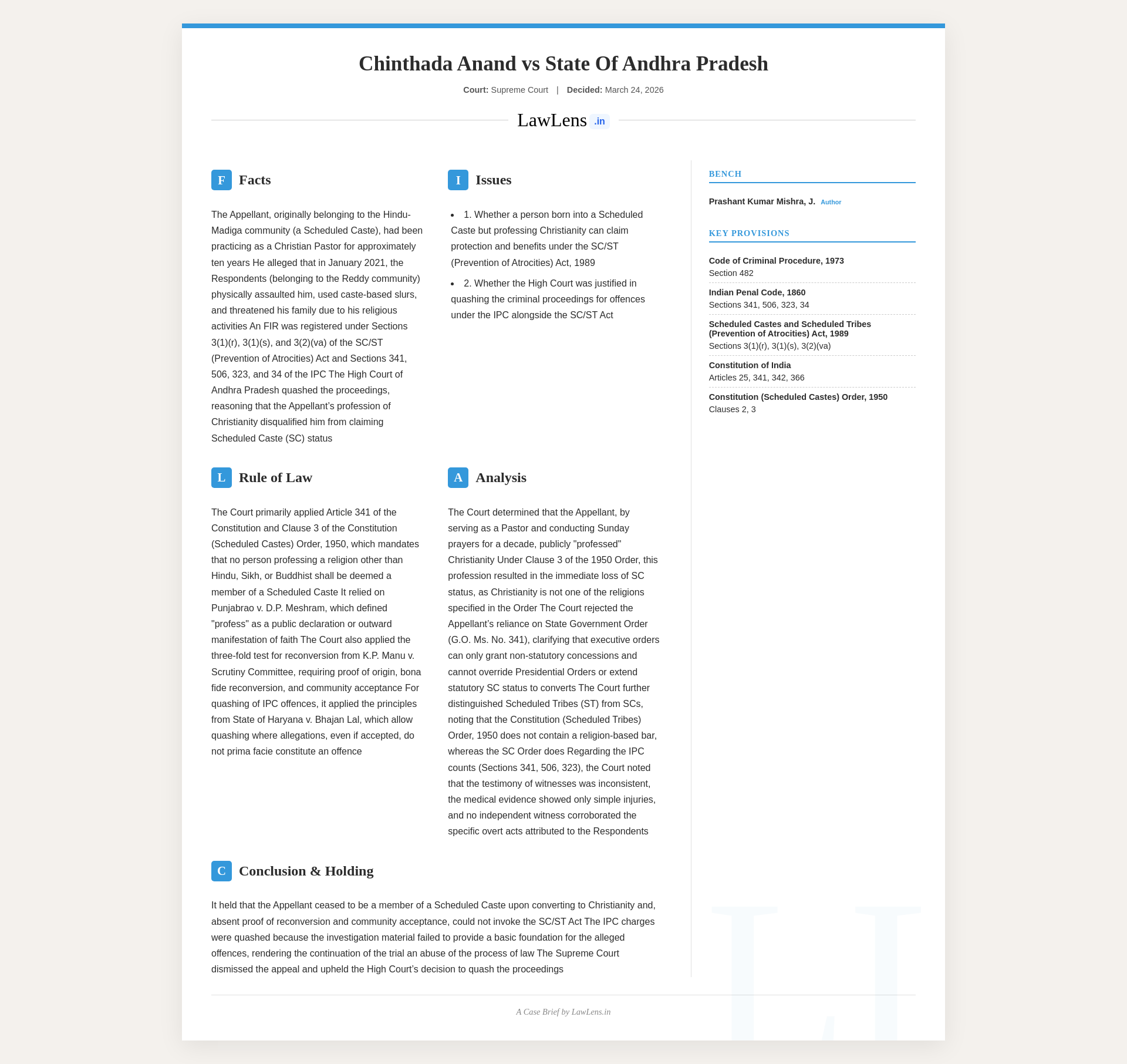
Chinthada Anand vs State of Andhra Pradesh 2026 INSC 283 - SC- ST Act - Caste Status - Conversion to Christianity
"When a person ceases to be a member of the Scheduled Caste on his conversion to Christianity, he cannot be a person aggrieved under the SC/ST Act."

Scheduled Castes and Scheduled Tribes (Prevention of Atrocities) Act, 1989 - When a person ceases to be a member of the Scheduled Caste on his conversion to Christianity, he cannot be a person aggrieved under the SC/ST Act. For a person to be recognised as a member of a Scheduled Caste, he must be professing the Hindu religion or such other religions as are expressly recognised under the Constitution (Scheduled Castes) Order, 1950. Once he converts to Christianity, the caste status stands eclipsed in the eyes of law. (Para 56) [Context: The Supreme Court held that the appellant, originally from the Madiga Scheduled Caste but long functioning as a Christian pastor, ceased in law to be a member of a Scheduled Caste under Clause 3 of the Constitution (Scheduled Castes) Order, 1950 and therefore could not invoke the SC/ST (Prevention of Atrocities) Act. The Court clarified general postulates: conversion to a religion other than Hinduism, Sikhism or Buddhism results in immediate loss of Scheduled Caste status and all statutory SC‑based benefits, and that reconversion requires strict proof of original caste, genuine reconversion, and community acceptance. On the IPC allegations, finding the material against the accused weak, inconsistent and unsupported by independent witnesses, it upheld the High Court’s quashing of all proceedings under both the SC/ST Act and the IPC, and dismissed the appeal.
Constitution (Scheduled Castes) Order, 1950 - Principles for determining the entitlement of a person to be recognised as a member of a Scheduled Caste or Scheduled Tribe: a) The claimant must demonstrably belong to a caste or tribe which is specifically notified and recognised under Clause 2 of the Constitution (Scheduled Castes) Order, 1950 and Constitution (Scheduled Tribes) Order, 1950, and such status must be established by clear, cogent, and unimpeachable evidence. b) No person who professes a religion other than Hindu, Sikh or Buddhist shall be deemed to be a member of a Scheduled Caste. This bar under Clause 3 of the Constitution (Scheduled Castes) Order, 1950 is categorical and absolute. Conversion to any religion not specified in Clause 3 results in immediate and complete loss of Scheduled Caste status from the moment of conversion regardless of birth. c) No statutory benefit, protection, reservation, or entitlement under the Constitution or under any enactment of Parliament or State Legislature that is predicated upon the membership of a Scheduled Caste can be claimed by or extended to any person who, by operation of Clause 3 of the Constitution (Scheduled Castes) Order, 1950, is not deemed to be a member of a Scheduled Caste. This bar is absolute and admits no exception. d) A person cannot simultaneously profess and practice a religion other than the ones specified in Clause 3 of Constitution (Scheduled Castes) Order, 1950 and claim membership of a Scheduled Caste at the same time. A person who professes and practices such religion for personal, social and spiritual purposes cannot in law, assert membership of a Scheduled Caste for the purpose of securing statutory benefits. The two positions are mutually exclusive and contrary to the Constitutional scheme. e) In cases where a person claims to have reconverted from a religion not specified in Clause 3 of the Constitution (Scheduled Castes) Order, 1950 back to Hindu, Sikh or Buddhist religion, the following three conditions must be cumulatively and conclusively established: i. There must be a clear proof that the person originally belonged to a caste notified under the Constitution (Scheduled Castes) Order, 1950. ii. There must be credible and unimpeachable evidence of bona fide reconversion to the original religion, accompanied by complete and unequivocal renunciation of the religion to which conversion had taken place, total dissociation therefrom, and actual adoption and observance of the customs, usages, practices, rituals, and religious obligations of the original caste.iii. There must be satisfactory and credible evidence establishing acceptance and assimilation by the members of the original caste and the concerned community. Mere self-proclamation is insufficient i.e., the community must recognize and accept the person as one of their own. All the above three conditions are mandatory and cumulative. The burden of proving reconversion lies entirely on the claimant, to be proven through unimpeachable evidence. Failure to establish even one condition renders the claim unsustainable. f) Where a person ceases to be a member of a Scheduled Caste by virtue of Clause 3 of the Constitution (Scheduled Castes) Order, 1950, the loss of such status carries with it the automatic and immediate termination of all eligibility for statutory benefits, protections, reservations, preferences and entitlements that are predicated upon or flow from such membership. (Para 55)
Constitution (Scheduled Tribes) Order, 1950 - Constitution (Scheduled Tribes) Order, 1950 does not prescribe religion-based exclusion. The determination of Scheduled Tribe status cannot rest on conversion alone, but must turn on whether the claimant continues to possess and is recognised for the essential attributes of tribal identity, including customary practices, social organisation, community life, and acceptance by the concerned tribal community. Where conversion or subsequent conduct results in a complete severance from the tribal way of life and loss of community recognition, the foundational basis for Scheduled Tribes status will stand eroded. Conversely, where such attributes demonstrably subsist or are genuinely re-established and accepted by the tribal community, the claim cannot be rejected mechanically. The assessment in such cases is necessarily fact-specific and is left to the competent authority to decide in accordance with Constitutional principles. (Para 55) Once a person belonging to a Scheduled Tribe converts to another religion, ultimately through the passage of time, the customs, rituals and other traits of that particular tribe may fall into eclipse. If so, in such circumstance, it is proved that the person in question has completely renounced himself from the customs, rituals and other traits of his tribe, and has assimilated into the converted religion following the practices and customs of that particular religion, a reasonable inference can be drawn that such a person shall not be considered a part of the tribe. (Para 31)
Constitution (Scheduled Castes) Order, 1950 - the term “profess” connotes to publicly declare or practice a religion. The essence of the word lies in the open avowal of one’s religious beliefs in a manner discernible to the public at large. It is not merely a question of personal belief or private conviction, but requires an outward manifestation of one’s faith. (Para 37-38)
Christianity - Caste - Christianity, by its very theological foundation, does not recognize or incorporate the institution of caste. (Para 39) Denominational distinctions ( Roman Catholics,Protestant, Syrian Christian etc) arise from differences in theological interpretation, liturgical practice (the form of worship) and ecclesiastical governance (the organizational framework within the church). They do not represent any caste-based hierarchal stratifications.
Code of Criminal Procedure 1973 - Section 482 - where the uncontroverted allegations and the evidence collected during investigation do not disclose the commission of any offence, continuation of criminal proceedings would amount to an abuse of the process of law. (Para 68)
Case Info
Case Information
Case name and neutral citation:Chinthada Anand vs State of Andhra Pradesh and Others, 2026 INSC 283
Coram:Justice Prashant Kumar MishraJustice Manmohan
Judgment date:24 March 2026 (Supreme Court of India, Criminal Appellate Jurisdiction)
Case Laws and Citations Referred
- State of Kerala vs. Chandramohan, (2004) 3 SCC 429
- C.M. Arumugam vs. S. Rajagopal, (1976) 1 SCC 863
- Guntur Medical College vs. Y. Mohan Rao, (1976) 3 SCC 411
- Punjabrao vs. D.P. Meshram, 1964 SCC OnLine SC 76
- M. Chandra vs. M. Thangamuthu and Another, (2010) 9 SCC 712
- C. Selvarani vs. The Special Secretary‑cum‑District Collector and Others, 2024 INSC 900
- K.P. Manu vs. Scrutiny Committee for Verification of Community Certificate, (2015) 4 SCC 1
- State of Haryana vs. Bhajan Lal, 1992 Supp (1) SCC 335
- Neeharika Infrastructure Private Limited vs. State of Maharashtra, (2021) 19 SCC 401
Statutes / Laws Referred
- Constitution of India, 1950
- Article 341 (Scheduled Castes)
- Article 342 (Scheduled Tribes)
- Article 366(24), 366(25) (definitions of Scheduled Castes and Scheduled Tribes)
- Article 25 (freedom of religion – referred in reasoning)
- Constitution (Scheduled Castes) Order, 1950
- Especially Clause 3 (bar on SC status for those professing religions other than Hindu, Sikh, Buddhist)
- Constitution (Scheduled Tribes) Order, 1950
- Scheduled Castes and Scheduled Tribes (Prevention of Atrocities) Act, 1989
- Sections 3(1)(r), 3(1)(s), 3(2)(va)
- Indian Penal Code, 1860
- Sections 341 (wrongful restraint)
- 323 (voluntarily causing hurt)
- 506 (criminal intimidation)
- 34 (common intention)
- Code of Criminal Procedure, 1973
- Section 482 (inherent powers of High Court to quash proceedings)
- Government Orders / Executive Instruments
- G.O. Ms. No. 341, Social Welfare Department, Government of Andhra Pradesh, dated 30.08.1977 (non‑statutory concessions to SC converts to Christianity/Buddhism)
- Central clarification
- PIB Press Release, Ministry of Social Justice & Empowerment, 03.08.2021: “Benefit of Centrally Sponsored Schemes to Converted Christians” (clarifying that SC converts to Christianity cannot get SC‑based centrally sponsored/statutory benefits)
Brief Summary (Three Sentences)
The Supreme Court held that the appellant, originally from the Madiga Scheduled Caste but long functioning as a Christian pastor, ceased in law to be a member of a Scheduled Caste under Clause 3 of the Constitution (Scheduled Castes) Order, 1950 and therefore could not invoke the SC/ST (Prevention of Atrocities) Act. The Court clarified general postulates: conversion to a religion other than Hinduism, Sikhism or Buddhism results in immediate loss of Scheduled Caste status and all statutory SC‑based benefits, and that reconversion requires strict proof of original caste, genuine reconversion, and community acceptance. On the IPC allegations, finding the material against the accused weak, inconsistent and unsupported by independent witnesses, it upheld the High Court’s quashing of all proceedings under both the SC/ST Act and the IPC, and dismissed the appeal.