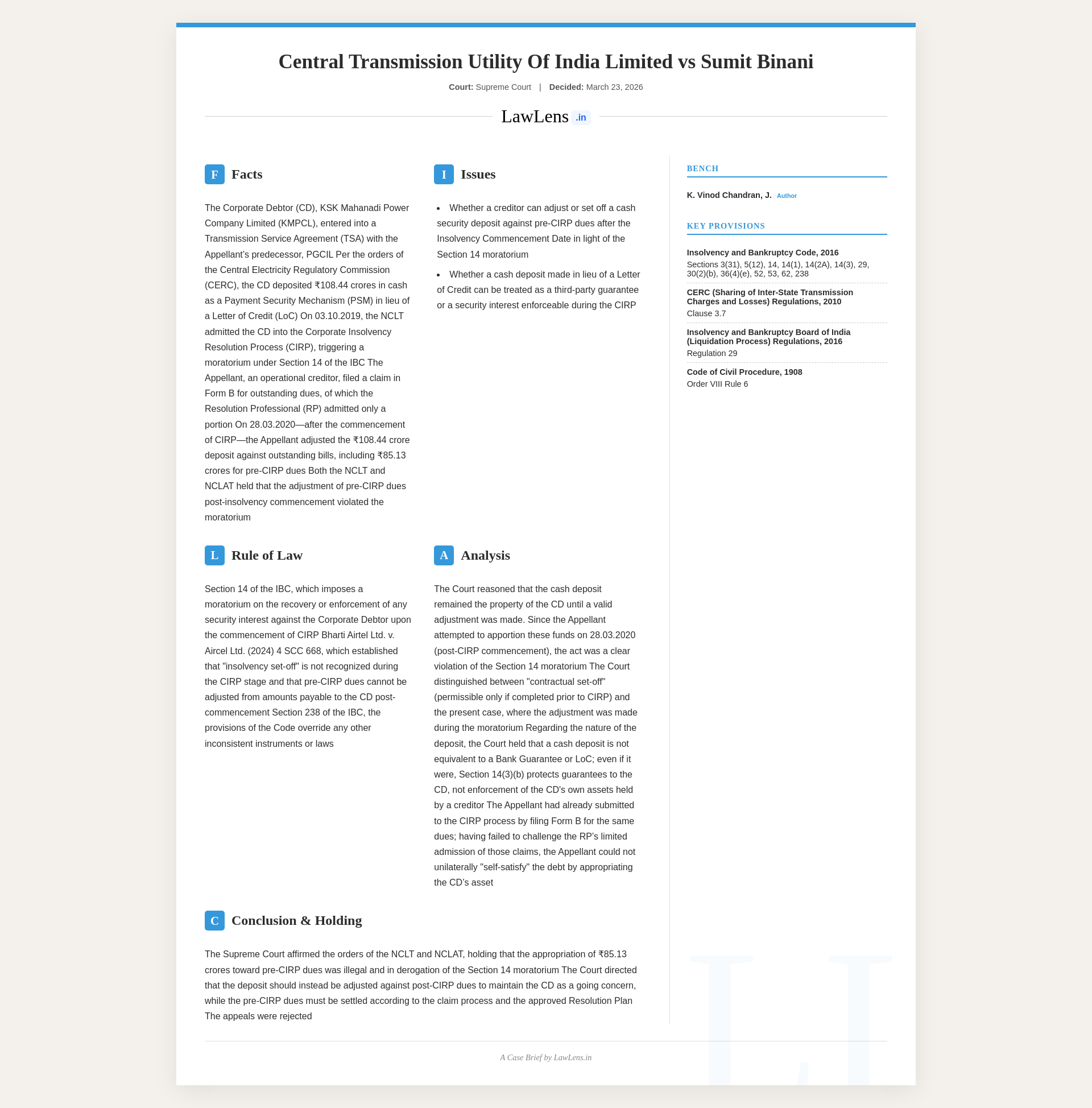
Central Transmission Utility of India Limited v. Sumit Binani 2026 INSC 284 - IBC - Set Off -
"Set-off would mitigate against the pari passu principle which is apparent from IBC scheme.."

Insolvency and Bankruptcy Code - Statutory set-off in terms of Order VIII Rule 6 of CPC or insolvency set-off as permitted by Regulation 29 of the Liquidation Regulations cannot be applied to CIRP. The exception being only of the contractual set-off being permitted before or on the date CIRP is put in motion or commenced, since pre-moratorium the terms of the contract are binding and are not altered or modified. (Para 16) Set-off would mitigate against the pari passu principle which is apparent from the scheme of the IBC. (Para 24)
Case Info
Case Information
Case name and neutral citation:Central Transmission Utility of India Limited v. Sumit Binani & Ors., 2026 INSC 284
Court and Coram:Supreme Court of India, Civil Appellate JurisdictionCoram: K. Vinod Chandran, J. and Sanjay Kumar, J.
Judgment date:23 March 2026 (as mentioned at the end of the judgment: “NEW DELHI; MARCH 23, 2026.”)
Statutes / Laws Referred
The judgment primarily interprets and applies provisions of the Insolvency and Bankruptcy Code, 2016 (IBC), including in substance:
- Section 5(12) – “Insolvency commencement date”
- Section 14 – Moratorium (including sub‑sections (1), (2A), (3) and specifically clause (c) of 14(1) and clause (d) of 14(3))
- Section 29 – Information Memorandum
- Section 30(2)(b) – Conditions for approval of a resolution plan
- Section 36(4)(e) – (referred to contextually via Bharti Airtel, in discussion on liquidation estate and set‑off)
- Section 52 and Section 53 – Rights of secured creditors and distribution waterfall (in the context of Jaypee Kensington and Vistra ITCL)
- Section 62 – Scope of appeal to Supreme Court (question of law)
- Section 238 – Non obstante clause giving IBC overriding effect
- Section 3(31) – “Security interest”
Other regulations / instruments:
- Central Electricity Regulatory Commission (Sharing of Inter‑State Transmission Charges and Losses) Regulations, 2010 – including the Billing, Collection and Disbursement (BCD) Procedure and Clause 3.7.
- Orders/directions of CERC relating to the Payment Security Mechanism (PSM) and deposit of Rs.108.44 crores in lieu of Letter of Credit.
Case Law and Citations Relied On
The Court cites and discusses the following precedents:
- Bharti Airtel Ltd. v. Aircel Ltd. & Dishnet Wireless Ltd. (Resolution Professional), (2024) 4 SCC 668– Detailed reliance on principles of set‑off (statutory, contractual, common law, equitable, insolvency set‑off) and their applicability in CIRP; particularly the bar on setting off pre‑CIRP dues against post‑CIRP receivables.
- Himadri Chemicals Industries Ltd. v. Coal Tar Refining Co., (2007) 8 SCC 110– Nature of bank guarantees and very limited grounds (fraud, irretrievable harm) for injuncting their encashment.
- Standard Chartered Bank v. Heavy Engineering Corporation Limited, (2020) 13 SCC 574– Bank guarantee as an independent, unconditional, irrevocable contract between bank and beneficiary.
- Jaypee Kensington Boulevard Apartments Welfare Assn. v. NBCC (India) Ltd., (2022) 1 SCC 401– Rights and treatment of dissenting secured financial creditors and their entitlement equivalent to the value of their security interest.
- Vistra ITCL (India) Ltd. v. Dinkar Venkatasubramanian, (2023) 7 SCC 324– Pledge of shares as security interest; status of such pledgee as a secured creditor not necessarily being a financial or operational creditor.
- DBS Bank Limited Singapore v. Ruchi Soya Industries Ltd., (2024) 3 SCC 752– Clarifies that Jaypee Kensington concerned dissenting financial creditors and explains conversion of security interest in an asset into monetary value under a resolution plan.
Three‑Sentence Brief Summary
The Supreme Court held that the sum of Rs.108.44 crores deposited by KSK Mahanadi Power Company Limited (KMPCL) with Central Transmission Utility of India Limited as a Payment Security Mechanism, though in lieu of a Letter of Credit, remained the property/asset of the corporate debtor as on the insolvency commencement date and could not be unilaterally appropriated towards pre‑CIRP dues after the moratorium under Section 14 IBC took effect. Relying heavily on Bharti Airtel, the Court reaffirmed that set‑off of pre‑CIRP dues against post‑CIRP entitlements is impermissible in CIRP, rejected the characterization of the appellant as a secured creditor, and treated the deposit not as an enforceable guarantee or security interest falling within the carve‑outs of Section 14(3). It therefore upheld the NCLT and NCLAT directions that the security deposit be adjusted only against post‑CIRP dues by way of book entries, with the pre‑CIRP dues to be satisfied strictly in accordance with the claims admitted in the CIRP and the approved resolution plan.