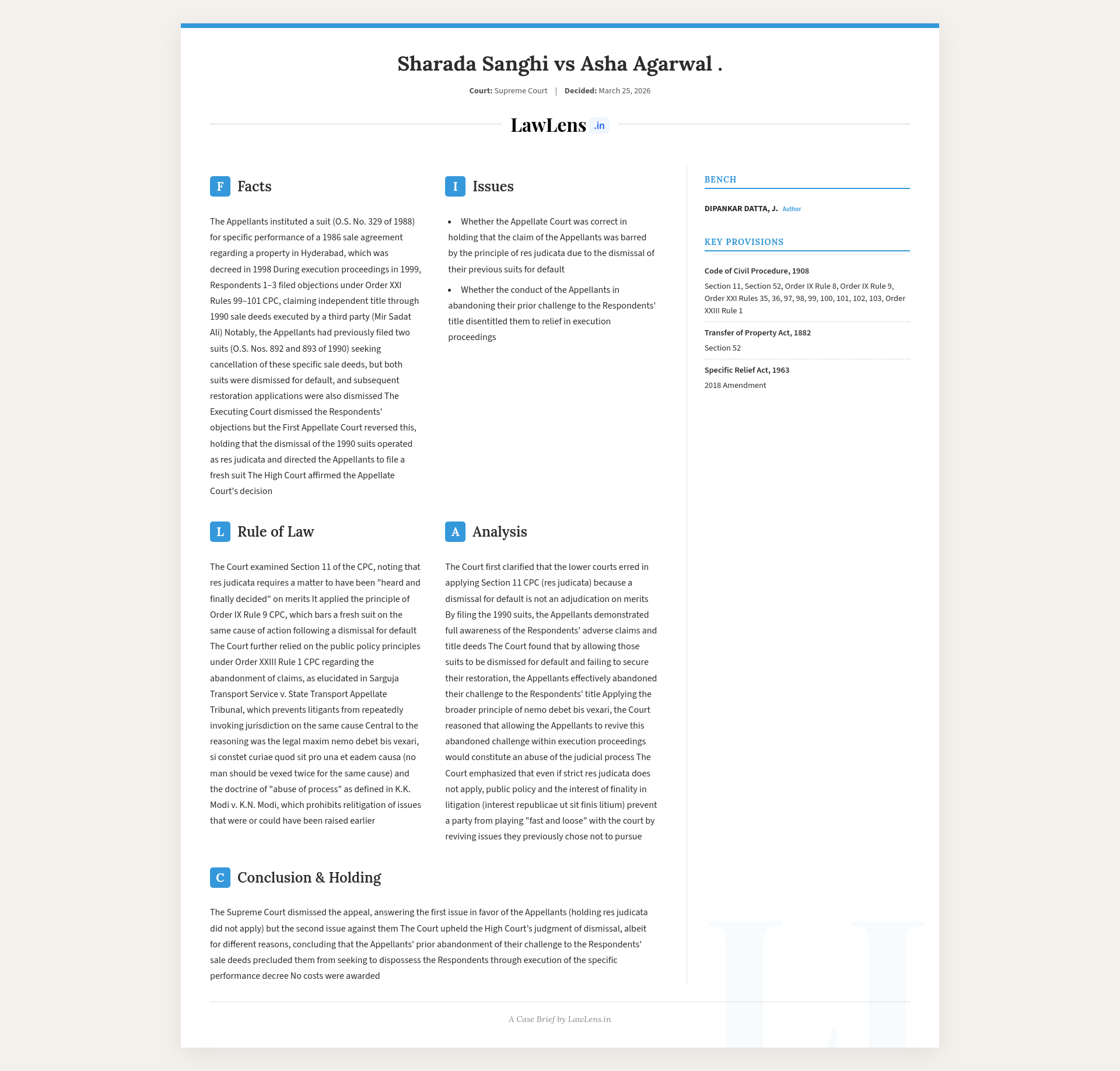
Sharada Sanghi v. Asha Agarwal 2026 INSC 292 - Dismissal For Default - Res Judicata

Code of Civil Procedure 1908 - Section 11 - Res Judicata - Dismissal of a suit for default, not being a decision on merits, cannot ordinarily be regarded as a final adjudication so as to attract the strict application of the principle of Res Judicata under Section 11, CPC. (Para 30) [Context: In this case, the Supreme Court held that although dismissal of earlier suits for default does not operate as res judicata under Section 11 CPC, the plaintiffs’ conduct in instituting and then abandoning those suits bars them, on broader principles akin to nemo debet bis vexari and abuse of process, from re‑agitating the same issues in execution]
Code of Civil Procedure 1908 - Order XXIII Rule 1 - When a plaintiff once institutes a suit in a court and thereby avails of a remedy given to him under law, he cannot be permitted to institute a fresh suit in respect of the same subject matter again after abandoning the earlier suit or by withdrawing it except with the permission of the court to file a fresh suit. (Para 49)
Code of Civil Procedure 1908 -Order IX Rules 8,9 - Once a suit is dismissed for default owing to the absence of the plaintiff but when the defendant is present, the legal consequences under Order IX Rule 8, CPC come into operation. In such a situation, the remedy available to the plaintiff is circumscribed by Order IX Rule 9 of CPC, which expressly bars the institution of a fresh suit on the same cause of action. The only course open to such a plaintiff is to seek restoration of the earlier suit by demonstrating sufficient cause for his absence on the date of dismissal. (Para 39)
Legal Maxim - Nemo debet bis vexari, si constet curiae quod sit pro una et eadem causa- No one ought to be twice troubled, if it appears to the court that it is for one and the same cause of action - It is different from res judicata in the sense that its application in a given situation does not require a decision on merits to be rendered in the earlier round of proceedings before the court. A litigant who set the ball rolling for decision on an issue later elects not to pursue it cannot be permitted to revive the same dispute at a later stage, particularly in collateral or execution proceedings, and that too by seeking to obtain an order behind the back of the contestants.
Legal Maxim - Interest republicae ut sit finis litium -It is in the public interest that litigation must come to an end. Courts cannot allow parties to reopen or indirectly challenge issues which they have chosen not to pursue earlier. (Para 46) The process of the court cannot be used to revive what has already been consciously abandoned. (Para 47)
Case Info
Basic Case Details
Case name and neutral citation:Sharada Sanghi & Ors. v. Asha Agarwal & Ors., 2026 INSC 292
Coram: Justice Dipankar Datta and Justice Augustine George Masih
Judgment date: 25 March 2026 (New Delhi)
Caselaws and Citations Referred
- Shreenath v. Rajesh, (1998) 4 SCC 543
- S.C.F. Finance Co. Ltd. v. Masri (No. 3), [1987] 2 WLR 81
- Khan v. Goleccha International Ltd., [1980] 1 WLR 1482
- Barber v. Staffordshire County Council, [1996] 2 All ER 748 (CA)
- Amruddin Ansari (Dead) Through LRs v. Afajal Ali, 2025 SCC OnLine SC 912
- S.P. Chengalvaraya Naidu v. Jagannath, (1994) 1 SCC 1
- Satluj Jal Vidyut Nigam v. Raj Kumar Rajinder Singh, (2019) 14 SCC 449
- K.K. Modi v. K.N. Modi, (1998) 3 SCC 573
- Greenhalgh v. Mallard, (1947) 2 All ER 255
- McIlkenny v. Chief Constable of West Midlands Police Force, (1980) 2 All ER 227
- Sarguja Transport Service v. State Transport Appellate Tribunal, (1987) 1 SCC 5
Statutes / Laws Referred
- Code of Civil Procedure, 1908
- Section 11 (res judicata)
- Order IX Rules 8 and 9
- Order XXI Rules 35, 36, 97–101, 102
- Order XXIII Rule 1
- Transfer of Property Act, 1882
- Section 52 (doctrine of lis pendens)
- Specific Relief Act, 1963 (pre‑2018 amendment), especially on discretionary nature of specific performance
- Principles of Mohammedan law on validity of oral gift (hiba)
- General equitable and public‑policy maxims:
- nemo debet bis vexari si constet curiae quod sit pro una et eadem causa
- interest reipublicae ut sit finis litium
Brief Summary (Three Sentences)
The Supreme Court held that although dismissal of earlier suits for default does not operate as res judicata under Section 11 CPC, the plaintiffs’ conduct in instituting and then abandoning those suits bars them, on broader principles akin to nemo debet bis vexari and abuse of process, from re‑agitating the same issues in execution. It found that the appellants, fully aware of the respondents’ rival title and having allowed their own cancellation suits and restoration applications to be dismissed, could not later seek to dispossess the respondents by riding on the specific‑performance decree obtained without impleading them. Upholding the appellate court’s interference with execution (though on different reasoning), the Court dismissed the appeal and refused to allow the appellants to reap the benefit of the decree against the respondents.