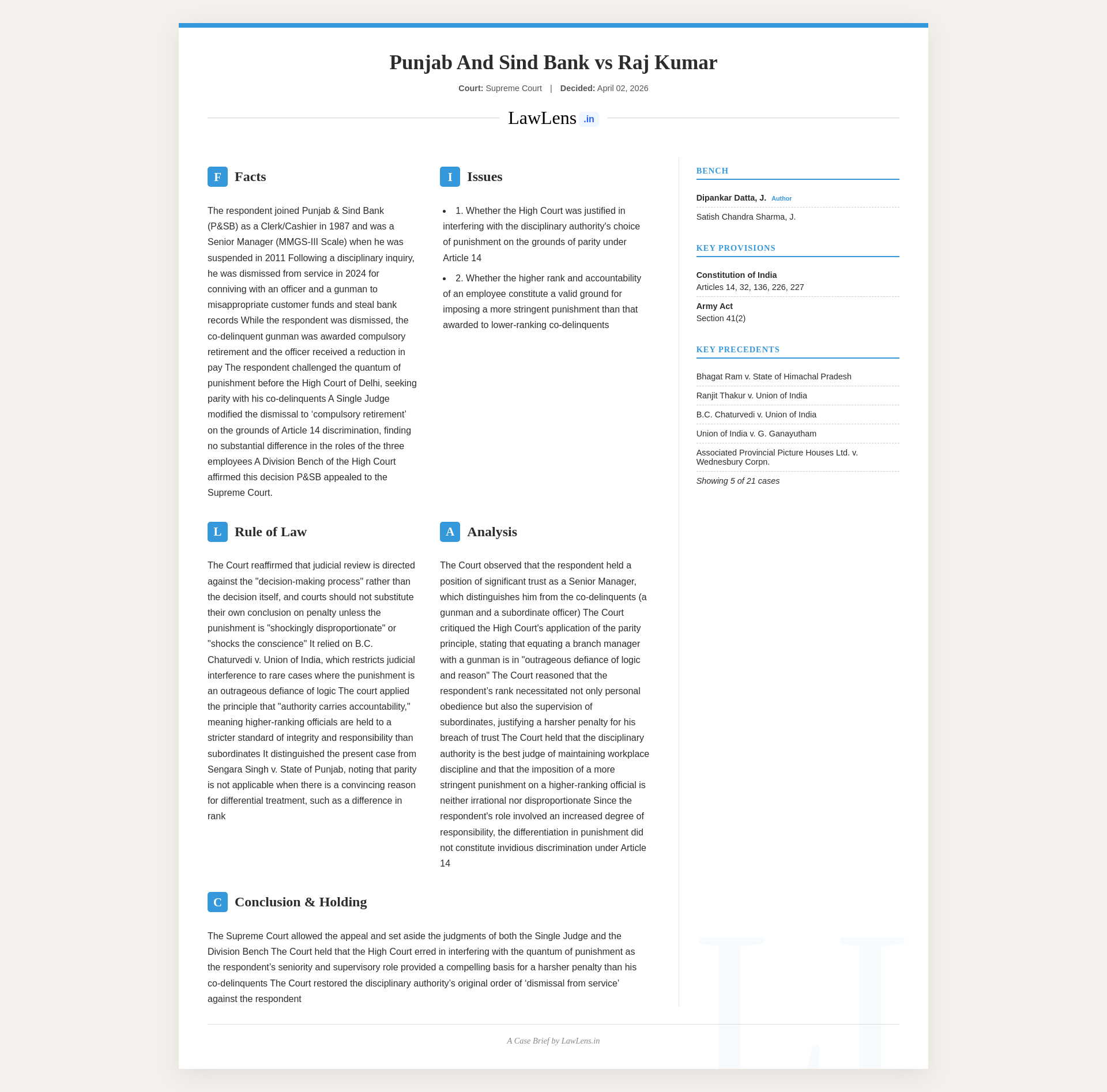
Punjab & Sind Bank v. Sh. Raj Kumar 2026 INSC 313 - Disciplinary Proceedings - Parity - Punishment
The greater the trust reposed, the stricter the scrutiny imposed.

Disciplinary Proceedings -The greater the trust reposed, the stricter the scrutiny imposed -The differentiation in rank coupled with the increased trust of the employer on the employee constitutes a compelling ground for a more stringent punishment to be imposed on him. [ Context: The Supreme Court considered whether the High Court was justified in reducing the punishment of a Senior Manager of Punjab & Sind Bank from dismissal to compulsory retirement on the ground of parity with two co‑delinquents - The Court held that a higher‑ranking officer, entrusted with greater responsibility and supervisory obligations, can legitimately receive a harsher penalty than lower‑ranked co‑delinquents for the same incident. Finding no perversity or irrationality in the bank’s decision to dismiss the respondent, the Court set aside the High Court’s orders and restored the punishment of dismissal from service.]
Constitution of India - Article 14, 226 - Disciplinary Proceedings - No court in exercise of its power of judicial review should interfere with an order of punishment imposed on a delinquent as a measure of disciplinary action by the competent authority and substitute its own judgment for that of the former. interference could be warranted if it appeals to the court that the disciplinary authority has ‘used a sledgehammer for cracking a nut’. A punishment, which is strikingly or shockingly disproportionate and is not commensurate with the gravity of misconduct, proved to have been committed in course of inquiry or otherwise, would border on arbitrariness and offend Article 14 -Where a court, upon due consideration, arrives at the conclusion that the punishment imposed is disproportionate, its intervention is circumscribed in nature. Judicial scrutiny and interference, if at all, has to be based on reasons in support of the court’s ultimate satisfaction that the disciplinary authority has faltered in the exercise of his discretion. In such a situation, the court may adopt one of two courses: it may remit the matter to the competent authority for reconsideration of the punishment; or, in the rarest of cases, it may substitute the punishment while supporting such a course with cogent reasons.. (Para 8-10)
Case Info
Case Details
Case name: Punjab & Sind Bank v. Sh. Raj KumarNeutral citation: 2026 INSC 313Court: Supreme Court of India, Civil Appellate JurisdictionCase number: Civil Appeal No. 847 of 2026Coram: Justice Dipankar Datta and Justice Satish Chandra SharmaJudgment date: April 02, 2026 (New Delhi)
Caselaws and Citations Referred
- Bhagat Ram v. State of Himachal Pradesh, (1983) 2 SCC 442
- Ranjit Thakur v. Union of India, (1987) 4 SCC 611 : 1988 SCC (L&S) 1 : (1987) 5 ATC 113
- B.C. Chaturvedi v. Union of India, (1995) 6 SCC 749 : 1996 SCC (L&S) 80 : (1996) 32 ATC 44
- Union of India v. G. Ganayutham, (1997) 7 SCC 463 : 1997 SCC (L&S) 1806
- Om Kumar v. Union of India, (2001) 2 SCC 386
- Union of India v. R.K. Sharma, (2001) 9 SCC 592
- Chairman and Managing Director, United Commercial Bank v. P.C. Kakkar, (2003) 4 SCC 364
- State of Gujarat v. Anand Acharya, (2007) 9 SCC 310
- S.R. Tewari v. Union of India, (2013) 6 SCC 602
- Rajasthan SRTC v. Bajrang Lal, (2014) 8 SCC 693
- Sengara Singh v. State of Punjab, (1983) 4 SCC 225
Statutes / Laws Referred
The judgment primarily applies constitutional and administrative law principles, notably:
- Article 14 of the Constitution of India (equality, arbitrariness, proportionality in punishment).
- Internal service rules: Punjab and Sind Officer Employees’ (Conduct) Regulations, 1981 (governing disciplinary proceedings and misconduct of bank officers).