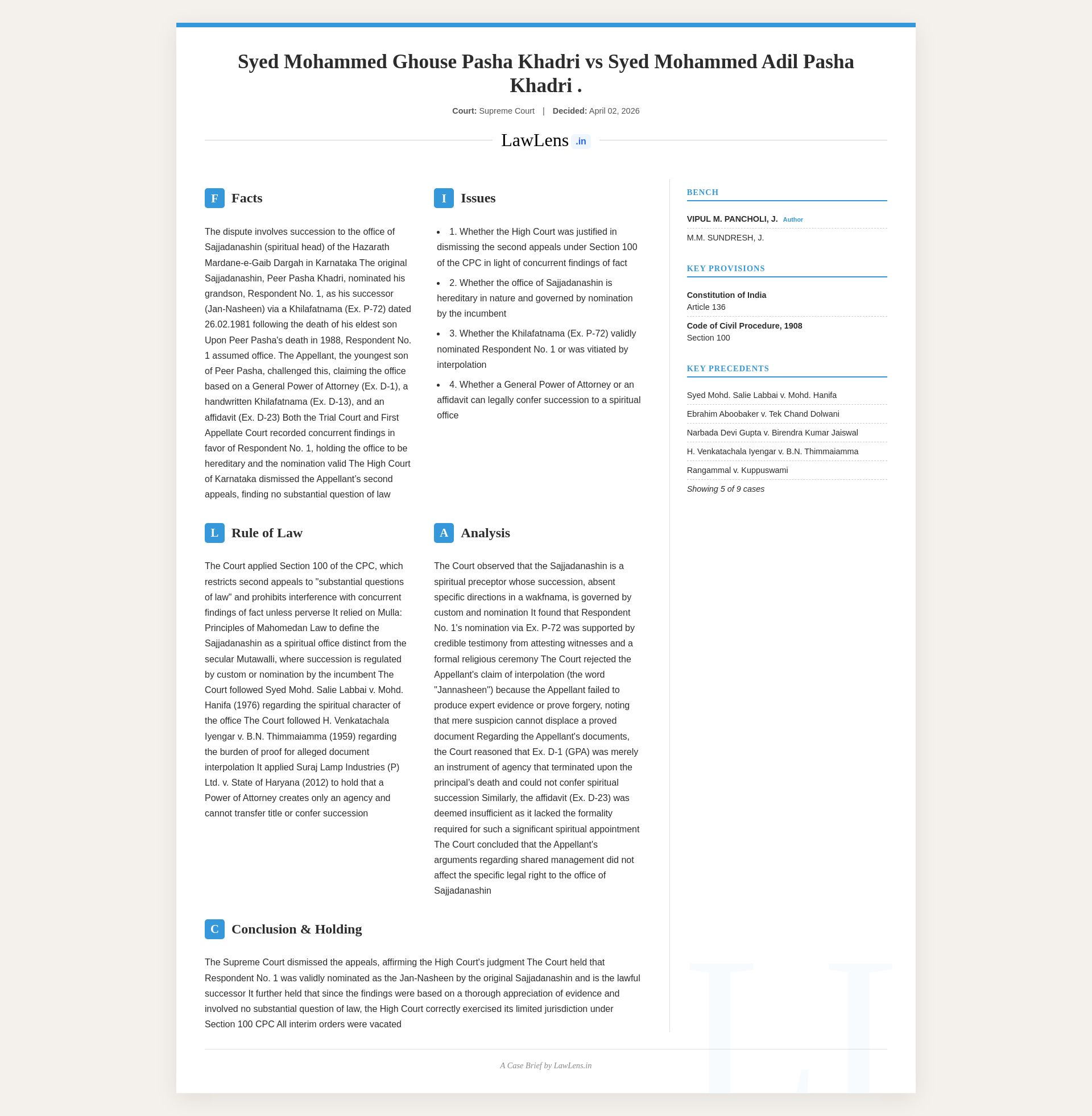
Syed Mohammed Ghouse Pasha Khadri v. Syed Mohammed Adil Pasha Khadri 2026 INSC 314 - Sajjadanashin - Mutawalli - Power Of Attorney
" A document which merely authorises another person to act on behalf of the executant cannot be construed as conferring succession to a spiritual office such as that of a Sajjadanashin. "

Power of Attorney - A power of attorney creates only an agency relationship and does not transfer title or confer independent rights. The authority granted under such an instrument is ordinarily co-terminus with the life and authority of the principal. Consequently, a power of attorney cannot operate as a mode of succession to a religious office. (Para 46) A power of attorney is merely an instrument of agency and cannot by itself transfer ownership or create proprietary rights. Applying the same principle, a document which merely authorises another person to act on behalf of the executant cannot be construed as conferring succession to a spiritual office such as that of a Sajjadanashin. Para 47)
Constitution of India - Article 136 - while exercising jurisdiction under Article 136 of the Constitution, the Court does not ordinarily interfere with concurrent findings of fact unless such findings suffer from manifest illegality or result in grave miscarriage of justice. (Para 54)
Evidence - Mere suspicion cannot displace a document which has otherwise been duly proved. The burden of establishing forgery or interpolation lies on the party alleging it. (Para 42)
Waqf Act 1995 -The office of the mutawalli and Sajjadanashin cannot be said to be one and the same in view of the aforesaid discussion. Sajjadanashin of a Waqf can also discharge the function of its Mutawalli, if appointed under Section 32(2)(g) of the Act of 1995, however, Mutawalli under Section 32(2)(g) cannot function as a Sajjadanashin but can only perform the duties as prescribed under the Act and the Rules. Sajjadanashin is the spiritual head of Waqf and declaration of Sajjadanashin is a religious affair, however, role of Mutawalli of a Waqf only pertains to the administration and management of the Waqf. (Para 42)
Context: The Supreme Court upheld concurrent findings that the office of Sajjadanashin of the Hazarath Mardane‑e‑Gaib Dargah, Shivasamudram, is hereditary and that Syed Mohammed Adil Pasha Khadri was validly nominated through the 1981 Khilafatnama, dismissing the rival claim of Syed Mohammed Ghouse Pasha Khadri. It held that allegations of interpolation in the Khilafatnama were unproved, that documents like GPA and affidavits cannot themselves confer Sajjadanashinship, and that no substantial question of law arose to justify interference under Section 100 CPC. In the connected Channapatna “Big Makan” matter, the Court clarified that a Sajjadanashin is a spiritual head distinct from a Mutawalli, that civil courts do have jurisdiction over disputes about appointment of Sajjadanashin, set aside the High Court’s ruling treating the decrees as nullities for want of jurisdiction, restored the trial and first‑appeal decrees, and remitted the second appeals to the High Court for decision on merits (other than jurisdiction).
Case Info
Extracted Information
Case name and neutral citation:Syed Mohammed Ghouse Pasha Khadri v. Syed Mohammed Adil Pasha Khadri & Ors. Etc., 2026 INSC 314
Coram:Hon’ble Mr. Justice M.M. Sundresh and Hon’ble Mr. Justice Vipul M. Pancholi
Judgment date:02 April 2026 (New Delhi)
Key case laws and citations referred:
From the first appeal (Sajjadanashin of Hazarath Mardane‑e‑Gaib Dargah, Shivasamudram):
- Santosh Hazari v. Purushottam Tiwari, (2001) 3 SCC 179
- Syed Mohd. Salie Labbai v. Mohd. Hanifa, (1976) 4 SCC 780
- Ebrahim Aboobaker v. Tek Chand Dolwani, AIR 1953 SC 298
- Narbada Devi Gupta v. Birendra Kumar Jaiswal, (2003) 8 SCC 745
- H. Venkatachala Iyengar v. B.N. Thimmaiamma, AIR 1959 SC 443
- Rangammal v. Kuppuswami, (2011) 12 SCC 220
- Suraj Lamp & Industries (P) Ltd. v. State of Haryana, (2012) 1 SCC 656
From the second set of appeals (Hazarath Akhil Shah Quadri Dargah – “Big Makan”, Channapatna):
- Ramesh Gobindram (Dead) through LRs v. Sugra Humayun Mirza Wakf, (2010) 8 SCC 726
- S.V. Cheriyakoya Thangal v. S.V.P. Pookoya & Ors., 2024 SCC OnLine SC 1586
- Fakhruddin v. Tajuddin, (2008) 8 SCC 12
- Mumtaz Yarud Dowla Wakf v. Badam Balakrishna Hotel (P) Ltd., 2023 SCC OnLine SC 1378
- Kolhapur Canesugar Works Ltd. v. Union of India, (2000) 2 SCC 536
- Harshad Chiman Lal Modi v. DLF Universal Ltd., (2005) 7 SCC 791
- Aliya Thammuda Beethathebiyyappura Pookoya v. Pattakal Cheriyakoya, (2019) 16 SCC 1
The judgment also relies heavily on standard texts:
- Mulla, Principles of Mahomedan Law (20th Edn., Ch. XII – Wakfs)
- Asaf A.A. Fyzee, Outlines of Muhammadan Law
- Ameer Ali, Mahommedan Law
Statutes / laws referred:
- Code of Civil Procedure, 1908 – particularly Section 100 CPC (Regular Second Appeal jurisdiction)
- Waqf Act, 1995 – especially Sections 3(i), 32, 50, 64, 83, 85
- Earlier Waqf Act, 1954 (pari materia definitions)
- Karnataka Waqf Rules, 2017 – Rule 2(xiii) (definition of Sajjadanashin) and Rule 57 (duties of Mutawalli)
- Article 136 of the Constitution of India (Supreme Court’s special leave jurisdiction)