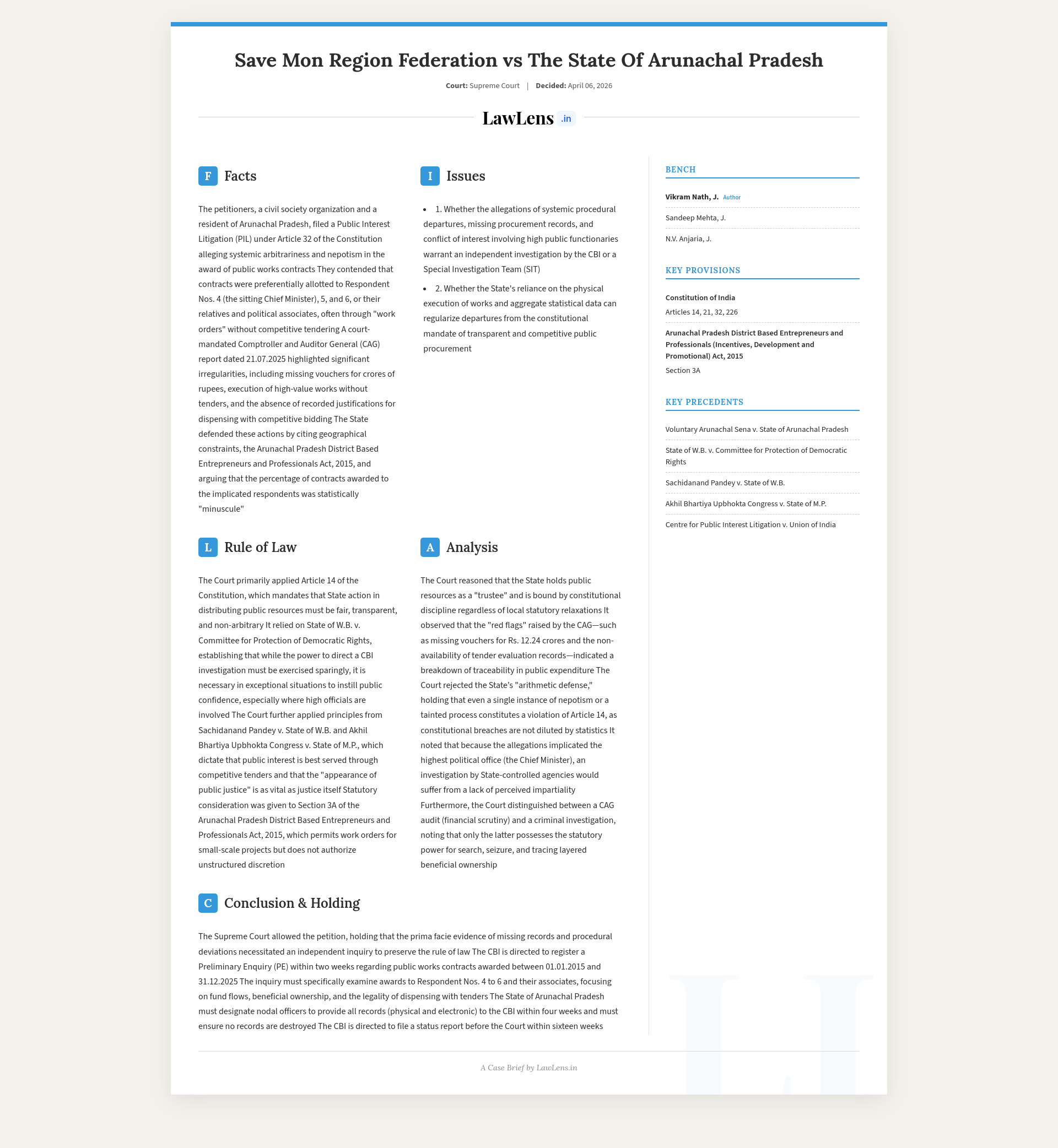
Save Mon Region Federation v State of Arunachal Pradesh 2026 INSC 320 - Public Resources - CBI Investigation
While considering a request for CBI investigation or constitution of an SIT, the Court does not undertake an adjudication on culpability.

Constitution of India - Article 32- While considering a request for CBI investigation or constitution of an SIT, the Court does not undertake an adjudication on culpability. The Court examines whether the material placed discloses a prima facie case which necessitates entrustment of investigation to an independent agency so that the rule of law is upheld and the investigative process commands confidence, particularly where the status or authority of persons implicated may reasonably give rise to apprehensions about the impartiality of the ordinary investigative process. In determining whether the extraordinary jurisdiction to entrust investigation to the CBI should be exercised, the Court ordinarily examines whether the material placed before it discloses (i) a prima facie case raising serious questions of legality, (ii) circumstances suggesting that investigation by the ordinary State machinery may not inspire confidence where high public functionaries are implicated, and (iii) the necessity of an independent inquiry to preserve public confidence in the rule of law. (Para 9) [Context: The petitioners alleged systemic arbitrariness, nepotism, conflict of interest, and serious procedural violations in the award of public works contracts in Arunachal Pradesh, particularly favouring the Chief Minister (Respondent No. 4), Respondents 5 and 6, and related entities, often through non‑tender “work orders” and with missing core procurement records. Relying on constitutional principles of transparency and equality in public procurement, the Supreme Court held that repeated resort to non‑competitive methods, absence of recorded reasons, and gaps in vouchers and tender documentation—corroborated by the CAG audit findings—raise prima facie concerns of abuse of public office and conflict of interest that cannot be answered by general affidavits or statistical percentages. The Court therefore directed the CBI to register a preliminary enquiry and conduct a time‑bound investigation into public works contracts and work orders in Arunachal Pradesh between 01.01.2015 and 31.12.2025, with full cooperation and preservation of records by the State, while clarifying that its observations are only for deciding on the need for an independent investigation.]
Constitution of India - Article 14,32 -Public Resources - The award of public contracts is an exercise of public power. It involves the expenditure of public funds and the conferment of economic benefit by the State. Such decisions are not insulated as matters of private contract. They are subject to the discipline of Article 14 of the Constitution of India, because the State must act fairly, transparently, and in a non-arbitrary manner when it distributes public resources (Para 10) The State does not hold public resources as a private proprietor, but as a trustee on behalf of the people. Whenever the State undertakes the allocation of public resources, the award of public contracts, or the execution of public works, it is bound to act in a manner that is transparent, fair, and consistent with the guarantee of equality under Article 14 of the Constitution of India. The process through which such decisions are taken must therefore be capable of withstanding objective scrutiny and must reflect a decision-making framework that is free from arbitrariness, favouritism, or undisclosed conflicts of interest- Public confidence in governance rests upon the assurance that opportunities created by the State are administered through institutions that respect equality, integrity, and accountability. Where the distribution of public resources is clouded by allegations of nepotism, patronage, or opaque decisionmaking, the issue is not merely one of administrative irregularity. It raises concerns that go to the heart of the constitutional promise that State action shall be fair, impartial, and guided by reason. Constitutional courts, as guardians of that promise, are therefore required to ensure that the exercise of public authority remains anchored in legality, transparency, and institutional accountability. (Para 1-2)
Case Info
Here’s the information extracted from the judgment you’re viewing:
Basic Case Details
Case name: Save Mon Region Federation & Anr. v. State of Arunachal Pradesh & Ors.Neutral citation: 2026 INSC 320Coram: Vikram Nath, J.; Sandeep Mehta, J.; N.V. Anjaria, J.Judgment date: April 06, 2026 (New Delhi)
Caselaws and Citations Referred
- State of W.B. v. Committee for Protection of Democratic Rights, (2010) 3 SCC 571
- Sachidanand Pandey v. State of W.B., (1987) 2 SCC 295
- Akhil Bhartiya Upbhokta Congress v. State of M.P., (2011) 5 SCC 29
- Centre for Public Interest Litigation v. Union of India, (2012) 3 SCC 1
Statutes / Laws Referred
The judgment refers to, among others:
- Constitution of India
- Article 14 (equality and non‑arbitrariness in State action)
- Article 21 (protection of life and personal liberty, in context of fair investigation)
- Article 32 (writ jurisdiction of Supreme Court, public interest litigation and power to order CBI probe)
- Article 226 (in discussing precedent on court‑directed CBI investigations)
- Arunachal Pradesh District Based Entrepreneurs and Professionals (Incentives, Development and Promotional) Act, 2015, including Section 3A (work orders up to Rs 50 lakhs without tender, subject to conditions).