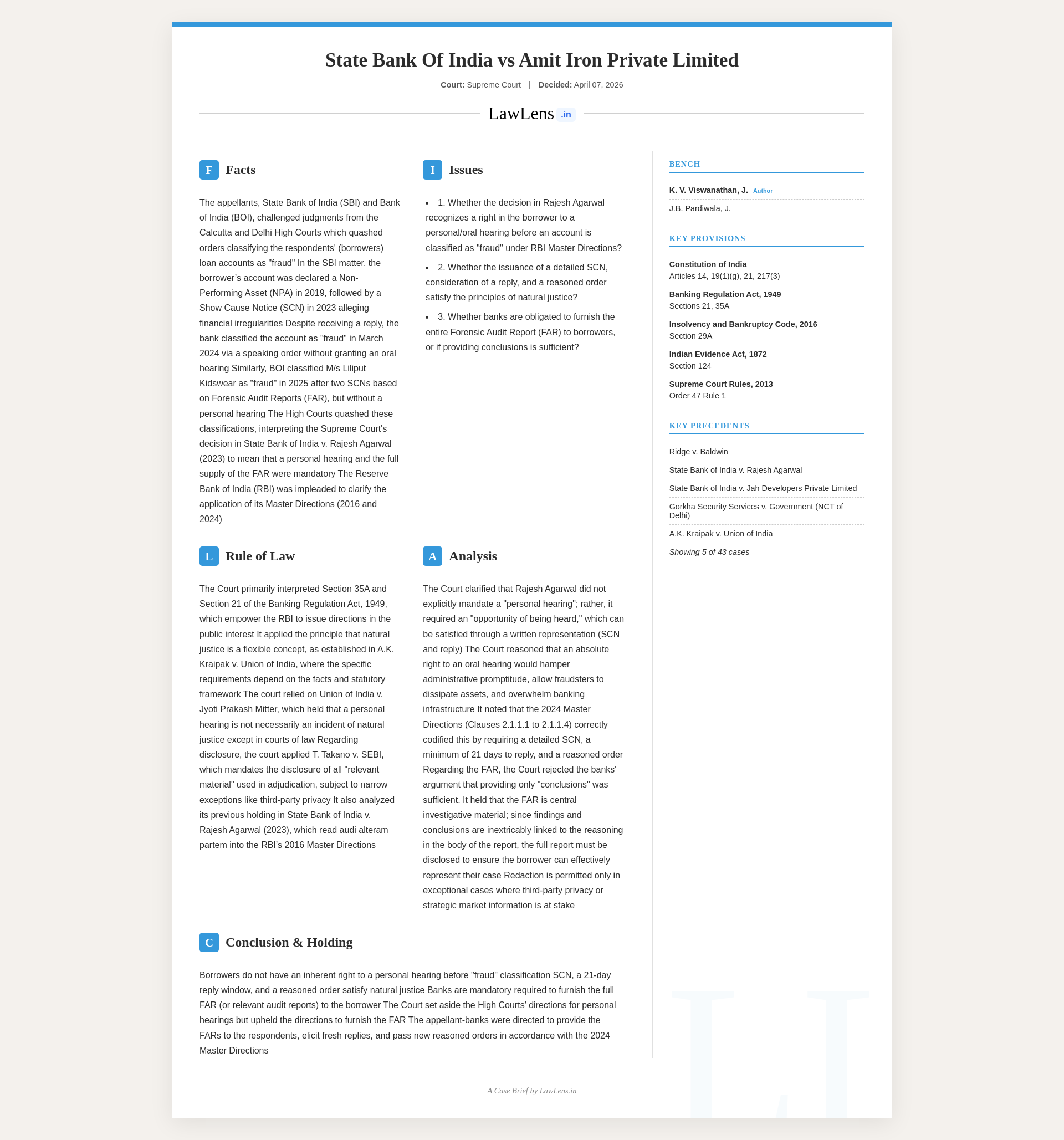
State Bank of India v. Amit Iron Private Limited 2026 INSC 323 - RBI Directions - Fraud Accounts Declaration - Personal Hearing Right
Borrowers do not have a right to a personal/oral hearing before banks classify their loan accounts as “fraud” under RBI’s fraud Master Directions.

Banking Law -Reserve Bank of India (Fraud Risk Management in Commercial Banks (including Regional Rural Banks) and All India Financial Institutions) Directions, 2024 - Borrowers do not have a right to a personal/oral hearing before banks classify their loan accounts as “fraud” under RBI’s fraud Master Directions, and that the procedure of show‑cause notice, disclosure of material, written reply and a reasoned order sufficiently satisfies principles of natural justice. At the same time, it rules that where banks rely on forensic/other audit reports for fraud classification, furnishing those audit reports to the borrower is the rule and is mandatory, subject only to narrow, recorded exceptions for genuinely sensitive third‑party material which may be redacted. a) State Bank of India & Ors. v. Rajesh Agarwal & Ors., (2023) 6 SCC 1 did not recognize any right in the borrower to a personal hearing by the banks before classifying their account as a fraud account; b) The RBI in its Master Directions of 15.07.2024 correctly understood the scope of Rajesh Agarwal (supra) and incorporated Clause 2.1.1.1, 2.1.1.2, 2.1.1.3, and 2.1.1.4 as the procedure to be followed before classifying an account as a fraud account; c) The procedure set out in Rajesh Agarwal (supra) which has been incorporated in the Master Directions of 2024 strikes a fair balance between promptitude and fairness and duly comports with the principles of natural justice ensuring fairness to the borrower whose account is likely to be classified as a fraud account. d) Wherever audit reports are available, including forensic audit reports, the same shall be furnished to the borrower and their representation on the report, including on the findings and conclusions be elicited, in case the banks consider the audit report relevant for classifying the account as fraud account. In view of the same, disclosure by furnishing copies of the audit report, including the forensic audit report to the borrower is mandatory. Supply of reports in digital form will be valid compliance; e) If the banks, for reasons to be recorded establish that the disclosure of any part of the report would effect the privacy of third parties, in that exceptional situation banks would be justified to withhold those portions of the report which concern third party rights; f) The rule is to supply the audit reports, including the forensic audit reports since even under Clause 4 of Chapter IV of the 15.07.2024 Master Directions post the red-flagging of the account banks use the audit mechanism for further investigation. Even in the exceptional cases we hope and expect that the banks will not unreasonably use the power of redaction since that will only end up delaying the culmination of proceedings. Clause 4.1.4 also reiterates that banks shall ensure the principles of natural justice.
Doctrine of Merger - Once the Superior Court has disposed of the lis and irrespective of whether the decree or order under appeal is set aside or modified or simply confirmed, it is the decree or order of the Superior Court, Tribunal or Authority which is the final binding of an operative decree, wherein merges the decree passed by the Court below. In certain cases reasons for decision can also be said to have merged in the order of Superior Court if the superior Court has while formulating its own judgment or order either adopted or reiterated the reasoning, or recorded an express approval of the reasoning, incorporated in the judgment or order of the fora below. (Para 105)
Precedent - Judgments of Court are not to be read like theorems of Euclid - A case is only an authority for what it actually decides and it cannot be quoted for a proposition that may seem to follow logically. (Para 105- 108)
Case Info
Case name and neutral citation:State Bank of India v. Amit Iron Private Limited & Ors. (with connected appeals including Bank of India v. Liliput Kidswear Ltd. & Ors.), 2026 INSC 323
Coram:Hon’ble Mr. Justice J.B. Pardiwala and Hon’ble Mr. Justice K.V. Viswanathan (judgment authored by K.V. Viswanathan, J.)
Judgment date:7 April 2026 (as noted at the end of the judgment)
Key case laws and citations referred:
- Ridge v. Baldwin, 1964 AC 40
- State Bank of India & Ors. v. Rajesh Agarwal & Ors., (2023) 6 SCC 1
- State Bank of India v. Jah Developers Private Limited & Ors., (2019) 6 SCC 787
- Gorkha Security Services v. Government (NCT of Delhi) & Ors., (2014) 9 SCC 105
- A.K. Kraipak v. Union of India, (1969) 2 SCC 262
- Natwar Singh v. Directorate of Enforcement, (2010) 13 SCC 255
- T. Takano v. SEBI, (2022) 8 SCC 162
- Madhyamam Broadcasting Limited v. Union of India, (2023) 13 SCC 401
- Electronics Corporation of India Ltd. v. B. Karunakar, (1993) 4 SCC 727
- Union of India v. Jesus Sales Corporation, (1996) 4 SCC 69
- Union of India v. Jyoti Prakash Mitter, (1971) 1 SCC 396
- State of Maharashtra v. Lok Shikshan Sanstha, (1971) 2 SCC 410
- Chairman, Board of Mining Examination v. Ramjee, (1977) 2 SCC 256
- Kunhayammed v. State of Kerala, (2000) 6 SCC 359
- S. Shanmugavel Nadar v. State of T.N., (2002) 8 SCC 361
- Goodyear India Ltd. v. State of Haryana, (1990) 2 SCC 71
- Union of India v. Mohan Lal Capoor, (1973) 2 SCC 836
- K.S. Puttaswamy v. Union of India, (2017) 10 SCC 1
- Modern Dental College & Research Centre v. State of M.P., (2016) 7 SCC 353
- A.K. Roy v. Union of India, (1982) 1 SCC 271
- Olga Tellis v. Bombay Municipal Corporation, (1985) 3 SCC 545
- S.L. Kapoor v. Jagmohan, (1980) 4 SCC 379
- Dhakeswari Cotton Mills Ltd. v. CIT, (1954) 2 SCC 602
- Mona Jignesh Acharya v. Bank of India, 2021 SCC OnLine Guj 2811 (Gujarat HC)
- Goldberg v. Kelly, 397 US 254 (1970)
- Matthews v. Eldridge, 424 US 319 (1976)
- R (Smith) v. Parole Board, [2005] UKHL 1
- Dr S Sengupta v. CN Holmes, [2002] EWCA Civ 1104
- Quinn v. Leathem, [1901] AC 495
(Several of these are discussed at length in relation to natural justice and fair hearing.)
Statutes / laws referred:
- Banking Regulation Act, 1949 – Sections 21 and 35A (RBI’s power to issue binding directions and determine policy on advances)
- Reserve Bank of India (Frauds Classification and Reporting by Commercial Banks and Select FIs) Directions, 2016 (“Master Directions‑2016”)
- Reserve Bank of India (Fraud Risk Management in Commercial Banks (including Regional Rural Banks) and All India Financial Institutions) Directions, 2024 (“Master Directions‑2024”) – esp. Chapter II, clause 2.1.1.1–2.1.1.4; Clause 6.1; Chapter IV, clause 4 etc.
- RBI Master Circulars on Wilful Defaulters (including circular dated 30.07.2024 and earlier 28.11.2025 circular)
- Constitution of India – Articles 14, 19(1)(g), 21 (civil consequences, blacklisting, right to reputation and to carry on business, proportionality)
- Insolvency and Bankruptcy Code, 2016 – Section 29A (relevance of fraud label/wilful default to ineligibility under IBC is discussed conceptually)
Three‑sentence brief summary
The Supreme Court holds that borrowers do not have a right to a personal/oral hearing before banks classify their loan accounts as “fraud” under RBI’s fraud Master Directions, and that the procedure of show‑cause notice, disclosure of material, written reply and a reasoned order sufficiently satisfies principles of natural justice. At the same time, it rules that where banks rely on forensic/other audit reports for fraud classification, furnishing those audit reports to the borrower is the rule and is mandatory, subject only to narrow, recorded exceptions for genuinely sensitive third‑party material which may be redacted. Applying these principles, the Court partly allows SBI/Bank of India’s appeals by setting aside the High Courts’ directions mandating personal hearing, but upholds the directions requiring supply of forensic audit reports and directs the banks’ committees to re‑decide classification after giving borrowers that disclosure and an opportunity to respond.