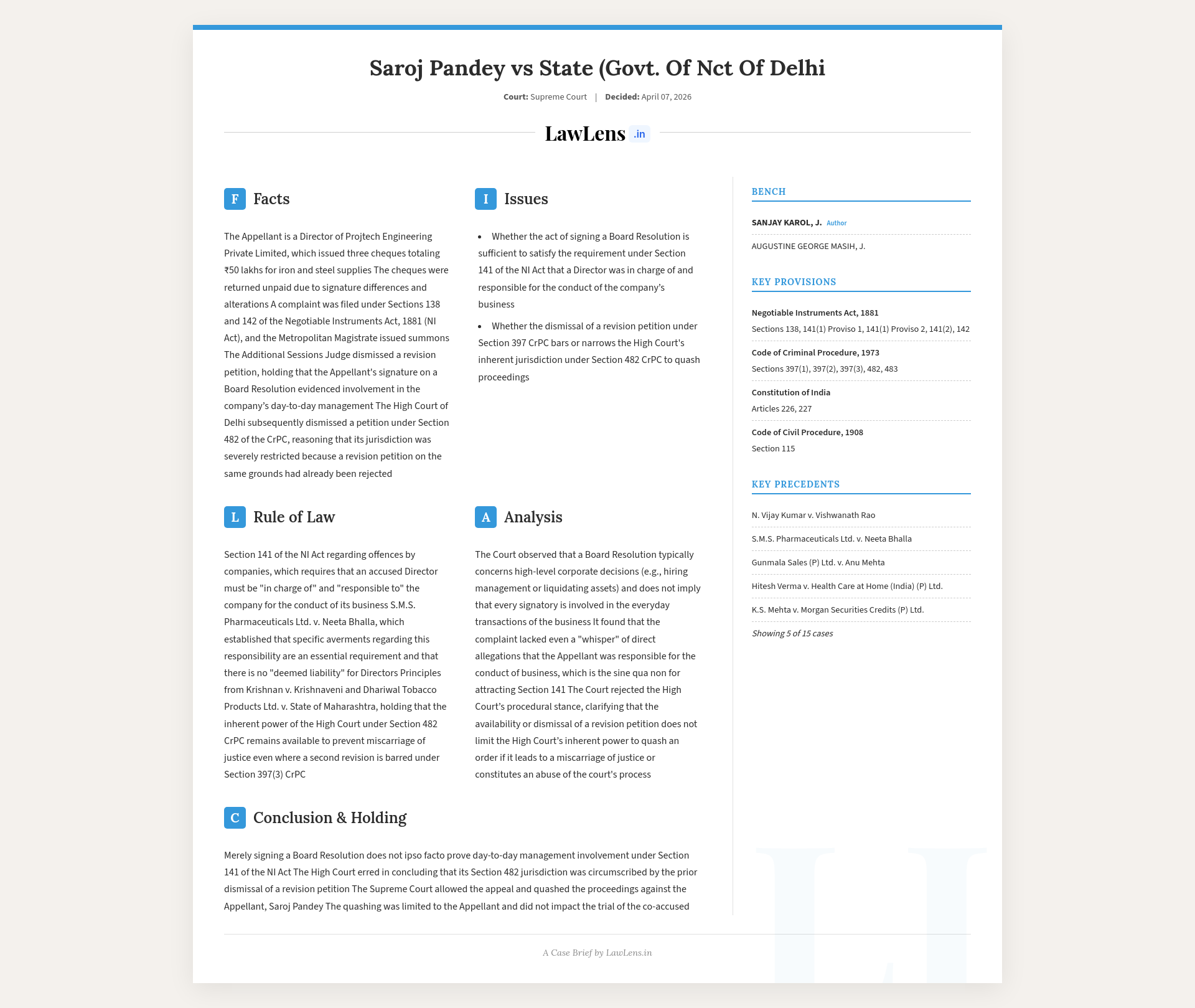
Saroj Pandey v. Govt. of NCT of Delhi 2026 INSC 324 - S.141 NI Act - Board Resolution
A Board Resolution is a document that is signed by the members of the Board of Directors for decisions taken or conclusions arrived at for matters placed before the Board for consideration and decision.

Negotiable Instruments Act 1882 - Section 138,141 - A Board Resolution is a document that is signed by the members of the Board of Directors for decisions taken or conclusions arrived at for matters placed before the Board for consideration and decision. This may be inter alia regarding hiring of personnel at management levels, acquisition or liquidation of assets affecting the overall position of the assets and liabilities of the Company or any other such major directional issue. This, however, does not in any manner mean that each and every member of the Board of Directors is aware of all decisions taken in the everyday transactions that are involved in running a business concern. (Para 8)
Code of Criminal Procedure 1973 - Section 482, 397 - Supreme Court disapproved the view of the High Court that once a petition under Section 397 Cr.PC has been entertained, irrespective of its end result, a subsequent petition under Section 482 Cr.PC on the same grounds limits the jurisdiction of the latter and in ordinary course matters are liable to be dismissed on this short ground alone - though the revision before the High Court under subsection (1) of Section 397 is prohibited by subsection (3) thereof, inherent power of the High Court is still available under Section 482 of the Code and as it is paramount power of continuous superintendence of the High Court under Section 483. (Para 9-11)
Factual Summary
The appellant, a director of Projtech Engineering Pvt. Ltd., was summoned in a cheque dishonour case under Sections 138 and 141 NI Act solely because she had signed a board resolution, with no specific allegation that she was in charge of and responsible for the conduct of the company’s business. Applying settled law from S.M.S. Pharmaceuticals, Gunmala Sales and related precedents, the Supreme Court held that mere directorship or signing of a board resolution does not satisfy the mandatory pleading requirement under Section 141 and that there was not even a basic averment connecting her with day‑to‑day management. The Court therefore quashed the proceedings against Saroj Pandey and also clarified, relying on Krishnan v. Krishnaveni and Dhariwal Tobacco, that a petition under Section 482 CrPC is not barred merely because a revision under Section 397 was earlier filed.
Case Info
Basic case details
Case name: Saroj Pandey v. Govt. of NCT of Delhi and Ors.
Neutral citation: 2026 INSC 324
Coram: Sanjay Karol, J. and Augustine George Masih, J.
Judgment date: 7 April 2026 (New Delhi)
Case law and citations referred
The judgment refers to and applies several Supreme Court decisions on Section 138/141 NI Act and the scope of Section 482 CrPC:
- N. Vijay Kumar v. Vishwanath Rao N., 2025 SCC OnLine SC 873
- S.M.S. Pharmaceuticals Ltd. v. Neeta Bhalla, (2005) 8 SCC 89
- Gunmala Sales (P) Ltd. v. Anu Mehta, (2015) 1 SCC 103
- Hitesh Verma v. Health Care at Home (India) (P) Ltd., (2025) 7 SCC 623
- K.S. Mehta v. Morgan Securities & Credits (P) Ltd., (2025) 7 SCC 615
- Krishnan & Anr. v. Krishnaveni & Anr., (1997) 4 SCC 241
- Madhu Limaye v. State of Maharashtra, (1977) 5 SCC 551
- V.C. Shukla v. State through CBI, 1980 Supp SCC 92
- Dhariwal Tobacco Products Ltd. v. State of Maharashtra, (2009) 2 SCC 370
- Prabhu Chawla v. State of Rajasthan, (2016) 16 SCC 30
- R.P. Kapur v. State of Punjab, AIR 1960 SC 866
- Som Mittal v. Govt. of Karnataka, (2008) 3 SCC 574 : (2008) 2 SCC (Cri) 1 : (2008) 1 SCC (L&S) 910
- Surya Dev Rai v. Ram Chander Rai, (2003) 6 SCC 675
- Puran v. Rambilas, (2001) 6 SCC 338 : 2001 SCC (Cri) 1124
- Kailash Verma v. Punjab State Civil Supplies Corpn., (2005) 2 SCC 571 : 2005 SCC (Cri) 538
Statutes / provisions referred
The Court discusses:
- Negotiable Instruments Act, 1881
- Section 138 – Dishonour of cheque
- Section 141 – Offences by companies
- Section 142 – Cognizance of offences
- Code of Criminal Procedure, 1973
- Section 482 – Inherent powers of High Court
- Section 397 – Revisional jurisdiction
- Section 483 – Powers of High Court to exercise continuous superintendence
The judgment also generally refers to criminal appellate jurisdiction of the Supreme Court.