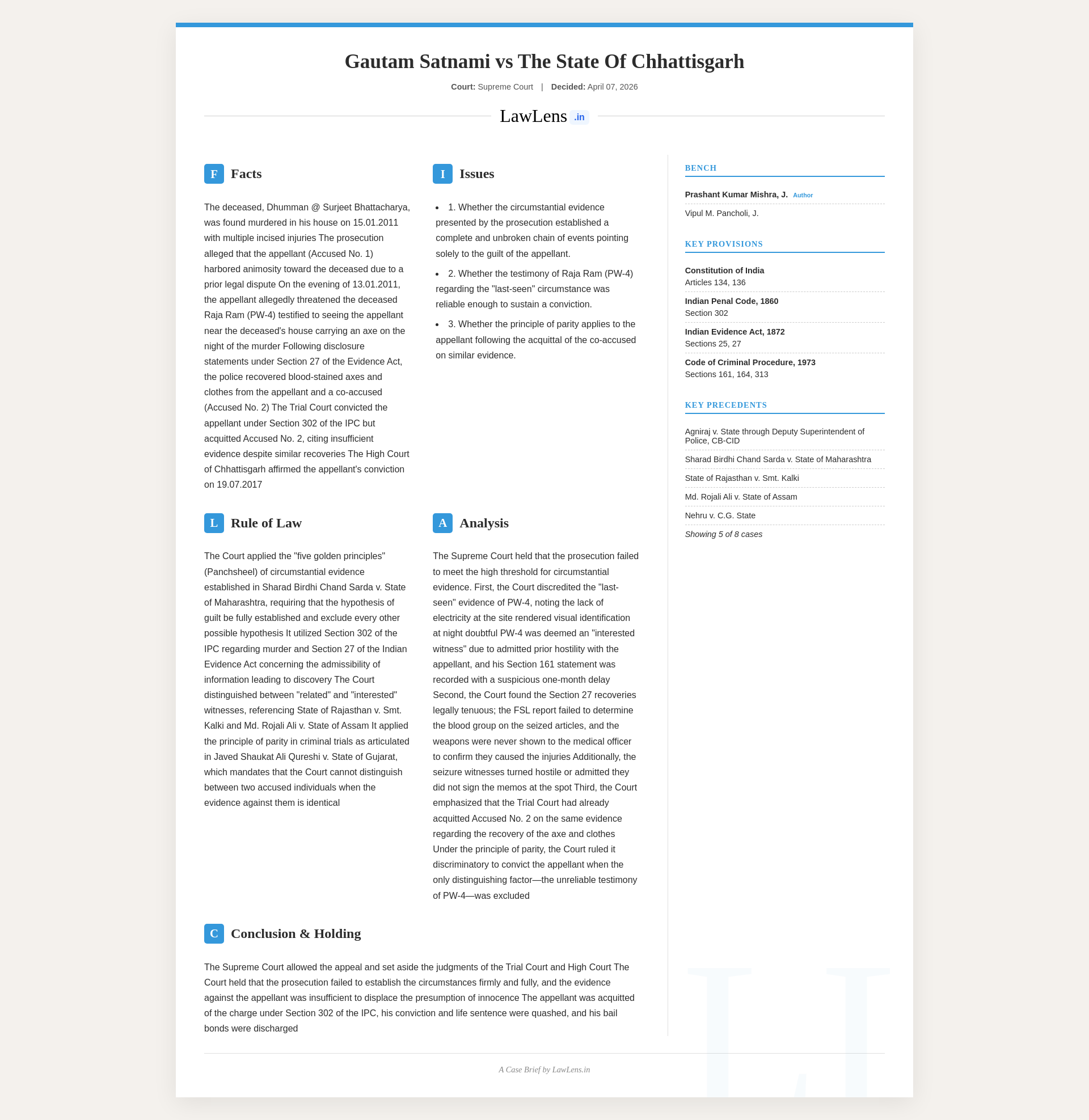
Gautam Satnami @ Gautam Deshlahre v. State of Chhattisgarh 2026 INSC 325- Related and Interested Witness
A ‘related’ witness is not necessarily an ‘interested’ witness, and an ‘interested’ witness need not be a ‘related’ one.

Criminal Trial - A ‘related’ witness is not necessarily an ‘interested’ witness, and an ‘interested’ witness need not be a ‘related’ one. (Para 19)
Criminal Trial - Circumstantial Evidence - Five ‘golden principles’ laid down in Sharad Birdhi Chand Sarda vs. State of Maharashtra - I. the circumstances from which the conclusion of guilt is to be drawn should be fully established; II. the facts so established should be consistent only with the hypothesis of the guilt of the accused, that is to say. they should not be explainable on any other hypothesis except that the accused is guilty; III. the circumstances should be of a conclusive nature and tendency; IV. they should exclude every possible hypothesis except the one to be proved; and V. there must be a chain of evidence so complete as not to leave any reasonable ground for the conclusion consistent with the innocence of the accused and must show that in all human probability the act must have been done by the accused. (Para 14)
Case Info
Basic Case Details
Case name: Gautam Satnami @ Gautam Deshlahre v. State of Chhattisgarh
Neutral citation: 2026 INSC 325
Court & Coram: Supreme Court of India, Criminal Appellate JurisdictionBench: Justice Prashant Kumar Mishra and Justice Vipul M. Pancholi
Judgment date: 07 April 2026 (New Delhi)
Statutes / Laws Referred
Indian Penal Code, 1860:
- Section 302 (murder)
Code of Criminal Procedure, 1973:
- Section 313 (examination of accused)
- Sections 161 and 164 (recording of statements)
Indian Evidence Act, 1872:
- Section 25 (confession to police officer inadmissible)
- Section 27 (disclosure leading to discovery)
Constitution of India:
- Article 134 (criminal appeals to Supreme Court)
- Article 136 (special leave jurisdiction)
Case Laws and Citations Cited
- Sharad Birdhi Chand Sarda v. State of Maharashtra, 1984 INSC 121 (five golden principles for conviction on circumstantial evidence).
- Agniraj & Ors. v. State through Deputy Superintendent of Police, CBCID, 2025 INSC 774 (scope of Article 136; “self‑imposed constraints on interference”; power to correct striking defects in prosecution evidence).
- State of Rajasthan v. Smt. Kalki & Anr., 1981 INSC 94 (distinction between “related” and “interested” witnesses).
- Md. Rojali Ali & Ors. v. The State of Assam, Ministry of Home Affairs through the Secretary, 2019 INSC 223 (who is an “interested” witness; prior enmity and motive to falsely implicate).
- Nehru v. State of Chhattisgarh, 2005 (1) MANISA 90 (C.G.) (blood on weapon/cloth alone insufficient to connect accused with murder).
- Hanumant Govind Nargundkar v. State of Madhya Pradesh, AIR 1960 SC 29 (links in chain of circumstantial evidence must be complete; if a single link fails, conviction cannot stand).
- Javed Shaukat Ali Qureshi v. State of Gujarat, 2023 INSC 829 (principle of parity: where evidence and role are similar, court cannot convict one accused and acquit another).
- Ram Singh v. State of U.P., 2024 INSC 128, ¶32 (reaffirming principle of parity between similarly placed co‑accused).
Three‑Sentence Brief Summary
The Supreme Court set aside the conviction of the appellant for murder under Section 302 IPC, holding that the prosecution’s case rested entirely on weak and inconsistent circumstantial evidence. The Court found the “last‑seen” testimony doubtful, the alleged recoveries and forensic links legally tenuous, the driving licence recovery suspicious, and the supposed prior threat and motive either unproved or too weak to complete the chain of circumstances, especially when a co‑accused had already been acquitted on essentially similar evidence. Applying the principles governing circumstantial evidence and parity among co‑accused, the Court extended the benefit of doubt to the appellant, acquitted him, and directed that his bail bonds stand discharged.