UCO Bank v. S.K. Shrivastava 2026 INSC 328 Service Law - UCO Bank
"A positive act of passing an order of refusal is required to be undertaken by the appointing authority."

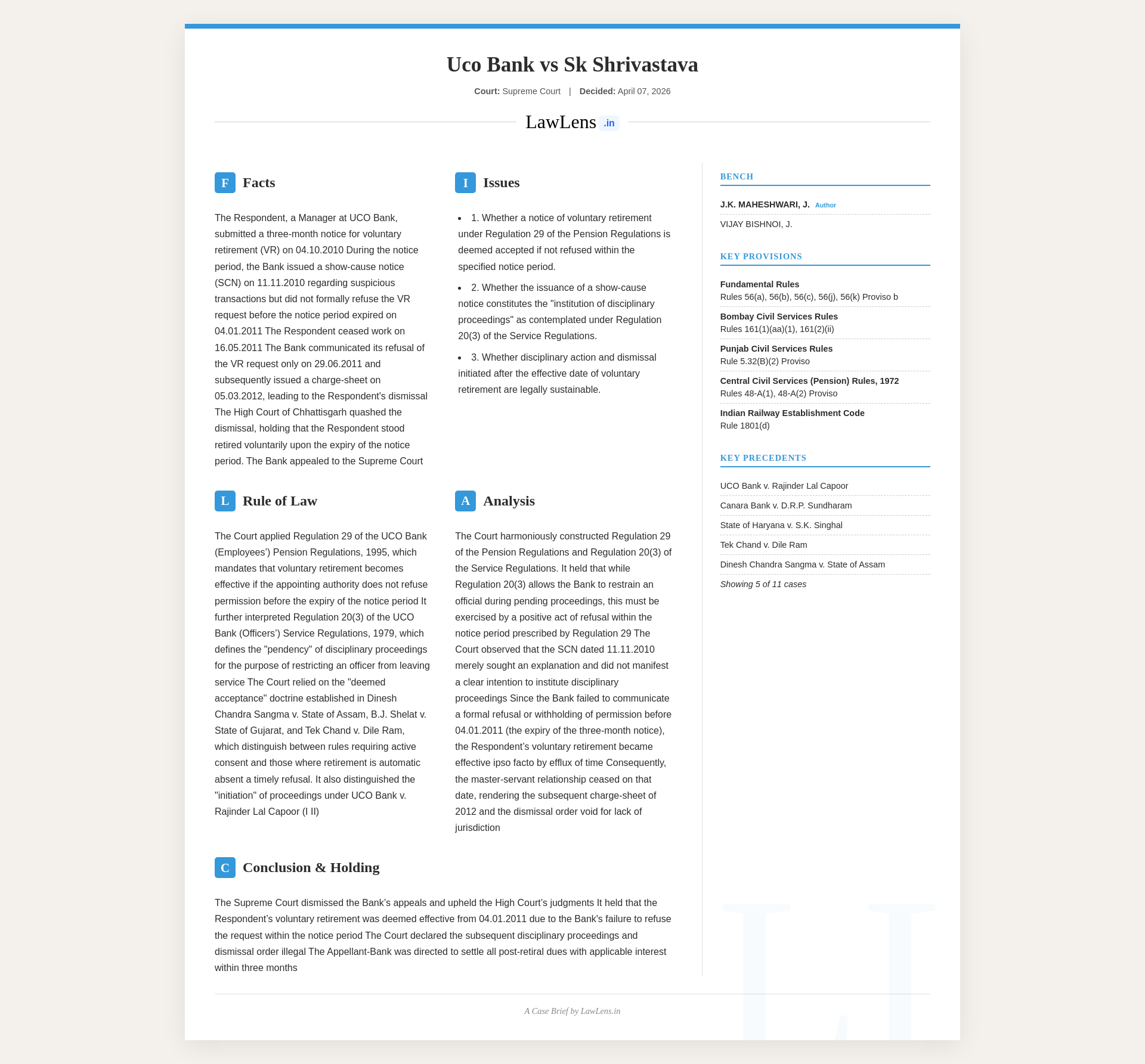
UCO Bank (Employees’) Pension Regulations, 1995 - Regulation 29(2) - Acceptance of the notice by the appointing authority is subject to compliance of proviso, whereby refusal to let the employee retire voluntarily ought to be ordered before expiry of the notice period, and communicate, otherwise, in terms of proviso to Regulation 29(2), voluntary retirement shall be deemed to be effective on lapse of the notice period. Therefore, a positive act of passing an order of refusal is required to be undertaken by the appointing authority. (Para 26)
UCO Bank (Officers’) Service Regulations, 1979 – Regulation 20(3)- if disciplinary proceedings against an officer are pending and he wishes to leave/discontinue or resign, he may be permitted to do so by prior approval of the competent authority in writing. Such notice, if any, given by the officer before or during the disciplinary proceedings, shall not be given effect unless accepted by the competent authority. The pendency of the disciplinary proceedings would include suspension or issuance of a show-cause notice for institution of the disciplinary proceedings. Regulation 20(3)(iii) of the Service Regulation applies where the disciplinary proceedings were initiated prior to attaining the age of superannuation, and prescribes the recourse to the bank after attaining the age of superannuation, which is not of much relevance in the facts of this case. (Para 31-32)
Case Info
Case Information
Case name and neutral citation:UCO Bank & Ors. v. S.K. Shrivastava & Ors., 2026 INSC 328
Court, coram, date:Supreme Court of India, Civil Appellate JurisdictionCoram: J.K. Maheshwari, J. and Vijay Bishnoi, J.Judgment date: 07 April 2026
Case laws and citations referred
- UCO Bank v. Rajinder Lal Capoor (R.L. Capoor – I), (2007) 6 SCC 694
- UCO Bank v. Rajinder Lal Capoor (R.L. Capoor – II), (2008) 5 SCC 257
- Canara Bank v. D.R.P. Sundharam, (2016) 12 SCC 724
- State of Haryana & Ors. v. S.K. Singhal, (1999) 4 SCC 293
- Tek Chand v. Dile Ram, (2001) 3 SCC 290
- Dinesh Chandra Sangma v. State of Assam & Ors., (1977) 4 SCC 441
- B.J. Shelat v. State of Gujarat & Ors., (1978) 2 SCC 202
- Union of India & Ors. v. Sayed Muzaffar Mir, 1995 Supp (1) SCC 76
- State Bank of India & Ors. v. Navin Kumar Sinha, 2024 SCC OnLine SC 3369
- UCO Bank & Ors. v. M.B. Motwani (Dead) through LRs & Ors., (2024) 13 SCC 109
Statutes / Regulations referred
- UCO Bank (Employees’) Pension Regulations, 1995 – especially Regulation 29(1) & 29(2) (pension on voluntary retirement and deemed effectiveness if not refused within notice period).
- UCO Bank (Officers’) Service Regulations, 1979 – especially Regulation 20(3)(i), (ii) & (iii) (termination of service, deemed pendency of disciplinary proceedings, effect at superannuation).
- Comparative / analogous provisions discussed from:
- Fundamental Rule 56 (Government service – voluntary retirement/superannuation).
- Rule 161 of the Bombay Civil Services Rules.
- Rule 48-A of the Central Civil Services (Pension) Rules, 1972.
- Punjab Civil Services Rules, Rule 5.32(B).
Brief summary (three sentences)
The Supreme Court held that under Regulation 29 of the UCO Bank Pension Regulations, once an employee gives a three‑month notice of voluntary retirement, the retirement becomes automatically effective on expiry of that period if the appointing authority does not positively refuse it within the notice period. The Court found that the show‑cause notice dated 11.11.2010 did not amount to institution or deemed pendency of disciplinary proceedings under Regulation 20(3)(ii), and no valid refusal of voluntary retirement was passed before 04.01.2011, so the respondent stood voluntarily retired before any charge‑sheet was issued. Consequently, the subsequent disciplinary proceedings and order of dismissal were held without jurisdiction, and the High Court’s direction granting all consequential post‑retiral benefits with interest was affirmed and the bank’s appeals dismissed.