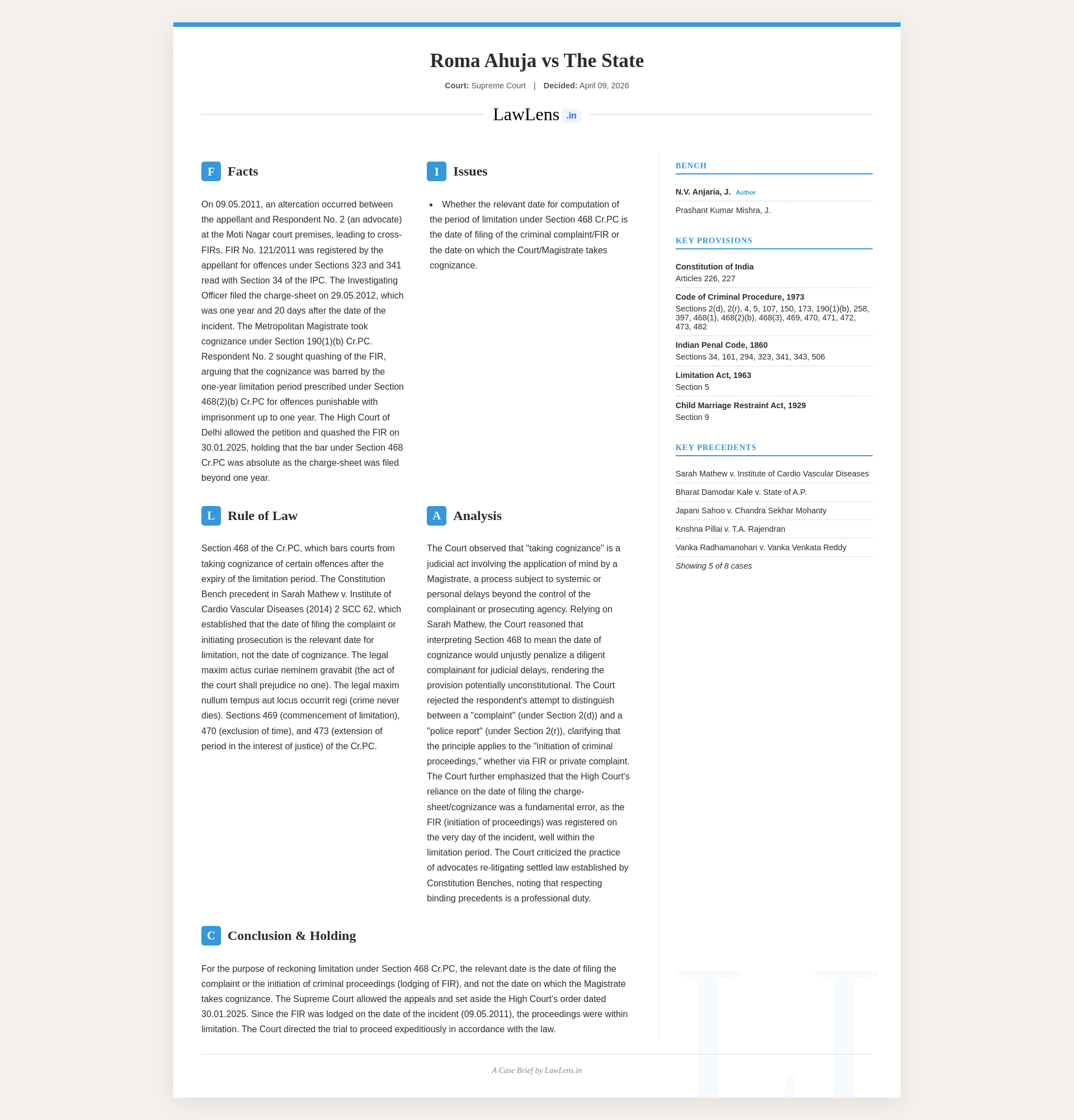
Roma Ahuja v. State 2026 INSC 336 - S.468 CrPC - Limitation Commencement
The criminal proceedings can be said to have been initiated in both categories of complaint when the complaint is filed before the Magistrate or FIR is lodged before the police, as the case may be.

Code of Criminal Procedure 1973 - Section 468 - The computing point of limitation for the purpose of Section 468, Cr.PC is held to be the date of filing complaint – the date of initiation of criminal proceedings. Whether the case belongs to one instituted before the Magistrate or it is upon a complaint filed before the police, what matters is the date of initiation of criminal proceedings. The criminal proceedings can be said to have been initiated in both categories of complaint when the complaint is filed before the Magistrate or FIR is lodged before the police, as the case may be. It remains a complaint made either to the Magistrate or to the police to become the starting point of initiation of criminal proceedings. (Para 7.2-7.3)
Advocates - Professional Ethics - Disclosure of honest and full facts before the Court is part of the fair conduct on the part of lawyers, respecting the binding precedence of the judgments and conceding its applicability in a case is also a duty in fairness to be discharged by the advocates in conducting their case. They are part of the system of administration of justice and are not expected to breach the rules of the game to argue against settled principles or contrary to well settled law, just for the sake of doing it. Giving up an argument where a point of law is already decided is a professional virtue. It is part of ethics in professional conduct before the Court. Lawyers are also expected to respect the strong-operated precedent emanating from a judgment holding the field unless exceptional grounds exist to distinguish the decision are available. Merely for the purpose of demonstrating the argumentative skill, the lawyers ought not to eat up the valuable public time of the court by making the submissions, which are worthless against binding precedent. (Para 8.1)
Legal Maxims - Legal maxims which trace their origin and birth in the experience of the older times and emerge in the progress of civilization, blend reasonableness, wisdom, truthfulness and objectivity, to be much useful in developing the legal concepts out of the codified law and in interpreting the statutory provisions. They play role of enriching the interpretational contents and adding to the jurisprudential stuff.
Case Info
Key Case Details
Case name and neutral citation:Roma Ahuja v. The State and Another, 2026 INSC 336
Coram:Justice N.V. Anjaria and Justice Prashant Kumar Mishra
Judgment date:09 April 2026 (New Delhi)
Statutes / Laws Referred
Criminal Procedure Code, 1973 (Cr.PC):Sections 2(d), 2(r), 4, 5, 107, 150, 173, 187, 190, 258, 397, 468–473, Chapter XXXVI (Limitation for taking cognizance).
Indian Penal Code, 1860 (IPC):Sections 323, 341, 343, 34, 161, 294, 506.
Other statutes:Child Marriage Restraint Act, 1929 – Section 9 (as discussed in Krishna Pillai case).Drugs and Magic Remedies (Objectionable Advertisements) Act, 1954 (in context of Bharat Kale).
Case Law Cited (with citations)
- Sarah Mathew v. Institute of Cardio Vascular Diseases by its Director Dr. K.M. Cherian and Others, (2014) 2 SCC 62 – Constitution Bench; held that for Section 468 CrPC, limitation runs from date of filing complaint/institution of prosecution, not date of cognizance.
- Bharat Damodar Kale and Another v. State of A.P., (2003) 8 SCC 559 – Date of filing complaint within limitation is decisive; court’s later cognizance cannot prejudice complainant.
- Japani Sahoo v. Chandra Sekhar Mohanty, (2007) 7 SCC 394 – Reiterated that relevant date for limitation is filing/initiating proceedings, not cognizance.
- Krishna Pillai v. T.A. Rajendran and Another, 1990 (Supp) SCC 121 – View that limitation runs up to date of cognizance; confined to its own facts and held not good law for Section 468 CrPC by Constitution Bench.
- S.K. Sinha, Chief Enforcement Officer v. Videocon International Ltd. and Others, (2008) 2 SCC 492 – On meaning and stage of “taking cognizance”.
- Vanka Radhamanohari v. Vanka Venkata Reddy, (1993) 3 SCC 4 : 1993 SCC (Cri) 571 – Scope of Section 473 CrPC; duty of court to consider whether justice requires condonation of delay.
- Amritlal v. Shantilal Soni and Others, (2022) 13 SCC 128 – Applied Sarah Mathew; High Court erred in treating date of cognizance as relevant for limitation.
- Somawanti v. State of Punjab, 1962 SCC OnLine SC 23 : AIR 1963 SC 151 – Binding effect of Supreme Court decisions does not depend on whether every possible argument was considered.
Brief Three‑Sentence Summary
The Supreme Court held that, under Section 468 CrPC, the relevant date for computing limitation is the date of filing of the FIR/complaint or initiation of criminal proceedings, not the date on which the Magistrate takes cognizance. Applying the Constitution Bench decision in Sarah Mathew and rejecting contrary arguments, the Court ruled that the Delhi High Court erred in quashing FIR No. 121 of 2011 as time-barred merely because cognizance was taken beyond one year. Consequently, the impugned High Court order was set aside and the criminal trial based on FIR No. 121 of 2011 was directed to proceed expeditiously.