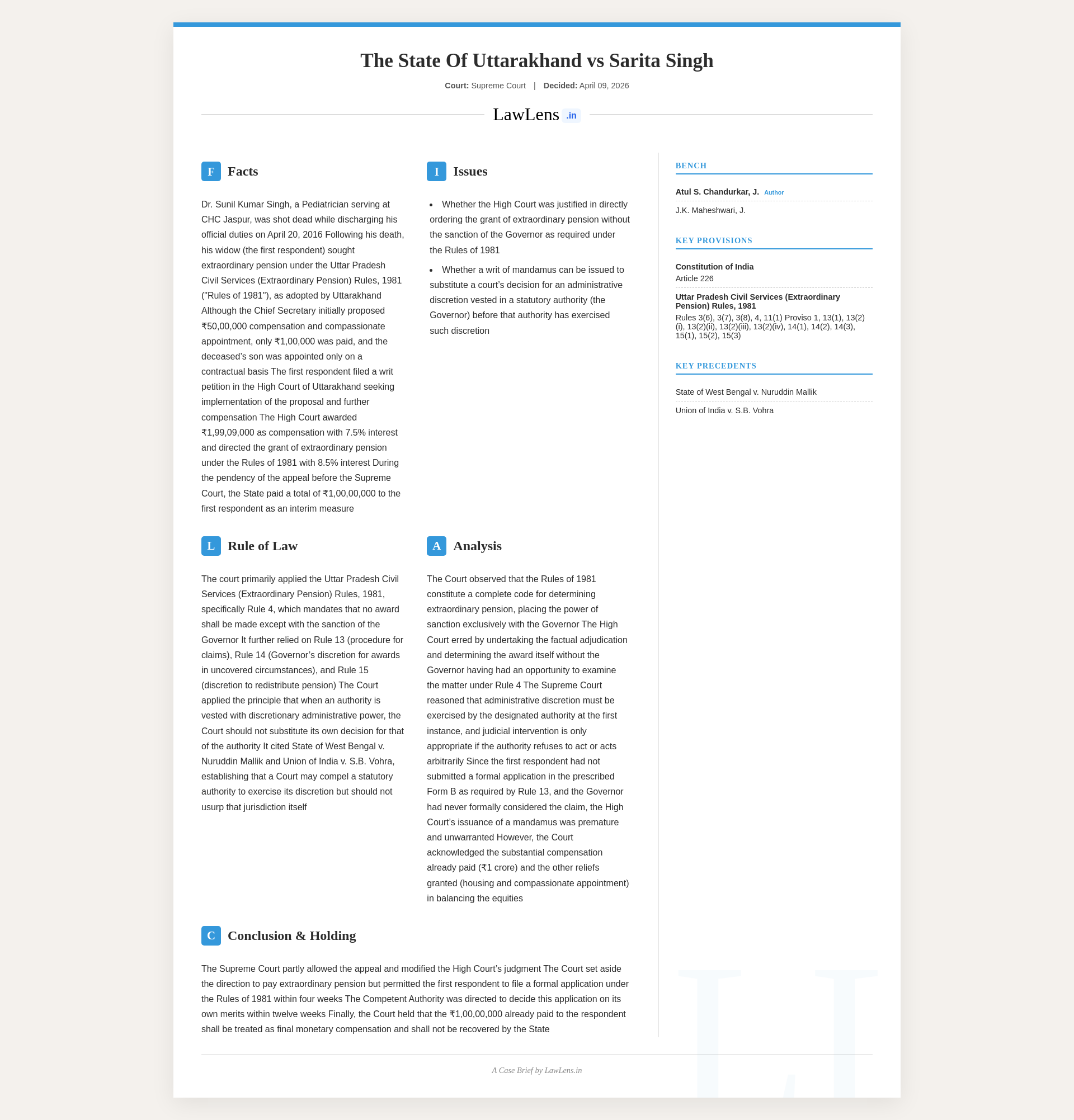
State of Uttarakhand v. Sarita Singh 2026 INSC 337 - UP Civil Services - Extraordinary Pension

Uttar Pradesh Civil Services (Extraordinary Pension) Rules, 1981 - In the matter of award of extraordinary pension, the sanction of the Hon’ble Governor is necessary. Such sanction is expected to be granted by the Hon’ble Governor after examining all relevant aspects referred to in the Rules of 1981. Thus, grant of sanction to the award of extraordinary pension is pursuant to an exercise of administrative power conferred on the Hon’ble Governor. It is, therefore, obvious that at the first instance it is for the Hon’ble Governor to consider whether a case has been made out for granting sanction to the award of extraordinary pension. (Para 12)
Constitution of India - Article 226 - Administrative Law- Where an authority has been conferred with discretionary powers that have to be exercised while taking an administrative decision and the considerations to be taken into account while exercising such discretion are duly enumerated, it would always be preferable that such authority itself takes such decision. In such a scenario, the Court would be slow to itself take such decision especially when the authority on whom the power has been conferred to take such decision has had no occasion to examine the matter and exercise its discretion in accordance with law. It would be a different matter if such authority has either refused to take any decision for a reasonable period of time or the decision taken is found to be wholly arbitrary or suffering from non-application of mind. Even in such situations, normally, a direction to the authority concerned to take a decision afresh would follow. Ordinarily, the Court would not substitute its decision in place of the decision required to be taken by the concerned authority in exercise of its discretion. (Para 12)
Case Info
Case name and neutral citationState of Uttarakhand v. Sarita Singh and Others, 2026 INSC 337
Coram (Bench)Justice J.K. MaheshwariJustice Atul S. Chandurkar (author of the judgment)
Judgment date9 April 2026 (New Delhi)
Caselaws and citations referred
- State of West Bengal v. Nuruddin Mallik, Civil Appeal No. 4895 of 1998, decided on 18.09.1998
- Union of India v. S.B. Vohra and Others, 2004 INSC 5
Statutes / Rules referred
- Uttar Pradesh Civil Services (Extraordinary Pension) Rules, 1981 (as adopted by the State of Uttarakhand), including in particular:
- Rule 3 (definitions, including “risk of office”, “special risk”, “violence”)
- Rule 4 (sanction of Governor and discretion to withhold/reduce award)
- Rule 13 (procedure and forms for claim; Schedule IV, Forms A, B, C)
- Rule 14 (Governor’s power to make awards in circumstances not covered or exceeding amounts)
- Rule 15 (Governor’s discretion to redistribute or continue pension in exceptional cases)
- Uttarakhand Medicare Services Persons and Institutions (Prevention of Violence and Damage of Property) Act, 2013 (referred to by the High Court, and noted in the Supreme Court’s narration).
- Uttar Pradesh Reorganisation Act, 2000 (only as background to State bifurcation and service of the deceased doctor).
Brief summary (three sentences)The widow of Dr. Sunil Kumar Singh, a government doctor shot dead while on duty in Uttarakhand, had obtained from the Uttarakhand High Court a large compensation award and a mandamus directing grant of extraordinary pension under the 1981 Rules. In appeal, the Supreme Court upheld the monetary compensation of ₹1,00,00,000, the compassionate appointment of the son, housing allotment, arrears and family pension, but held that the High Court could not itself order extraordinary pension without the Governor first exercising the statutory discretion under the Rules of 1981. The Court therefore set aside only the direction granting extraordinary pension, permitted the widow to file a proper application under the 1981 Rules within four weeks, and directed the competent authority to decide that claim on its own merits within twelve weeks, without being influenced by observations of either the High Court or the Supreme Court.