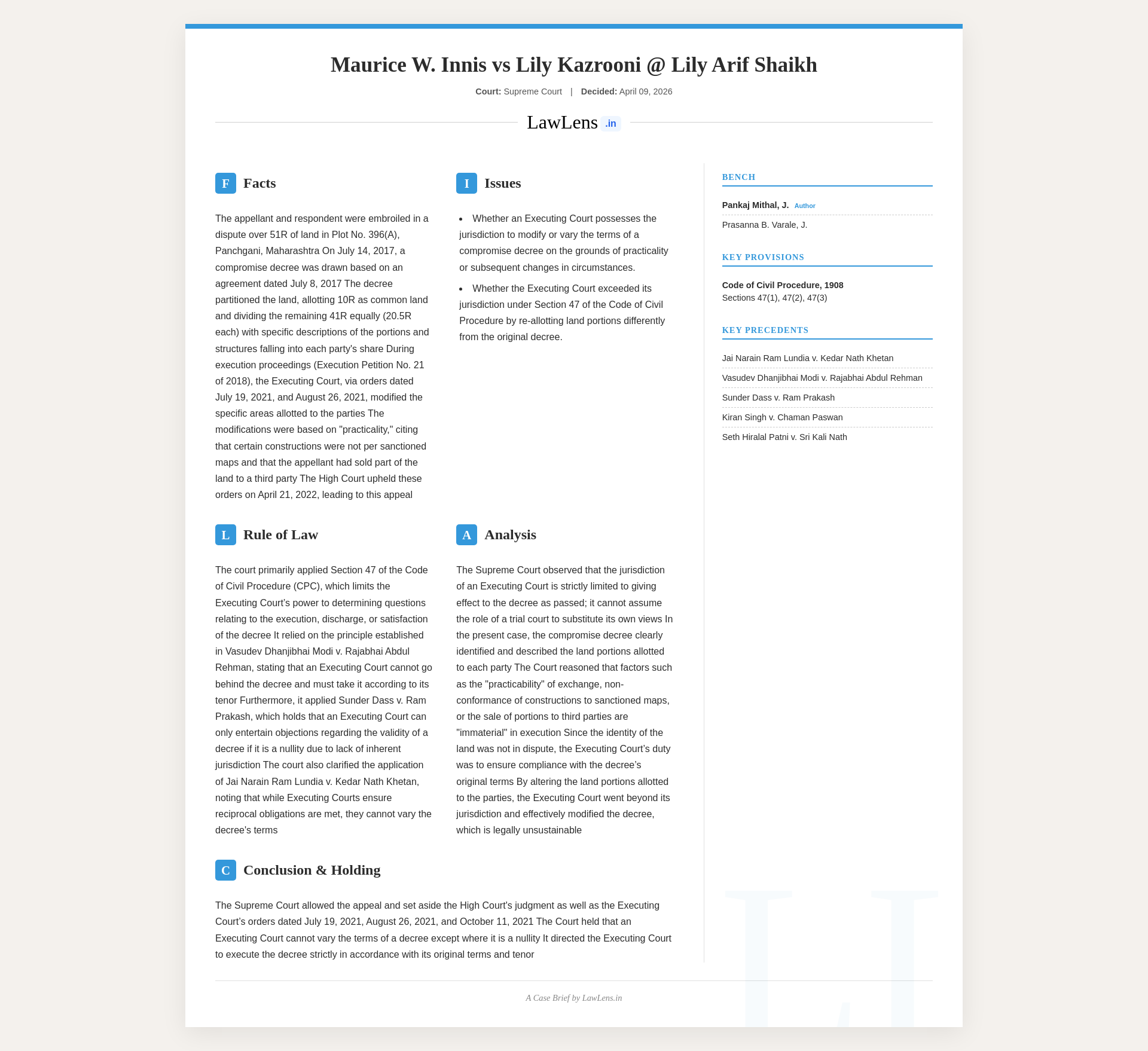
Maurice W. Innis v. Lily Kazrooni @ Lily Arif Shaikh 2026 INSC 340. - S.47 CPC - Execution Court Jurisdiction
The jurisdiction of Executing Court is limited to give effect to the decree as passed and not to assume the role of a trial court so as to substitute its own view in place of that expressed under the decree.

Code of Civil Procedure 1908 - Section 47- The Executing Court is empowered to decide questions relating to execution, discharge or satisfaction of the decree and has no jurisdiction to go beyond the decree sought to be executed. It has to execute the decree as it is without changing the same - The jurisdiction of Executing Court is limited to give effect to the decree as passed and not to assume the role of a trial court so as to substitute its own view in place of that expressed under the decree. Executing Court has to strictly conform to the decree under execution and if the decree provides for reciprocal obligations, it must ensure compliance of those conditions by both the parties in pith and substance, unless the decree is a nullity which is not the case herein. (Para 23-27)
Case Info
Extracted Information
Case name and neutral citation:Maurice W. Innis v. Lily Kazrooni @ Lily Arif Shaikh, 2026 INSC 340.
Coram:Justice Pankaj Mithal and Justice Prasanna B. Varale.
Judgment date:09 April 2026.
Caselaws and citations referred:
- Jai Narain Ram Lundia v. Kedar Nath Khetan and Ors., (1956) 1 SCC 75.
- Vasudev Dhanjibhai Modi v. Rajabhai Abdul Rehman and Ors., (1970) 1 SCC 670.
- Sunder Dass v. Ram Prakash, (1977) 2 SCC 662.
- Kiran Singh v. Chaman Paswan, AIR 1954 SC 340.
- Seth Hiralal Patni v. Sri Kali Nath, AIR 1962 SC 199.
Statutes / laws referred:
The Court primarily refers to Section 47 of the Code of Civil Procedure, 1908 (questions to be determined by the executing court). The general law on execution and the limits of executing court’s jurisdiction are discussed in light of the above precedents.
Brief Summary (Three Sentences)
The dispute arose from execution of a compromise decree dated 14.07.2017 concerning division of 51R of non‑agricultural land in plot No. 396(A), village Panchgani, between the appellant and respondent. The executing court, while enforcing the decree, re‑allocated portions of land different from those fixed in the compromise decree on grounds of practicality and constructions not conforming to the sanctioned plan, and further modified its own order in review, which modifications were upheld by the High Court. The Supreme Court held that an executing court cannot go beyond or vary the terms of a decree under Section 47 CPC, set aside the executing court’s orders (including the consequential possession order), and directed that the decree be executed strictly according to its terms and tenor.