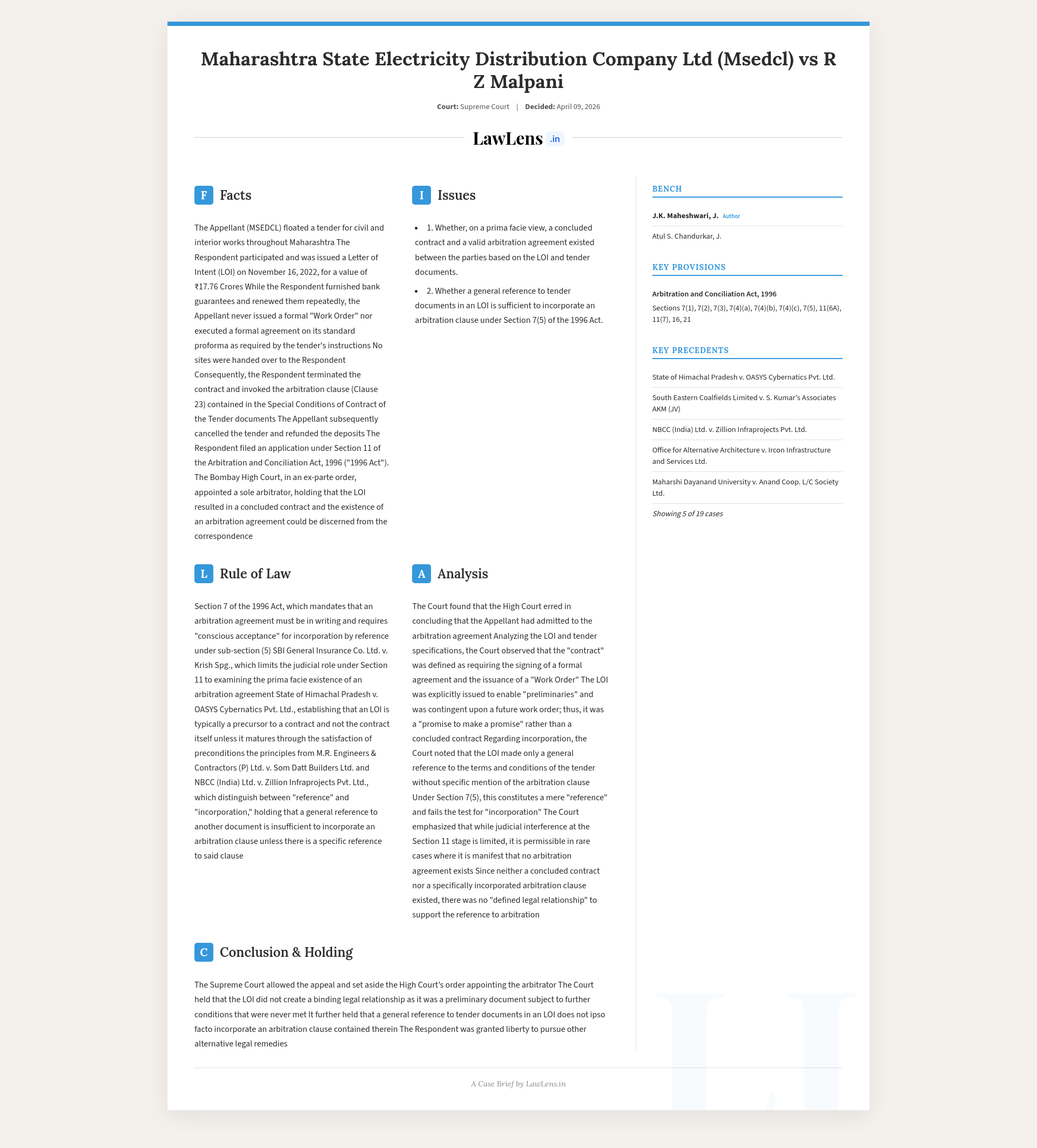
Maharashtra State Electricity Distribution Company Limited (MSEDCL) v. R Z Malpani, 2026 INSC 342 - Arbitration Agreement - Letter of Intent
A letter of intent does not, in and of itself, create a legal relationship or contractual obligations until there is a clear, unambiguous final acceptance by the parties.

Arbitration and Conciliation Act 1996 - Section 11 - The scope of inquiry at the stage of Section 11 is extremely limited and only pertains to an examination about prima facie existence of an arbitration agreement. Judicial non-interference in the arbitration process is the sacrosanct principle which guides alternative dispute resolution and Courts must be highly circumspect in interfering at the referral stage, especially since there is no appeal available in the 1996 Act against an order under Section 11. The Arbitral Tribunal, in exercise of its jurisdiction under Section 16 must be left to decide on its jurisdiction. The Courts should follow the principle of ‘When in doubt, do refer’ and lean towards referring matters to arbitration when the arbitration agreement is prima facie existent. However, it is only in the rarest of rare cases where even on a prima facie view, without going into disputed facts between the parties, there appears to be no existence of arbitration agreement between the parties, the Court can reject the application for appointment of an arbitrator and reference of the parties to arbitration. (Para 42)
Arbitration and Conciliation Act 1996 - Section 7- Letter of intent - A letter of intent does not, in and of itself, create a legal relationship or contractual obligations until there is a clear, unambiguous final acceptance by the parties. It is an expression of one party’s intent to enter into a contract with the other party in the forthcoming future. When the intent of the parties can be evinced from the letter of intent or the tender specifications and it is clear that the letter of intent is to be followed by a final award or a concluded agreement, it cannot be said that the letter of intent itself binds the parties to the terms of the tender. Contractual obligations cannot be foisted upon a party without a clear indication of its intent to enter into a binding concluded contract. Therefore, what needs to be distinguished is whether the intent of the parties is to make a ‘promise’ or a ‘promise to make a promise’ - A tender is essentially in the nature of an ‘invitation to offer’ and submission of a bid by the tenderer is an ‘offer’. By means of a letter of intent, however, it must be examined by the Court whether the party extending the letter of intent is in consensus ad idem with the other party and intends to create a conclusive and binding agreement. (Para 31) [Context: The Supreme Court held that the Letter of Intent (LOI) issued by MSEDCL, read with the tender documents, did not create a concluded contract or a binding arbitration agreement under Section 7 of the Arbitration and Conciliation Act, 1996. It found that the LOI was only a conditional step towards a future work order and formal agreement, and that a mere general reference to the tender conditions was insufficient to incorporate the arbitration clause, especially when no work order was issued and the contract was never acted upon.]
Case Info
Case Information Extracted
Case name and neutral citation:Maharashtra State Electricity Distribution Company Limited (MSEDCL) & Ors. v. R Z Malpani, 2026 INSC 342
Coram:Hon’ble Mr. Justice J.K. MaheshwariHon’ble Mr. Justice Atul S. Chandurkar
Judgment date:09 April 2026 (New Delhi)
Statutes / laws referred:
- Arbitration and Conciliation Act, 1996
- Section 7 (Arbitration agreement)
- Section 11 (Appointment of arbitrators), including Section 11(6A), 11(7)
- Section 16 (Kompetenz-Kompetenz)
- Section 21
- (Background discussion also engages with principles under the Indian Contract Act on concluded contracts and letters of intent, though not cited section-wise.)
Case laws and citations referred:
- State of Himachal Pradesh and Anr. v. OASYS Cybernetics Pvt. Ltd., 2025 SCC OnLine SC 2536
- South Eastern Coalfields Limited and Ors. v. S. Kumar’s Associates AKM (JV), (2021) 9 SCC 166
- NBCC (India) Ltd. v. Zillion Infraprojects Pvt. Ltd., (2024) 7 SCC 174
- Office for Alternative Architecture v. Ircon Infrastructure and Services Ltd., 2025 SCC OnLine SC 1098
- Maharshi Dayanand University v. Anand Coop. L/C Society Ltd., (2007) 5 SCC 295
- UNISSI (India) (P) Ltd. v. Post Graduate Institute of Medical Education and Research, (2009) 1 SCC 107
- Vidya Drolia & Ors. v. Durga Trading Corporation, (2021) 2 SCC 1
- NTPC Ltd. v. SPML Infra Ltd., (2023) 9 SCC 385
- SBI General Insurance Co. Ltd. v. Krish Spg., (2024) 12 SCC 1
- Interplay Between Arbitration Agreements under Arbitration Act, 1996 & Stamp Act, 1899, In re, (2024) 6 SCC 1
- Govind Rubber Ltd. v. Louis Dreyfus Commodities Asia (P) Ltd., (2015) 13 SCC 477
- M.R. Engineers & Contractors (P) Ltd. v. Som Datt Builders Ltd., (2009) 7 SCC 696
- Inox Wind Ltd. v. Thermocables Ltd., (2018) 2 SCC 519
- Duro Felguera, S.A. v. Gangavaram Port Ltd., (2017) 9 SCC 729
- Elite Engg. & Construction (Hyd.) (P) Ltd. v. Techtrans Construction India (P) Ltd., (2018) 4 SCC 281
- Glencore International AG v. Shree Ganesh Metals, 2025 SCC OnLine SC 1815
Three‑sentence brief summary
The Supreme Court held that the Letter of Intent (LOI) issued by MSEDCL, read with the tender documents, did not create a concluded contract or a binding arbitration agreement under Section 7 of the Arbitration and Conciliation Act, 1996. It found that the LOI was only a conditional step towards a future work order and formal agreement, and that a mere general reference to the tender conditions was insufficient to incorporate the arbitration clause, especially when no work order was issued and the contract was never acted upon. Consequently, the Court set aside the Bombay High Court’s Section 11 order appointing an arbitrator, characterising this as a “rarest of rare” case where, even on a prima facie view, no arbitration agreement existed, while leaving the respondent free to pursue other remedies in law.