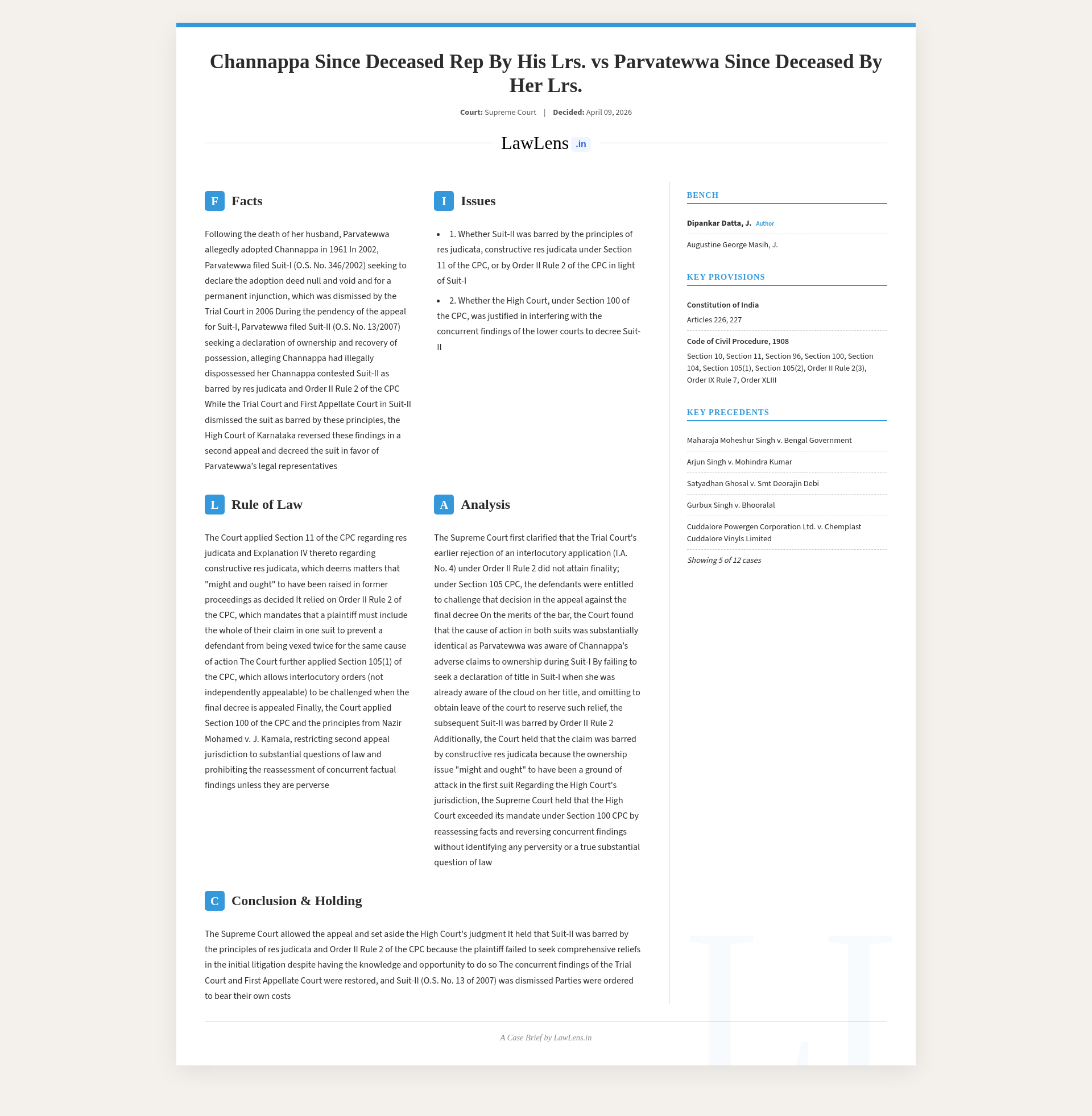
Channappa (D) v. Parvatewwa (D) 2026 INSC 343 - Order II Rule 2 CPC - Omitted Relief - Second Suit
Where a plaintiff omits to claim a relief which he or she is entitled to claim on the same cause of action, he/she is precluded from instituting a subsequent suit in respect of such omitted relief.

Code of Civil Procedure, 1908 - Order II Rule 2 - The doctrine underlying Order II Rule 2, CPC is founded upon the salutary principle that a defendant ought not to be vexed twice for the same cause of action and that the plaintiff must claim all reliefs arising from a single cause of action in one and the same proceeding. Where a plaintiff omits to claim a relief which he or she is entitled to claim on the same cause of action, he/she is precluded from instituting a subsequent suit in respect of such omitted relief. In order that a plea of a Bar under Order 2 Rule 2(3) of the Civil Procedure Code should succeed the defendant who raises the plea must make out; (i) that the second suit was in respect of the same cause of action as that on which the previous suit was based; (2) that in respect of that cause of action the plaintiff was entitled to more than one relief; (3) that being thus entitled to more than one relief the plaintiff, without leave obtained from the Court omitted to sue for the relief for which the second suit had been filed. (Para 20-21)
Code of Civil Procedure, 1908 - Section 105(1) - “Save as otherwise expressly provided ...”- The said expression is of determinative significance, inasmuch as it carves out exceptions to the general rule that interlocutory orders are not independently appealable but may be assailed in an appeal against the final decree. The legislative intent undergirding this phrase is to recognise that where the CPC itself provides a specific mechanism of challenge to certain orders, such orders must be assailed in the manner so prescribed, failing which the right to question them may stand foreclosed. (Para 12)
Code of Civil Procedure, 1908 - Section 11- Res judicata is not confined merely to issues that were actually decided but extends to issues that ought to have been raised in the earlier proceedings. (Para 31)
Code of Civil Procedure, 1908 - Section 100 - The jurisdiction of the High Court in such proceedings is confined to cases involving a substantial question of law. Findings of fact concurrently recorded by the courts below cannot ordinarily be interfered with unless such findings are shown to be perverse or based on no evidence. (Para 35)
Case Info
Case Information
Case name and neutral citation:Channappa (Dead) through LRs v. Parvatewwa (Dead) through LRs, 2026 INSC 343
Coram:Justice Dipankar Datta and Justice Augustine George Masih
Judgment date:9 April 2026 (New Delhi)
Case laws and citations referred
- Maharaja Moheshur Singh v. Bengal Government, (1859) 7 Moore’s Indian Appeals 283
- Arjun Singh v. Mohindra Kumar, AIR 1964 SC 993
- Satyadhan Ghosal v. Deorajin Debi, (1960) 3 SCR 590 (quoted in Arjun Singh)
- Gurbux Singh v. Bhooralal, AIR 1964 SC 1810
- Cuddalore Powergen Corporation Ltd. v. Chemplast Cuddalore Vinyls Ltd. & Anr, 2025 SCC OnLine SC 82
- Forward Construction Co. v. Prabhat Mandal (Regd.), (1986) 1 SCC 100
- Alka Gupta v. Narender Kumar Gupta, 2010 SCC OnLine SC 1085
- Greenhalgh v. Mallard, (1947) 2 All ER 255 (CA)
- Direct Recruit Class II Engineering Officers’ Association v. State of Maharashtra, (1990) 2 SCC 715
- P. Kishore Kumar v. Vittal K. Patkar, (2024) 13 SCC 553
- Nazir Mohamed v. J. Kamala, (2020) 19 SCC 57
- Gurdev Kaur v. Kaki, (2007) 1 SCC 546
Statutes / provisions referred
- Code of Civil Procedure, 1908:
- Section 10
- Section 11 (res judicata and constructive res judicata; Explanation IV)
- Section 96
- Section 100
- Section 104 read with Order XLIII
- Section 105(1), (2)
- Order II Rule 2
- Constitution of India:
- Articles 226 and 227
Brief summary (three sentences)
The Supreme Court held that the second suit (Suit II) filed by Parvatewwa for declaration of title and recovery of possession was barred by Order II Rule 2 and Section 11 CPC, since the cause of action and dispute over ownership already existed when she filed the first suit (Suit I) and she had omitted to claim those consequential reliefs there. It further ruled that the earlier interlocutory order rejecting an Order II Rule 2 objection (I.A. No. 4) did not attain finality and could validly be challenged in appeal against the final decree under Section 105 CPC. Concluding that the Trial Court and First Appellate Court had correctly applied res judicata/Order II Rule 2 and that the High Court exceeded its limited Section 100 CPC jurisdiction by overturning concurrent findings of fact, the Supreme Court set aside the High Court’s judgment and dismissed Suit II.