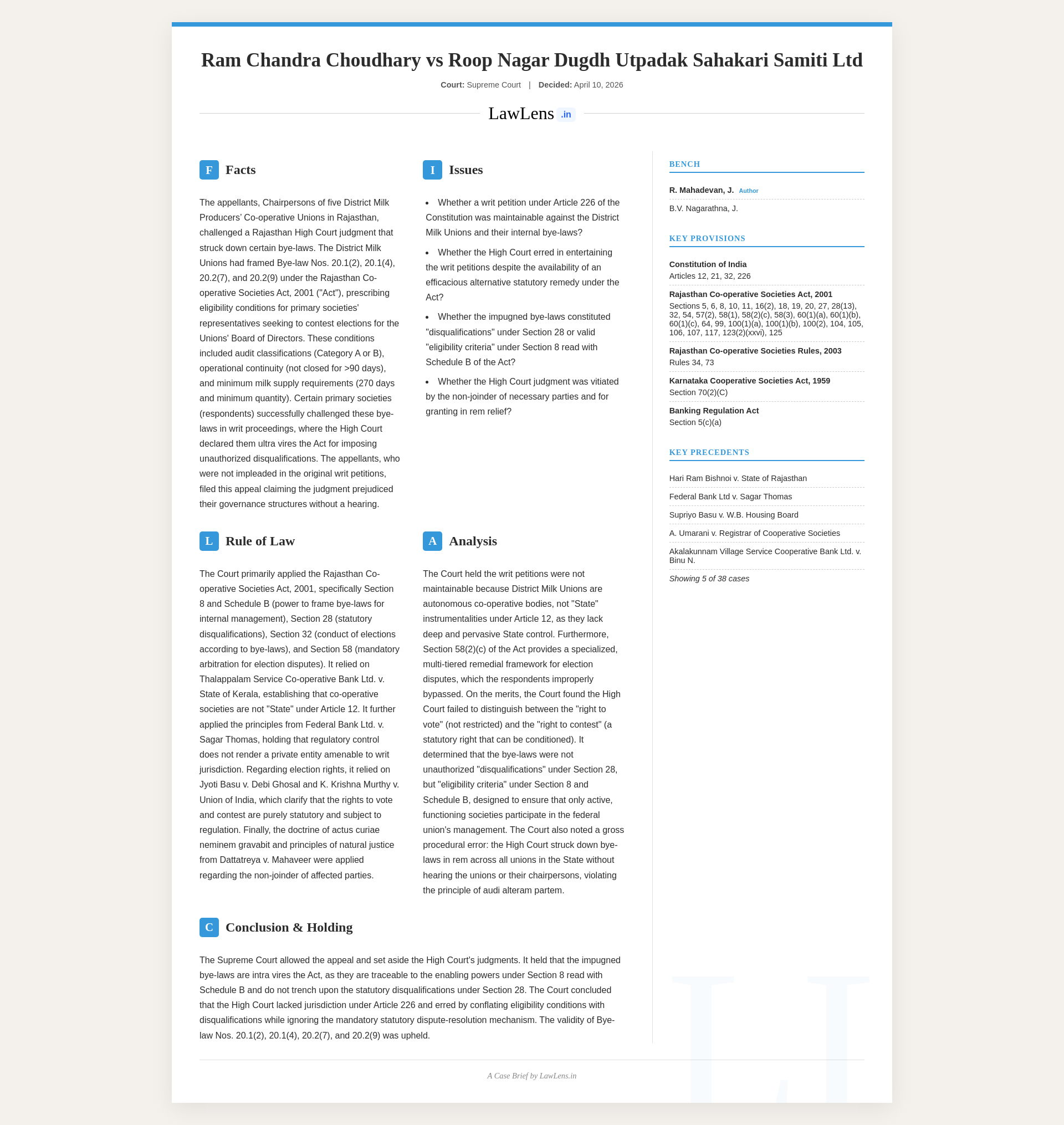
Ram Chandra Choudhary v. Roop Nagar Dugdh Utpadak Sahakari Samiti Limited 2026 INSC 347 - Writ Jurisdiction - District Milk Unions - Election Matters
Neither the right to vote nor the right to contest an election is a fundamental right.

Constitution of India - Article 226 - Though the existence of an alternative remedy does not operate as an absolute bar to the exercise of jurisdiction under Article 226, the High Courts ordinarily refrain from entertaining writ petitions, where an efficacious statutory remedy is available, particularly in matters concerning elections or where the statute provides for specialised forums. This principle assumes greater significance where the statute not only creates such forums but also manifests an intention to channel disputes through that mechanism. (Para 15.6)
Constitution of India - Article 226 - District Milk Unions are autonomous, memberdriven bodies governed by the provisions of the Act, 2001, the Rules framed thereunder, and their bye-laws. They are neither departments of the State nor owned, financially controlled, or administratively dominated by the State in a manner that would render them instrumentalities of the State within the meaning of Article 12. The fact that such societies are subject to statutory regulation, oversight by the Registrar or supervision by the State Co-operative Election Authority does not detract from their essential character as independent co-operative institutions. (Para 14.8)
Constitution of India - Neither the right to vote nor the right to contest an election is a fundamental right. These rights are purely statutory in nature and exist only to the extent conferred by statute . While the right to vote enables a member to exercise franchise in accordance with the statutory scheme, the right to contest an election or to be elected is a distinct and additional right which may legitimately be made subject to qualifications, eligibility conditions, and disqualifications. (Para 18.1) The right to vote is the right to participate in the electoral process by exercising franchise; and the right to contest is a distinct and additional right, enabling a person to seek election to an office. The latter is inherently subject to stricter regulation, including qualifications, disqualifications, and institutional requirements.(Para 18.3)
Constitution of India - Article 226 - Subordinate legislation carries a presumption of validity and may be invalidated only on limited grounds including lack of legislative competence, violation of constitutional or statutory provisions, inconsistency with the parent Act, or manifest arbitrariness. The inquiry must be directed at whether the subordinate legislation conforms to the object, scheme and scope of the enabling Act. (Para 20.8)
Constitution of India - Article 226 - The failure to implead affected parties in writ proceedings vitiates the adjudication where such parties are directly impacted. Such omission is not a mere technical defect, but a substantive violation of the principle of fair hearing, especially where the outcome affects vested rights or prior legal positions. (Para 21.3)
Case Info
Extracted Case Information
Case name and neutral citation:Ram Chandra Choudhary & Ors v. Roop Nagar Dugdh Utpadak Sahakari Samiti Limited & Others, 2026 INSC 347
Coram (Judges):Justice B.V. Nagarathna and Justice R. Mahadevan
Judgment date:10 April 2026 (New Delhi)
Case laws and citations referred
- Ajay Hasia v. Khalid Mujib Sehravardi, (1981) 1\ \text{SCC}\ 722
- Federal Bank Ltd v. Sagar Thomas, (2003) 10\ \text{SCC}\ 733
- Supriyo Basu v. W.B. Housing Board, (2005) 6\ \text{SCC}\ 289
- A. Umarani v. Registrar of Cooperative Societies, (2004) 7\ \text{SCC}\ 112
- Akalakunnam Village Service Cooperative Bank Ltd. v. Binu N., (2014) 9\ \text{SCC}\ 294
- P.S. Sadasivaswamy v. State of Tamil Nadu, (1975) 1\ \text{SCC}\ 152
- Titaghur Paper Mills Co. Ltd. v. State of Orissa, (1983) 2\ \text{SCC}\ 433
- Executive Engineer, Bihar State Housing Board v. Ramesh Kumar Singh, (1996) 1\ \text{SCC}\ 327
- Dattatreya v. Mahaveer, (2004) 10\ \text{SCC}\ 665
- Ram Janam Singh v. State of U.P., (1994) 2\ \text{SCC}\ 622
- Prabodh Verma v. State of U.P., (1984) 4\ \text{SCC}\ 251
- General Manager, Kishan Sahkari Chini Mills Ltd. v. Satrughan Nishad, (2003) 8\ \text{SCC}\ 639
- Thalappalam Service Co-operative Bank Ltd. v. State of Kerala, (2013) 16\ \text{SCC}\ 82
- Rama Kant Pandey v. Union of India, (1993) 2\ \text{SCC}\ 438
- K. Krishna Murthy v. Union of India, (2010) 7\ \text{SCC}\ 202
- Supreme Court Bar Association v. B.D. Kaushik, (2011) 13\ \text{SCC}\ 774
- Co-operative Central Bank v. Additional Industrial Tribunal, (1969) 2\ \text{SCC}\ 43
- A.P. Dairy Development Corporation Federation v. B. Narasimha Reddy, (2011) 9\ \text{SCC}\ 286
- Umesh Shivappa Ambi v. Angadi Shekara Basappa, (1998) 4\ \text{SCC}\ 529
- N.P. Ponnuswami v. Returning Officer, AIR 1952 SC 64 (referred via Krishna Murthy)
- Jyoti Basu v. Debi Ghosal, AIR 1982 SC 983
- Javed v. State of Haryana, (2003) 8\ \text{SCC}\ 369
- Indira Nehru Gandhi v. Raj Narain, (1975\ \text{Supp SCC}\ 1} (quoted via Krishna Murthy)
- Kuldip Nayar v. Union of India, (2006) 7\ \text{SCC}\ 1 (via Krishna Murthy)
- State of T.N. v. P. Krishnamurthy, (2006) 4\ \text{SCC}\ 517
- Indian Express Newspapers (Bombay) (P) Ltd. v. Union of India, (1985) 1\ \text{SCC}\ 641
- Supreme Court Employees’ Welfare Assn. v. Union of India, (1989) 4\ \text{SCC}\ 187
- Shri Sitaram Sugar Co. Ltd. v. Union of India, (1990) 3\ \text{SCC}\ 223
- St. John’s Teachers Training Institute v. Regional Director, NCTE, (2003) 3\ \text{SCC}\ 321
- Raleigh Investment Co. Ltd. v. Governor-General in Council, 1947 15 ITR 332 (PC) (through Titaghur)
- Kruse v. Johnson, (1898) 2\ \text{QB}\ 91
- Leila Mourning v. Family Publications Service, 411 US 356 (1973)
- Noel Harper v. Union of India, (2023) 3\ \text{SCC}\ 544
- High Court Bar Association Allahabad v. State of U.P., (2021) 7\ \text{SCC}\ 77
Statutes / laws referred
Key statutes and provisions cited include:
- Rajasthan Co-operative Societies Act, 1965 (repealed)
- Rajasthan Co-operative Societies Act, 2001 – especially:
- Section 5, 6 (general scheme)
- Section 8 read with Schedule B, Clause 1 (da), (e), (i), (r), (v), (w) (bye‑law making power)
- Sections 10, 11 (amendment/supervision of bye-laws)
- Sections 16, 18, 19, 20 (membership and voting rights, minimum utilisation)
- Sections 27, 28 (committee constitution and disqualifications)
- Section 28(13) (Registrar on disqualification)
- Section 32 (elections as per Act, Rules and bye-laws)
- Sections 54, 57, 58, 58(2)(c), 58(3), 60 (disputes/election disputes and arbitration)
- Sections 64, 73 (via Rules), 99, 100 (execution as civil decree)
- Sections 104–107 (appeal, tribunal, review, revision)
- Sections 117, 123, 123(2)(xxvi) (bar of jurisdiction; rule‑making)
- Sections 125 (Registrar’s power to rescind resolutions)
- Rajasthan Co-operative Societies Rules, 2003 – notably Rule 34 (disqualifications), Rule 73 (audit classification)
- Constitution of India – Articles 12, 21, 32, 226
- Transfer of Property Act, 1882 (referenced in Section 100 of the 2001 Act)
- Banking Regulation Act, 1949, Section 5(ca) (in Federal Bank)
- Right to Information Act, 2005, Section 2(h)(d)(i) (in Thalappalam)
Three-sentence brief summary
The Supreme Court held that writ petitions under Article 226 challenging bye‑laws of Rajasthan’s District Milk Producers’ Co‑operative Unions were not maintainable because the Unions are not “State” under Article 12 and an exclusive, efficacious dispute mechanism exists under the Rajasthan Co‑operative Societies Act, 2001 for election-related disputes. On merits, the Court ruled that the impugned bye‑laws prescribing audit‑based classification, minimum days/quantity of milk supply, and continuity of operations were valid eligibility criteria for candidature and representation, not additional disqualifications, and were traceable to Section 8 read with Schedule B of the 2001 Act. Consequently, it set aside the Rajasthan High Court’s judgment declaring these bye‑laws ultra vires and restored their operation across the District Milk Unions.