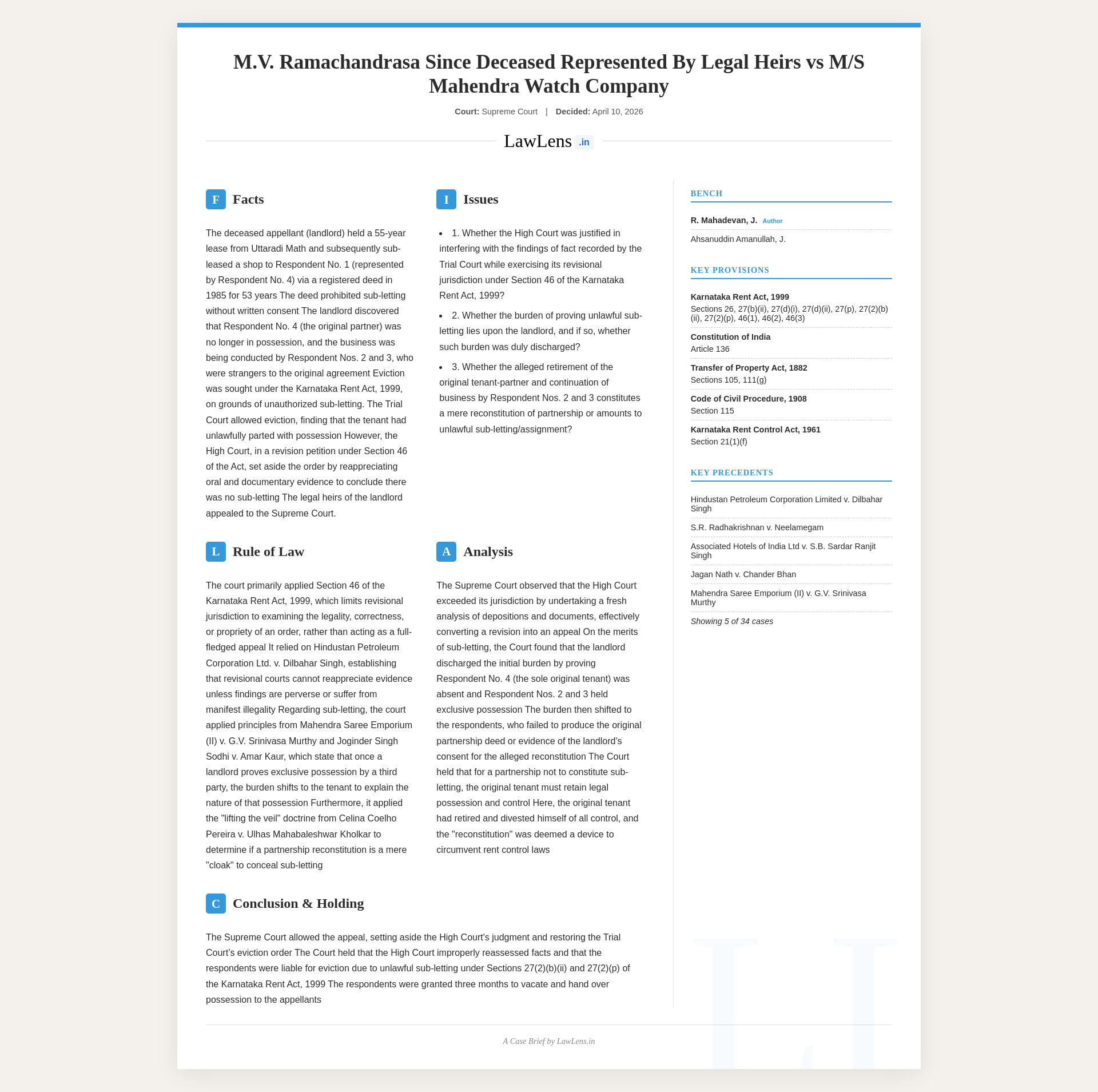
M.V. Ramachandrasa (D) v. Mahendra Watch Company 2026 INSC 348 - Karnataka Rent Act - Subletting - Partnership Firm
Subletting- The determinative test is whether the original tenant continues to retain legal possession and control over the premises.

Karnataka Rent Act, 1999 - Sections 27(2)(b) - Partnership firm is not a separate legal entity but merely a compendious name for its partners, and that sub-letting necessarily involves parting with legal possession. (i) sub-letting requires parting with legal possession, i.e., transfer of the right to exclusive possession; (ii) mere induction or retirement of partners does not amount to sub-letting so long as the tenant retains control and legal possession; (iii) courts are entitled to lift the veil of partnership where it is used as a device to conceal an impermissible transfer; and (iv) once exclusive possession of a third party is established, the burden shifts to the tenant to prove that the arrangement is bona fide. Thus, the determinative test is whether the original tenant continues to retain legal possession and control over the premises. (Para 14-14.3)
Karnataka Rent Act, 1999 - Sections 27(2)(b) - In eviction proceedings founded on the ground of sub-letting, the initial onus rests upon the landlord to establish that the tenant has parted with possession of the tenanted premises in favour of a third party without authority. The landlord discharges the initial burden by establishing (i) exclusive possession of a third party, and (ii) absence of the original tenant from possession. Upon such proof, a presumption of sub-letting arises, and the onus shifts to the tenant to demonstrate that such possession is lawful and not in the nature of sub-tenancy
Section 26 of the Karnataka Rent Act, 1999 - Section 46,26- Disapproved reappreciation of evidence in exercise of revisional powers- the revisional jurisdiction cannot be expanded so as to substitute or bypass the appellate mechanism. (Para 12-12.9)
Case Info
Extracted Information from the Judgment
Case name and neutral citation:Sri M.V. Ramachandrasa (since deceased) represented by legal heirs v. M/s Mahendra Watch Company represented by its partners & Ors, 2026 INSC 348 (Civil Appeal No. 4353 of 2026, arising out of SLP (C) No. 25957 of 2023).
Coram:Hon’ble Mr. Justice Ahsanuddin Amanullah and Hon’ble Mr. Justice R. Mahadevan (judgment authored by R. Mahadevan, J.).
Judgment date:10 April 2026 (New Delhi).
Caselaws and citations referred:
- Hindustan Petroleum Corporation Limited v. Dilbahar Singh, (2014) 9 SCC 78.
- S.R. Radhakrishnan v. Neelamegam, (2003) 10 SCC 705.
- Rukmini Amma Saradamma v. Kallyani Sulochana, (1993) 1 SCC 499.
- Rai Chand Jain v. Chandra Kanta Khosla, (1991) 1 SCC 422.
- Aundal Ammal v. Sadasivan Pillai, (1987) 1 SCC 183 : AIR 1987 SC 203.
- Ram Dass v. Ishwar Chander, (1988) 3 SCC 131.
- M.S. Zahed v. K. Raghavan, (1999) 1 SCC 439.
- Thankamony Amma v. Omana Amma N., (2020) 19 SCC 254.
- Associated Hotels of India Ltd v. S.B. Sardar Ranjit Singh, AIR 1968 SC 933.
- Jagan Nath (D) through LRs v. Chander Bhan, (1988) 3 SCC 57.
- Mahendra Saree Emporium (II) v. G.V. Srinivasa Murthy, (2005) 1 SCC 481.
- Joginder Singh Sodhi v. Amar Kaur, (2005) 1 SCC 31.
- Ram Murti Devi v. Pushpa Devi, (2017) 15 SCC 230.
- Kala v. Madho Parshad Vaidya, (1998) 6 SCC 573.
- Bharat Sales Ltd. v. LIC, (1998) 3 SCC 1̲2̲2 (as referred).
- Amar Nath Agarwalla v. Dhillon Transport Agency, (2007) 4 SCC 306.
- Murlidhar v. Chuni Lal, 1969 Ren CR 563 : 1970 Ren CJ 922 (SC).
- Mohammedkasam Haji Gulambhai v. Bakerali Fatehali, (1998) 7 SCC 608.
- Helper Girdharbhai v. Saiyed Mohmad Mirasaheb Kadri, (1987) 3 SCC 538.
- Shalimar Tar Products Ltd. v. H.C. Sharma, (1988) 1 SCC 70.
- Gundalapalli Rangamannar Chetty v. Desu Rangiah, AIR 1954 Mad 182.
- Jackson v. Simons, (1923) 1 Ch 373 : 1922 All ER Rep 583.
- Chaplin v. Smith, (1926) 1 KB 198 (CA).
- Vishwa Nath v. Chaman Lal Khanna, AIR 1975 Del 117.
- Gopal Saran v. Satyanarayana, (1989) 3 SCC 56.
- G.K. Bhatnagar v. Abdul Alim, (2002) 9 SCC 516.
- Parvinder Singh v. Renu Gautam, (2004) 4 SCC 794.
- Krishnawati v. Hans Raj, (1974) 1 SCC 289.
- Vaishakhi Ram v. Sanjeev Kumar Bhatiani, (2008) 14 SCC 356.
- Nirmal Kanta v. Ashok Kumar, (2008) 7 SCC 722.
Statutes / provisions referred:
- Karnataka Rent Act, 1999 – Sections 27(2)(b)(ii), 27(2)(d)(i)(ii), 27(2)(p), 26, 46.
- Transfer of Property Act, 1882 – Section 105, Section 111(g).
- Code of Civil Procedure, 1908 – Section 115 (in comparative discussion).
- Constitution of India – Article 136.
- Delhi Rent Control Act, 1958 – Section 14(1)(b) (in cited precedents).
- Rajasthan Premises (Control of Rent and Eviction) Act, 1950 – Section 13(1)(e) (in cited precedents).
- Karnataka Rent Control Act, 1961 – Section 21(1)(f) (in cited precedents).
Brief Summary (Three Sentences)
The Supreme Court held that the Karnataka High Court exceeded its limited revisional jurisdiction under Section 46 of the Karnataka Rent Act, 1999 by reappreciating evidence and overturning the trial court’s factual findings on sub‑letting. It found that the landlord had discharged the initial burden by showing that the original tenant‑partner was no longer in possession and that strangers to the lease (Respondents 2 and 3) were in exclusive occupation, and that the tenants failed to rebut the resulting presumption of unlawful sub‑letting, the alleged “reconstitution” of partnership being unsupported and merely a cloak. Consequently, the Court allowed the appeal, set aside the High Court’s order, restored the trial court’s eviction decree, and granted the respondents three months to vacate and hand over vacant possession.