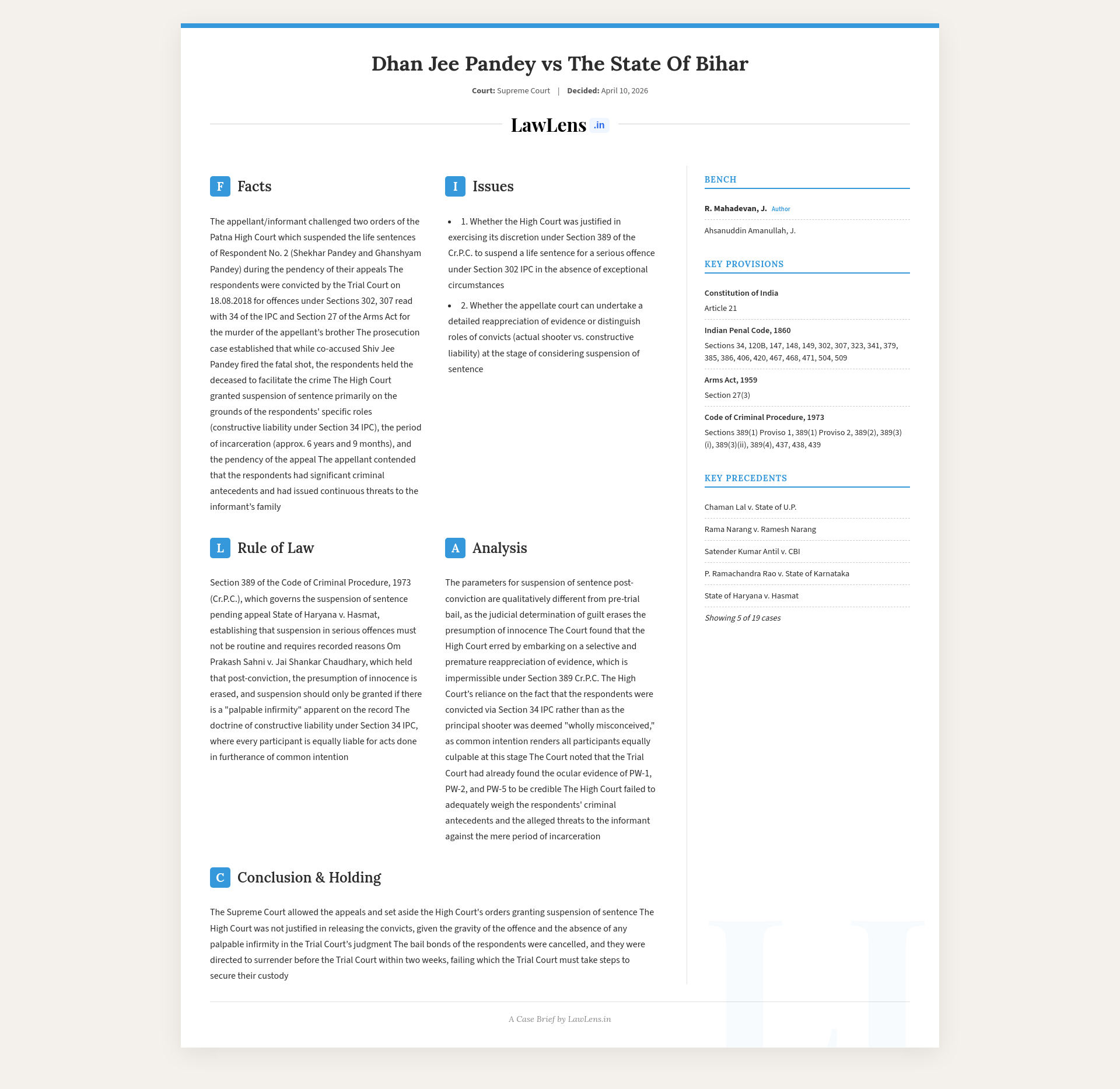
Dhan Jee Pandey v. State of Bihar 2026 INSC 349 - S.389 CrPC - Sentence Suspension
Parameters governing suspension of sentence post-conviction are qualitatively distinct from those applicable at the stage of pre-trial bail.

Code of Criminal Procedure 1973 - Section 389 - Parameters governing suspension of sentence post-conviction are qualitatively distinct from those applicable at the stage of pre-trial bail. Upon conviction, the presumption of innocence stands displaced by a judicial determination of guilt, and the appellate court is required to exercise its jurisdiction under Section 389 Cr.P.C. with due circumspection and restraint- The suspension of sentence in serious offences must not be granted as a matter of routine, and that the appellate court must apply its mind to the nature of the offence, the manner of its commission, and the gravity of the findings recorded by the trial Court- Suspension of sentence may be justified only where a palpable infirmity is apparent on the face of the record, indicating that the conviction may not ultimately withstand scrutiny - Such relief can be granted only in rare and exceptional circumstances and that reappreciation of evidence at the stage of Section 389 Cr.P.C. is impermissible - Undue weight cannot be accorded to the period of incarceration or the pendency of the appeal in isolation, particularly where the conviction is founded on credible evidence. (Para 14-21)
Case Info
Basic Case Details
Case name and neutral citation:Dhan Jee Pandey v. The State of Bihar & Another; Criminal Appeal No. 1864 of 2026 (arising out of SLP (Crl.) No. 4241 of 2025), and Criminal Appeal No. 1865 of 2026 (arising out of SLP (Crl.) No. 12906 of 2025); neutral citation: 2026 INSC 349.
Coram:Justice Ahsanuddin Amanullah and Justice R. Mahadevan (judgment authored by R. Mahadevan, J.).
Judgment date and court:Supreme Court of India, judgment dated 10 April 2026 (signed “NEW DELHI; APRIL 10, 2026.”).
Caselaws Cited (with SCC citations where given)
- Chaman Lal v. State of U.P. & Another, (2004) 7 SCC 525.
- State of Haryana v. Hasmat, (2004) 6 SCC 175.
- Rama Narang v. Ramesh Narang, (1995) 2 SCC 513.
- Satender Kumar Antil v. CBI, (2022) 10 SCC 51.
- P. Ramachandra Rao v. State of Karnataka, (2002) 4 SCC 578.
- Rajesh Ranjan Yadav v. CBI, (2007) 1 SCC 70 : (2007) 1 SCC (Cri) 254.
- Kashmira Singh v. State of Punjab, (1977) 4 SCC 291 : 1977 SCC (Cri) 559.
- Bhagirathsinh v. State of Gujarat, (1984) 1 SCC 284 : 1984 SCC (Cri) 63.
- Shaheen Welfare Assn. v. Union of India, (1996) 2 SCC 616 : 1996 SCC (Cri) 366.
- Joginder Kumar v. State of U.P., (1994) 4 SCC 260 : 1994 SCC (Cri) 1172.
- Ash Mohammad v. Shiv Raj Singh, (2012) 9 SCC 446 : (2012) 3 SCC (Cri) 1172.
- Kishori Lal v. Rupa, (2004) 7 SCC 638 : 2004 SCC (Cri) 2021.
- Vijay Kumar v. Narendra, (2002) 9 SCC 364 : 2003 SCC (Cri) 1195.
- Ramji Prasad v. Rattan Kumar Jaiswal, (2002) 9 SCC 366 : 2003 SCC (Cri) 1197.
- Vasant Tukaram Pawar v. State of Maharashtra, (2005) 5 SCC 281 : 2005 SCC (Cri) 1052.
- Gomti v. Thakurdas, (2007) 11 SCC 160 : (2008) 1 SCC (Cri) 644.
- Om Prakash Sahni v. Jai Shankar Chaudhary & Another, (2023) 6 SCC 123.
- Janardan Ray v. State of Bihar & Another, Criminal Appeal Nos. 1892–1893 of 2025, decided on 09.04.2025.
Statutes / Provisions Referred
- Indian Penal Code, 1860:Sections 302, 307, 120B, 34, 341, 323, 379, 509, 504, 386, 147, 148, 149, 406, 420, 467, 468, 471, 385.
- Arms Act, 1959:Section 27 and Section 27(3).
- Code of Criminal Procedure, 1973:Section 389 Cr.P.C. (suspension of sentence pending appeal; release on bail).
- Constitution of India:Article 21 (right to speedy trial – referred through case law).
Three‑Sentence Brief Summary
The Supreme Court considered appeals by the informant challenging Patna High Court orders suspending the sentences and granting bail to two life convicts, Shekhar Pandey and Ghanshyam Pandey, convicted under Section 302/34 IPC and related offences for a 2016 political‑rivalry murder in Buxar, Bihar. Reiterating that post‑conviction suspension of sentence under Section 389 Cr.P.C. in murder cases is permissible only in rare and exceptional circumstances, and that appellate courts cannot reappreciate evidence or dilute constructive liability under Section 34 IPC at the bail‑suspension stage, the Court found the High Court’s approach contrary to settled law. Holding that the conviction was based on credible ocular evidence, that there was no apparent infirmity in the trial court’s judgment, and noting the respondents’ criminal antecedents and alleged intimidation of the informant, the Supreme Court set aside the suspension of sentence orders in both appeals and directed the convicts to surrender within two weeks.