Anosh Ekka v. State 2026 INSC 357 - Suspension of Sentence
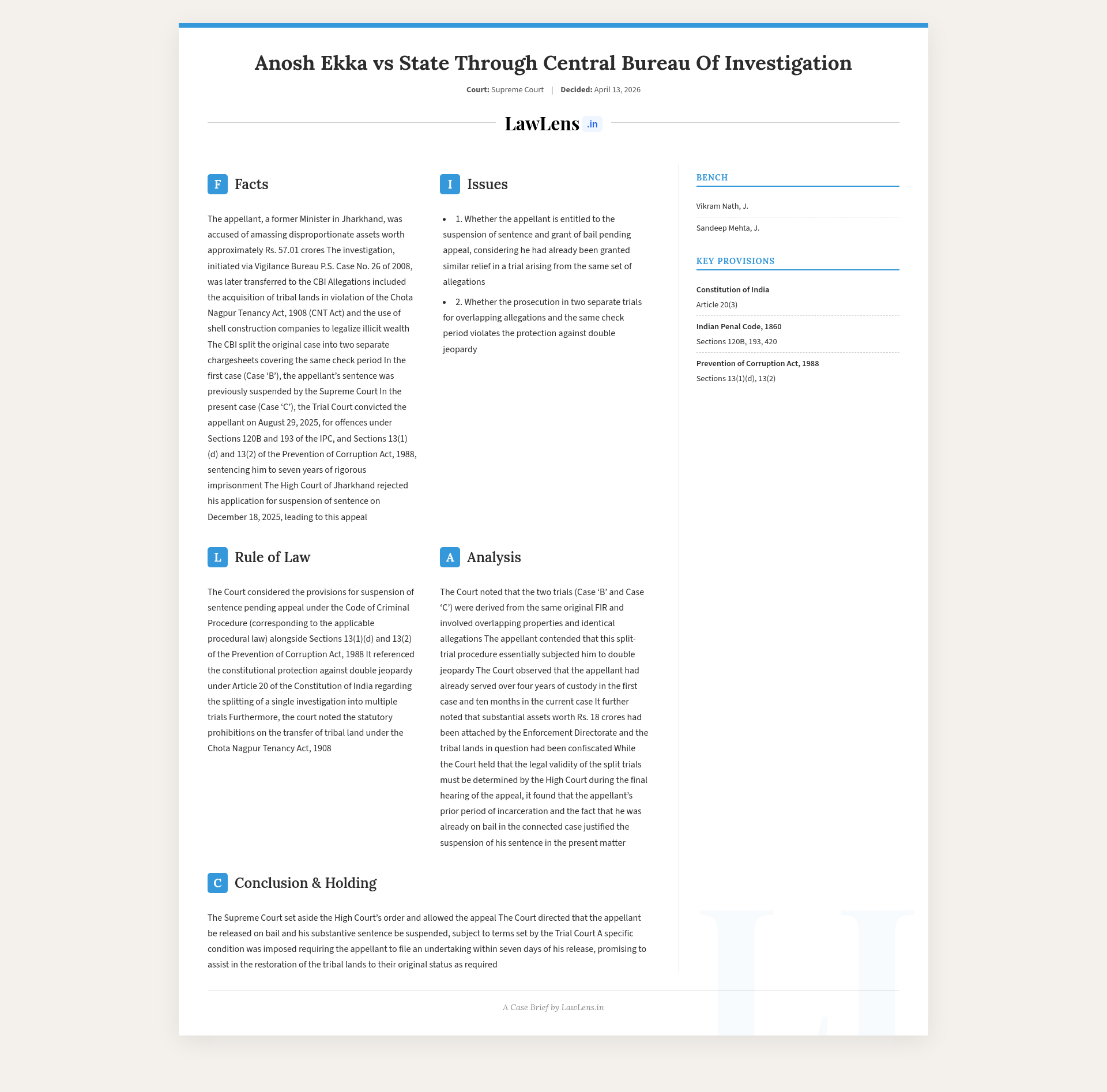
The Supreme Court considered an appeal by former Jharkhand Minister Anosh Ekka against the Jharkhand High Court’s refusal to suspend his sentence and grant bail in a CBI disproportionate-assets and corruption case.

Summary: The Supreme Court considered an appeal by former Jharkhand Minister Anosh Ekka against the Jharkhand High Court’s refusal to suspend his sentence and grant bail in a CBI disproportionate-assets and corruption case. Noting that two split charge-sheets stemmed from the same vigilance case with overlapping allegations and properties, that the appellant had already spent over four years in custody in the earlier case and over ten months in the present one, and that substantial assets (including tribal lands) had been attached/confiscated, the Court found it appropriate to suspend the substantive sentence.
Case Info
Here’s the structured information from the order you’re viewing:
Basic Case Details
Case name: Anosh Ekka v. State through Central Bureau of InvestigationNeutral citation: 2026 INSC 357Court: Supreme Court of India, Criminal Appellate JurisdictionCoram: Justice Vikram Nath and Justice Sandeep MehtaJudgment/order date: April 13, 2026Appeal: Criminal Appeal No(s). of 2026 (arising out of SLP (Crl.) No(s). 891 of 2026)
Statutes / Laws Referred
The order refers to the following laws:
- Indian Penal Code, 1860 (IPC):
- Section 120B (Criminal conspiracy)
- Section 193 (False evidence)
- Section 420 (Cheating) – mentioned in the chargesheet description
- Prevention of Corruption Act, 1988 (PC Act, 1988):
- Section 13(1)(d)
- Section 13(2)
- Chota Nagpur Tenancy Act, 1908 (CNT Act) – regarding prohibition on transfer of tribal lands
- Prevention of Money Laundering Act (PMLA):
- Referred through the “Special Court under the PMLA” and its confiscation order dated 21 March 2020
- Constitution of India:
- Article 20(3) – invoked by the appellant in argument as “right against double jeopardy” (though technically double jeopardy is Article 20(2), the order as extracted uses 20(3)).
Case Laws and Citations within the Order
The text you provided does not show any other judicial precedents (no other reported case citations like SCC, AIR, etc.). The only internal case references are to:
- WP (PIL) Nos. 4700 of 2008 and 2222 of 2009 – High Court PILs that led to CBI investigation.
- R.C. Case No. 04(A)/2010-AHD-R(B) – earlier CBI case on disproportionate assets.
- R.C. Case No. 04(A)/2010-AHD-R(C) – present CBI case from which this appeal arises.
- Criminal Appeal (SJ) No. 850 of 2025 – appeal pending before the Jharkhand High Court.
- SLP (Crl.) No. 5004 of 2023 – earlier SLP where Supreme Court suspended sentence in the first case.
These are procedural references, not reported precedents; no external case law with standard law-report citations appears in the provided text.
Brief Summary (Three Sentences)
The Supreme Court considered an appeal by former Jharkhand Minister Anosh Ekka against the Jharkhand High Court’s refusal to suspend his sentence and grant bail in a CBI disproportionate-assets and corruption case arising from Vigilance P.S. Case No. 26 of 2008. Noting that two split charge-sheets stemmed from the same vigilance case with overlapping allegations and properties, that the appellant had already spent over four years in custody in the earlier case and over ten months in the present one, and that substantial assets (including tribal lands) had been attached/confiscated, the Court found it appropriate to suspend the substantive sentence. The impugned High Court order was set aside and Ekka was directed to be released on bail, conditional on an undertaking to assist in restoration of tribal land and compliance with terms imposed by the trial court.